 Coaching Centre
Cell division and cancer
Why cells divide, how DNA is copied and shared out in mitosis to make two identical cells, binary fission in bacteria, how growth and repair are controlled, apoptosis, and how cancer starts when that control fails. Benign and malignant tumours.
You began as one cell, smaller than a full stop. By the time you were born, its descendants numbered in the trillions. Right now, millions of your cells are dividing every second to replace the ones you lose: the lining of your gut is replaced every few days, and you'll have a completely new outer layer of skin in about a month.
Why cells divide
Remember the cell theory: new cells only come from existing cells. Cell division is how that happens, and multicellular organisms use it for three things:
- Growth. A baby becomes an adult by making more cells, not bigger ones.
- Repair. Cuts heal, broken bones knit and lost skin is replaced by new cells.
- Replacement. Worn-out cells are replaced. A red blood cell lasts about four months; cells lining your stomach last only a few days.
Unicellular organisms also divide to reproduce. A bacterium simply copies its loop of DNA and splits in two, called binary fission. In ideal conditions some bacteria do this every 20 minutes, so one bacterium could become more than 2 million in 7 hours. That's why food left out on a warm day can make you sick.
Mitosis: making identical copies
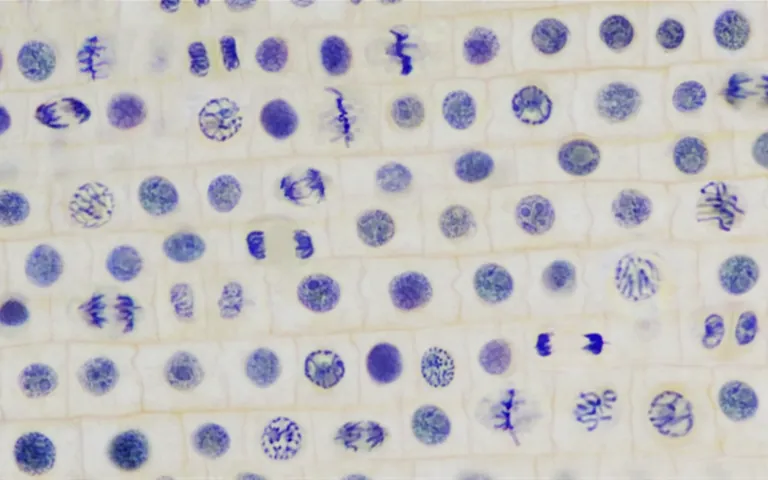
Before a cell divides, it has to make sure each new cell gets a full set of instructions. The DNA in the nucleus is packaged into thread-like chromosomes; human body cells have 46. The division of the nucleus that shares them out equally is called mitosis.
- The DNA copies itself. Each chromosome is copied, so the two copies sit joined together.
- Chromosomes line up across the middle of the cell. Fibres attach to each one.
- The copies are pulled apart, one copy of each chromosome to each end of the cell.
- The cell splits in two. A new nucleus forms around each set and the cytoplasm divides. In plant cells a new cell wall forms across the middle.
The result is two daughter cells, identical to each other and to the parent cell, with exactly the same DNA. A skin cell makes skin cells; a liver cell makes liver cells.
Keeping division under control
Your body controls exactly when cells divide. Cells check their DNA for damage before dividing, and they stop dividing when they are packed in tightly against their neighbours. When you cut yourself, cells at the edge of the wound sense the space, divide to fill it, and stop once the gap is closed.
DNA can be damaged, for example by UV light from the Sun, by chemicals in cigarette smoke, or just by copying mistakes. A cell with badly damaged DNA normally destroys itself in a tidy, controlled way called apoptosis ("programmed cell death"). Billions of your cells do this every day, and it is how webbing between your fingers disappeared before you were born.
- Press "Cut the skin" and watch. Where do new cells come from? When do they stop?
- Each colour is a family of cells. What do the colours tell you about the daughter cells mitosis makes?
- Press "Damage one cell's DNA" a few times. Sometimes the cell is removed and sometimes it isn't. What's the difference in what happens next?
- Cut the skin next to a cancer cell. Does the cut heal the same way?
Cancer: division out of control
Cancer starts when a cell's DNA is damaged in the genes that control division, and the cell escapes apoptosis. It keeps dividing even when it is crowded, and all its daughter cells inherit the same faults. The growing lump of cells is a tumour.
- A benign tumour stays in one place and doesn't invade other tissues. It can usually be removed by surgery, though it can still cause harm if it presses on something important, such as in the brain.
- A malignant tumour invades nearby tissues, and cells can break off and travel in the blood to start new tumours elsewhere in the body. This spread is what makes cancer so dangerous.
Treatments include surgery to cut tumours out, radiotherapy (radiation aimed at the tumour), chemotherapy (drugs that kill dividing cells, which is why they can also make hair fall out), and newer medicines that help the immune system recognise cancer cells.
You can lower your risk of some cancers: be sun-smart, don't smoke, eat plenty of fruit and vegetables, stay active, and get vaccinated.
Test yourself
A skin cell divides by mitosis. The two daughter cells are
Mitosis makes identical copies with the same DNA.
What happens first, before a cell divides by mitosis?
Each chromosome must be copied so each daughter cell gets a full set.
Bacteria reproduce by
They copy their DNA loop and split in two.
Apoptosis is
It removes damaged or unwanted cells, protecting against cancer.
A bacterium divides every 20 minutes. Starting with one, how many are there after 1 hour?
Three divisions: 1 → 2 → 4 → 8.
Put the stages of mitosis in order.
Name each stage.
Benign or malignant?
Explain how a cut on your arm heals, and how this differs from what happens in cancer.
When the skin is cut, cells at the edge of the wound divide by mitosis, each making two identical daughter cells. The new cells fill the gap, and once they are packed against neighbours on all sides they stop dividing, so the cut heals and division stops. In cancer, a cell's DNA is damaged in the genes that control division and the cell escapes apoptosis. It keeps dividing even when crowded, and all its daughter cells do the same, forming a lump of cells called a tumour.