 Coaching Centre
Solids, liquids and gases
What matter is, how to tell solids, liquids and gases apart using shape, volume and compressibility, tricky in-between substances like slime and sand, and plasma, the fourth state.
An iceberg, the ocean around it and the cloud above it look nothing alike. Yet all three are the same substance: water. So what actually changes when water goes from ice to liquid to cloud?
What counts as matter?
Matter is anything that has mass and takes up space. Your desk is matter. So is the water in your bottle, and so is the air you are breathing, even though you can't see it. Light, heat and sound are not matter: they have no mass and don't fill space. They are forms of energy.
Matter comes in different forms called states. On Earth you mostly meet three: solid, liquid and gas. The same substance can be found in more than one state. Water is the everyday example: ice, liquid water and water vapour are all made of exactly the same water particles.
Three tests that tell the states apart
You can work out the state of almost anything by asking three questions.
- Does it keep its own shape? Put it in a different container and see.
- Does it keep its own volume? Does it stay the same size, or spread out to fill whatever space it is given?
- Can it be squashed? Scientists call this compressibility. Block the end of a syringe and push the plunger.
| Solid | Liquid | Gas | |
|---|---|---|---|
| Shape | Keeps its own shape | Takes the shape of its container; the top surface is flat | Takes the shape of its container |
| Volume | Fixed | Fixed | Spreads out to fill the whole container |
| Squash it? | No | Hardly at all | Yes, easily |
| Flows? | No | Yes | Yes |
The syringe test is the quickest way to separate a gas from everything else. When you pump up a bike tyre you are doing exactly this: forcing more and more air into the same space.
Run all three tests on each substance and watch the table fill in.
- Which substances pass the squash test? What do they have in common?
- Sand pours like a liquid. Look at the particle view. Why is it still a solid?
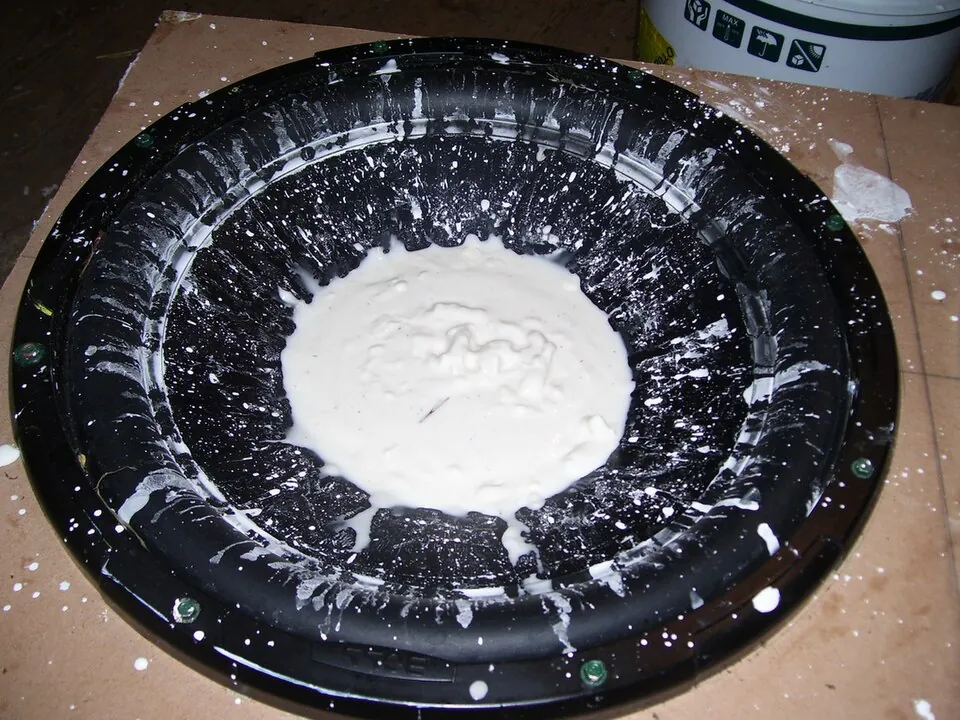
- Slime behaves differently depending on how fast you push it. Which state does it act like when you squash it slowly?
The tricky ones
Most things are obviously one state, but some refuse to fit neatly. That isn't a problem with the substances. It is a reminder that "solid, liquid, gas" is a model that people invented to sort things, and nature doesn't always follow our categories.
- Sand and salt pour, but each grain is a tiny solid that keeps its shape. A pile of sand also forms a heap with a sloping top, which a liquid never does.
- Honeycomb is a solid full of trapped gas bubbles. Bread, sponge cake and polystyrene are similar.
- Toothpaste, tomato sauce and honey are thick liquids. Scientists say they have high viscosity: they flow, just slowly.
- Slime can be poured slowly and stretched, but it bounces or snaps if you pull it fast. It acts partly like a liquid and partly like a solid.
- Clouds, fog and the "steam" above a kettle look like gases but are actually millions of tiny liquid droplets floating in air. You will see why in topic 4G.
Plasma: the fourth state
Heat a gas to thousands of degrees and it changes into plasma. The particles are so energetic that they start to break apart into electrically charged bits. Plasma is rare on Earth, where you see it in lightning, in some flames, in neon signs and in plasma balls. Out in space it is the most common state of all, because stars like the Sun are made of it.
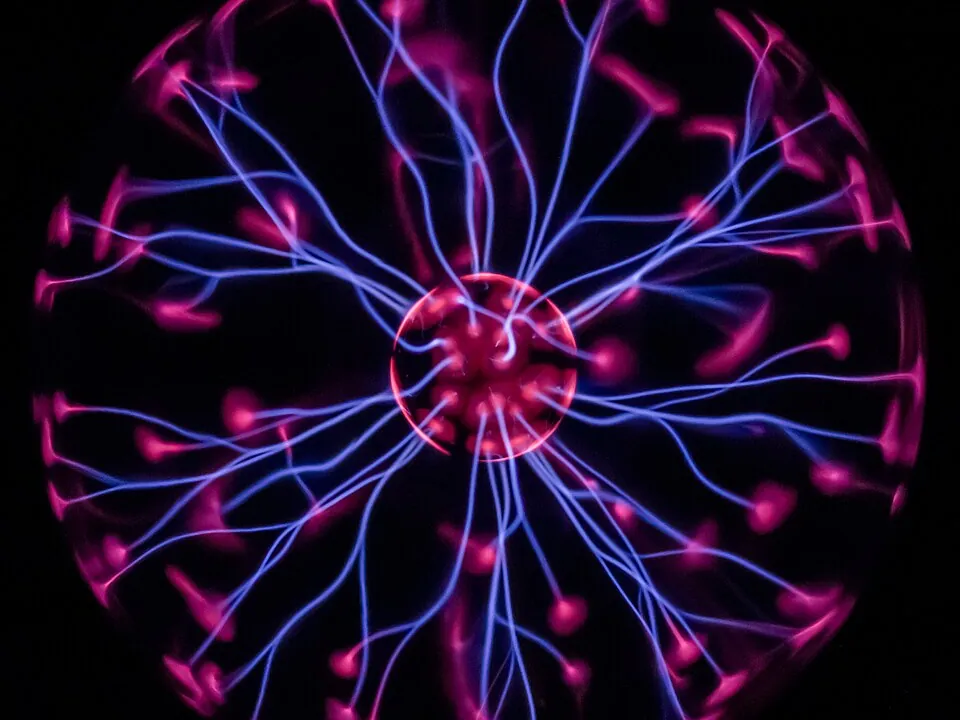
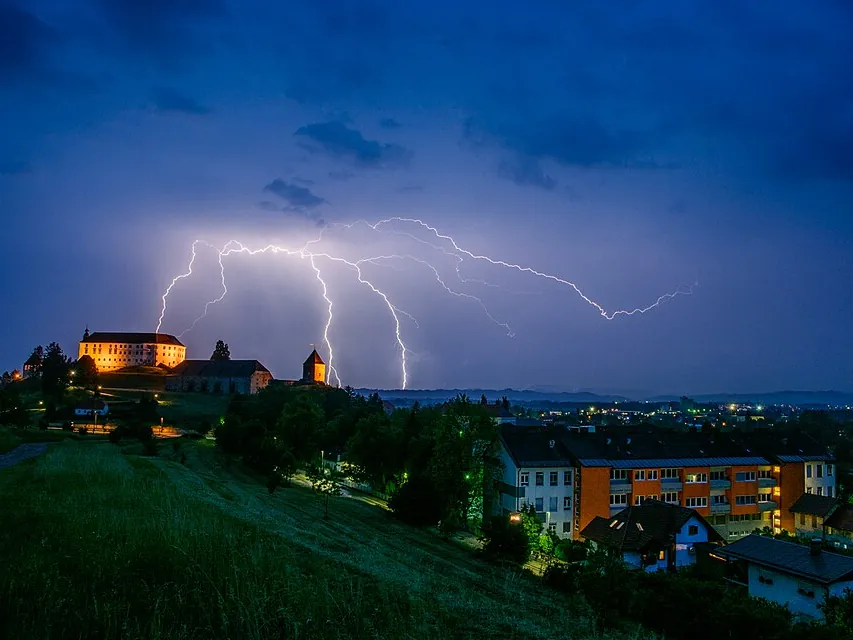
Don't mix this up with blood plasma, the yellowish liquid part of your blood. Same word, completely different thing.
Test yourself
Which of these is not matter?
Light has no mass and doesn't take up space, so it is energy, not matter.
A substance has a fixed volume but takes the shape of whatever container it is poured into. It is a
Fixed volume, changing shape: that is a liquid.
Which test would best show that a sealed syringe contains a gas rather than a liquid?
Gases can be compressed. Liquids barely can.
Why is sand classified as a solid even though it can be poured?
Pouring is not the test. Each grain is a small solid with a fixed shape.
Where would you find most of the plasma in the universe?
Stars are giant balls of plasma. Blood plasma is a different thing with the same name.
Honey flows much more slowly than water. Scientists say honey has a high
Viscosity is how thick or runny a liquid is, which is how easily it flows.
The white cloud just above a boiling kettle is made of
Water vapour is invisible. What you see is vapour that has cooled and turned back into tiny liquid droplets.
Sort each substance by its state at room temperature.
Matter is anything that has and takes up space. A solid keeps its own shape and . A liquid has a fixed volume but takes the of its container. A gas spreads out to its container and can easily be . Thick liquids such as honey have a high .
A student says that air is not matter because you cannot see it. Explain why the student is wrong.
Matter is anything that has mass and takes up space, and being visible has nothing to do with it. Air has mass: a blown-up balloon weighs slightly more than the same balloon when it is flat. Air also takes up space, because it is what fills and stretches the balloon. So air is matter even though we can't see it.
Describe how you could use a syringe to show the difference between a solid, a liquid and a gas.
Fill a syringe with a sample, block the end with your finger or a stopper and push the plunger. Repeat with sand, water and air. The air compresses into a much smaller space, the water barely moves and the sand doesn't move at all. This shows that gases are easily compressed, while liquids and solids are not.