 Coaching Centre
Chromatography
How paper chromatography separates the dyes in inks and food colourings, setting up a chromatogram, the start line and solvent front, calculating Rf values, and how forensic scientists, sports drug testers and food chemists use chromatography.
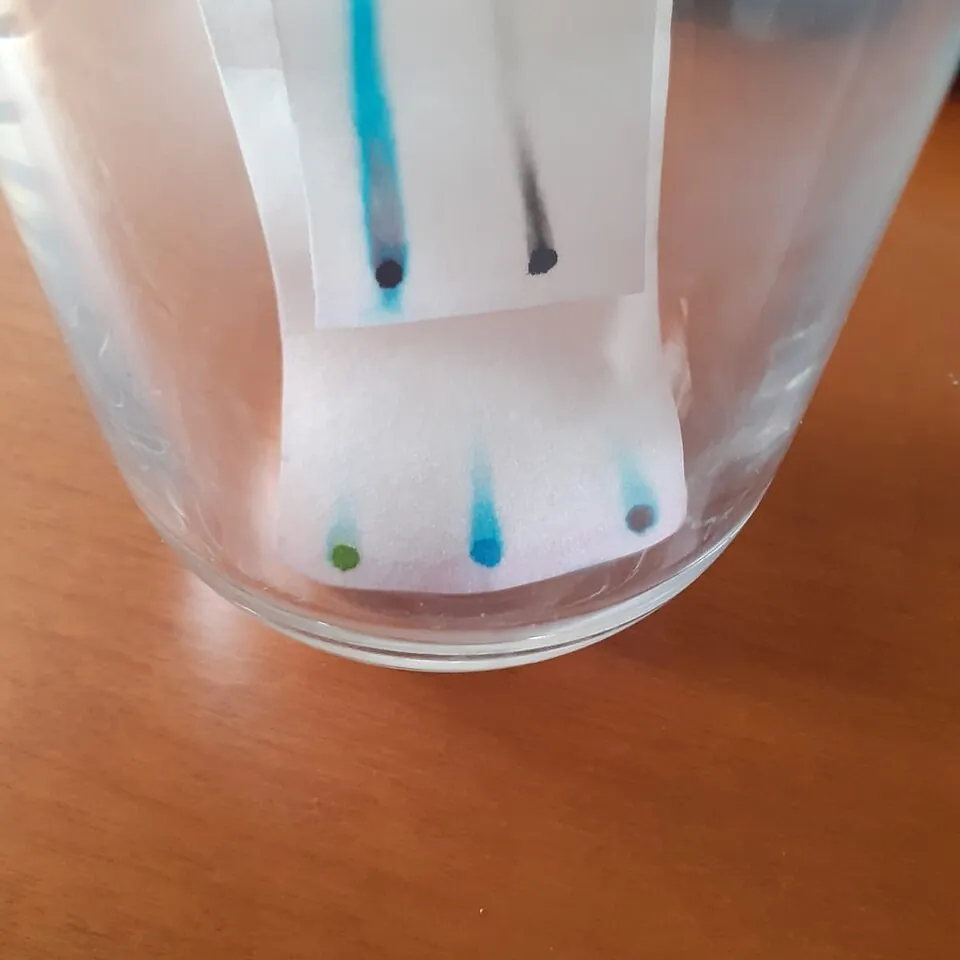
Put a dot of black felt-tip ink on a strip of paper towel and dip the bottom edge in water. As the water creeps up, the dot smears upwards and splits into bands of blue, purple, yellow and pink. "Black" ink was never one colour. It was a mixture of several dyes all along, and the paper has just pulled them apart.
How it works
Chromatography separates substances that are dissolved together and are very alike, such as the dyes in an ink. It works because, as a solvent moves through the paper, each substance in the mixture travels at a different speed.
- Dyes that dissolve well in the solvent are carried along easily.
- Dyes that stick to the paper more strongly get held back.
So each dye ends up at its own height. The finished paper, with its pattern of spots, is called a chromatogram (from the Greek for "colour writing").
Setting up a chromatogram
- Draw a start line (also called the baseline) in pencil, about 1.5 cm from the bottom of the paper. Pencil is graphite, which doesn't dissolve and run. A pen line would run and spoil the result.
- Put a small, concentrated dot of each sample on the line, spaced apart.
- Stand the paper in a beaker with a little solvent (water, or a salt or alcohol solution), making sure the solvent level is below the start line. If the dots sit in the solvent, they simply dissolve into it.
- Cover the beaker so the solvent doesn't evaporate off the paper, and wait.
- Take the paper out just before the solvent reaches the top, and mark how far it got (the solvent front) in pencil straight away, before it dries.
Reading the result: a sample that gives one spot is probably a pure substance. A sample that gives several spots is a mixture. Two samples with spots of the same colour at the same heights contain the same dyes.
Rf values
Comparing heights works only on the same piece of paper, because some runs go further than others. Chemists compare substances using the Rf value (retention factor), which doesn't depend on how long the paper was left in:
Rf = distance moved by the substance ÷ distance moved by the solvent
A yellow dye travels 6.3 cm from the start line. The solvent front is 9.0 cm from the start line.
Rf = 6.3 ÷ 9.0 = 0.70
An Rf value has no units, and it's always between 0 (didn't move) and 1 (moved with the solvent). The same dye in the same solvent always has the same Rf.
- Run the chromatogram for Case 1. Which pens have the same number of dyes as the note?
- Tap a spot to measure its Rf. Do two spots of the same colour have the same Rf?
- Solve all three cases. In Case 3, two pens look almost right. What gives the wrong one away?
Where chromatography is used
- Forensics. Comparing ink from a forged document or ransom note with the pens of suspects, or identifying drugs and poisons in a sample.
- Sport. Anti-doping laboratories use gas chromatography and mass spectrometry to find tiny amounts of banned substances in athletes' urine and blood.
- Food. Checking which colourings are in a lolly or drink, since some people are allergic to particular dyes, and testing for pesticide residues on fruit.
- Medicine and the environment. Measuring blood alcohol, testing water and air for pollutants.
In a lab, the paper is replaced by a long, thin tube packed with powder (liquid chromatography) or filled with a moving gas (gas chromatography). Computers detect each substance as it comes out of the end, and can find less than one gram of a substance dissolved in thousands of litres of water.
Test yourself
The start line on a chromatogram is drawn in pencil because
Ink from a pen line would separate and spoil the result.
A dye moves 4 cm and the solvent front moves 10 cm. Its Rf value is
Rf = 4 ÷ 10 = 0.4.
A food colouring produces a single spot on a chromatogram. This suggests it is
A mixture would separate into more than one spot.
Dye X travels further up the paper than dye Y. This is because dye X
The further a dye travels, the more it is carried by the solvent.
Why must the solvent level be below the start line?
The samples must be carried up the paper, not washed off it.
Label the chromatogram.
Put the steps for running a chromatogram in order.
Chromatography separates substances because they move through the paper at different . The finished paper is called a . The furthest point the solvent reached is the solvent . An Rf value is always between 0 and . A sample that separates into several spots is a .
A forged cheque was written in black ink. Police have black pens from three suspects. Describe how chromatography could be used to find which pen was used, and how you would decide on a match.
Scrape or dissolve a little ink from the cheque and put a dot of it on a pencil start line on chromatography paper, then put a dot from each suspect's pen beside it. Stand the paper in a beaker of a suitable solvent with the solvent below the start line, cover it and let the solvent rise. Each black ink separates into the different dyes it contains. The pen that was used will give exactly the same pattern as the cheque ink: the same number of spots, the same colours and each at the same height, so the same Rf values. A pen with a missing or extra spot can be ruled out.