 Coaching Centre
Eclipses
Solar and lunar eclipses, umbra and penumbra, total, partial and annular eclipses, why eclipses don't happen every month (the Moon's 5-degree tilted orbit), the red "blood moon", eye safety, eclipse myths, and Sydney's total solar eclipse in 2028.
On the afternoon of 22 July 2028, the sky over Sydney will go dark. Birds will fall silent, the temperature will drop, stars will appear, and for a few minutes a ghostly white glow will surround a black disc where the Sun used to be. It will be the first total solar eclipse seen from Sydney in more than 150 years. Astronomers can predict the time to within a few seconds, centuries in advance.
Solar eclipses
A solar eclipse happens when the Moon passes directly between the Sun and the Earth and its shadow falls on the Earth. It can only happen at new moon.
The Moon's shadow has two parts:
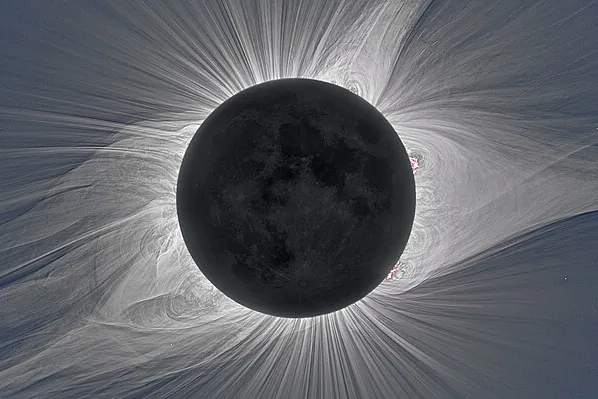
- The umbra is the dark centre, where all of the Sun is blocked. People standing in the umbra see a total eclipse. The umbra is only up to about 250 km wide where it touches the Earth, and it races across the ground at over 1500 km/h, so totality lasts only a few minutes in any one place.
- The penumbra is the paler outer shadow, where only part of the Sun is blocked. People there see a partial eclipse, with a "bite" taken out of the Sun.
It's a remarkable coincidence that the Sun is about 400 times wider than the Moon and also about 400 times further away, so they look almost exactly the same size in our sky. When the Moon is a little further from Earth than usual it can't quite cover the Sun, and we see a bright ring around it: an annular eclipse. During totality, the Sun's faint outer atmosphere, the corona, becomes visible, which is why scientists have long travelled across the world to study total eclipses.
Lunar eclipses
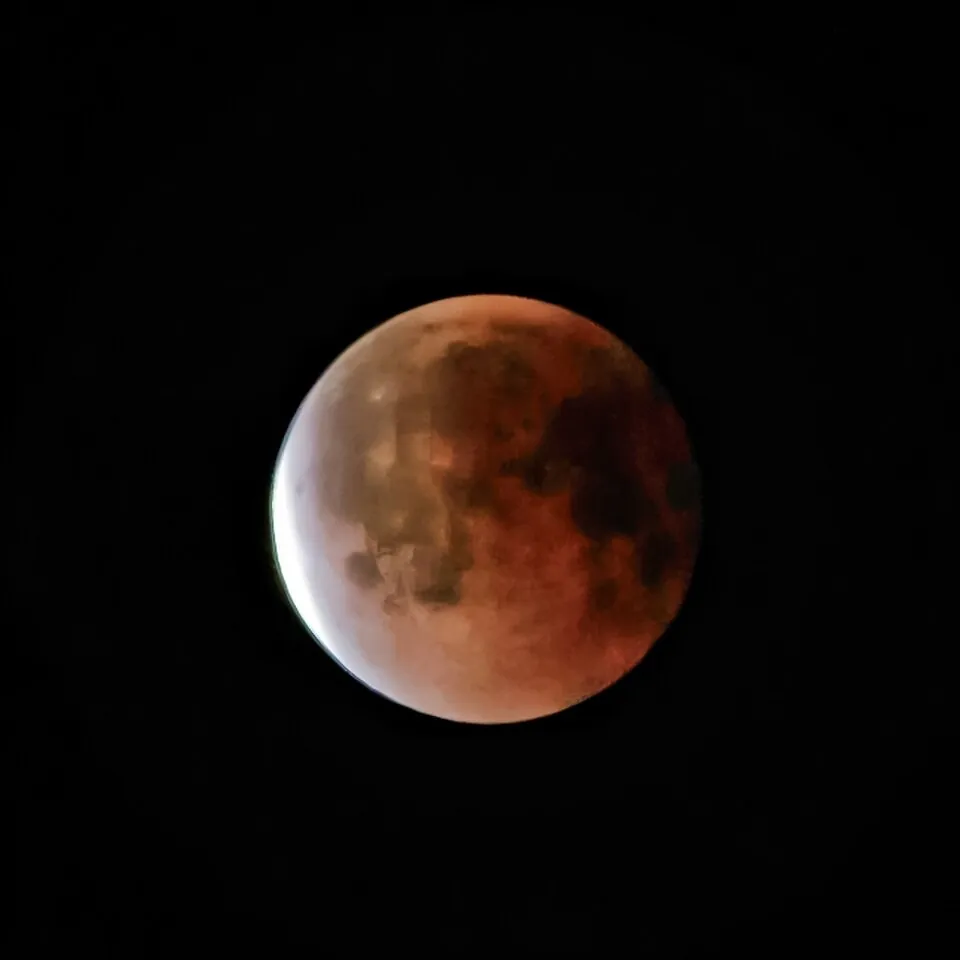
A lunar eclipse happens when the Earth passes directly between the Sun and the Moon, and the Moon moves into the Earth's shadow. It can only happen at full moon. Because the Earth's shadow is much bigger than the Moon, a lunar eclipse lasts a few hours, and everyone on the night side of the Earth can see it. They're completely safe to watch.
During a total lunar eclipse the Moon doesn't disappear. It turns a coppery red, sometimes called a "blood moon". Sunlight passing through the Earth's atmosphere is bent towards the Moon, and the air scatters away the blue light, leaving the red: the Moon is lit by the light of every sunrise and sunset on Earth at once. Australians saw total lunar eclipses in September 2025 and March 2026.
Why not every month?
If the Moon passes between the Earth and the Sun every new moon, why isn't there a solar eclipse every month? Because the Moon's orbit is tilted by about 5° compared with the Earth's orbit. Most months, the new moon passes a little above or below the Sun as seen from Earth, and its shadow misses us; the full moon passes above or below the Earth's shadow. An eclipse only happens when a new or full moon occurs at one of the two places where the Moon's orbit crosses the Earth's orbital plane. These line up with the Sun about twice a year, in "eclipse seasons", giving between four and seven eclipses each year.
- Set "Days since new moon" to 0. Is there an eclipse? Now change the time of year until there is.
- Find all four types: total solar, partial solar, total lunar and partial lunar.
- Look at the side view when there's no eclipse at new moon. Where is the Moon's shadow going?
| Solar eclipse | Lunar eclipse | |
|---|---|---|
| Order in space | Sun, Moon, Earth | Sun, Earth, Moon |
| Moon phase | New moon | Full moon |
| Whose shadow? | The Moon's, on the Earth | The Earth's, on the Moon |
| Who can see it? | Only people in a narrow path (total) or nearby (partial) | Everyone on the night side of Earth |
| How long? | Totality: a few minutes at most | A few hours; totality up to about 1¾ hours |
| Safe to look? | No (except during totality) | Yes |
Test yourself
A solar eclipse can only happen at
The Moon must be between the Sun and the Earth.
The order in space during a lunar eclipse is
The Earth is in the middle, casting its shadow on the Moon.
People standing in the Moon's umbra see
The umbra is where all of the Sun is blocked.
There isn't an eclipse every month because
Most months the Moon passes above or below the line.
The Moon looks red during a total lunar eclipse because
It's lit by the reddened light of Earth's sunrises and sunsets.
Label the two eclipses.
Solar, lunar or both?
Explain why a total solar eclipse can be seen from only a small part of the Earth, while a total lunar eclipse can be seen by about half the world. Include the words umbra and shadow in your answer.
In a solar eclipse the Moon is between the Sun and the Earth. The Moon is small, so the darkest part of its shadow, the umbra, is only up to about 250 km wide when it reaches the Earth. Only people standing inside the umbra see a total eclipse; people nearby in the penumbra see a partial one. In a lunar eclipse the Earth is between the Sun and the Moon, and the whole Moon moves into the Earth's shadow, which is far bigger than the Moon. The Moon itself goes dark, so everyone on the night side of the Earth, about half the world, can see it.