 Coaching Centre
Evaporation, crystallisation and distillation
Using heat to separate solutions: evaporation to recover a dissolved solid, crystallisation to grow pure crystals, and distillation to collect the solvent as well. Separating salt from sand step by step, how a condenser works, and fractional distillation.
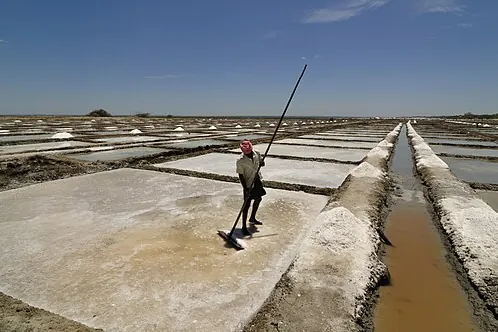
Drive past Lake Macleod in Western Australia and you'll see huge shallow ponds turning pink, then white. Sea water is pumped in and the sun and wind slowly evaporate the water, leaving behind millions of tonnes of salt a year. It's the simplest separation of all: let the solvent go and keep what was dissolved in it.
Evaporation
Filtering can't separate a solution, because dissolved particles pass through the paper. But the solute and solvent have very different boiling points: water boils at 100 °C, while salt doesn't melt until 801 °C. Heat the solution and the water turns to vapour and escapes, leaving the solid behind. This is evaporation.
Evaporation is quick, but the solid left behind can be powdery and may spit out of the dish as the last of the water boils away. Wear safety glasses, and stop heating when only a little liquid is left: the hot dish will finish the job.
Crystallisation
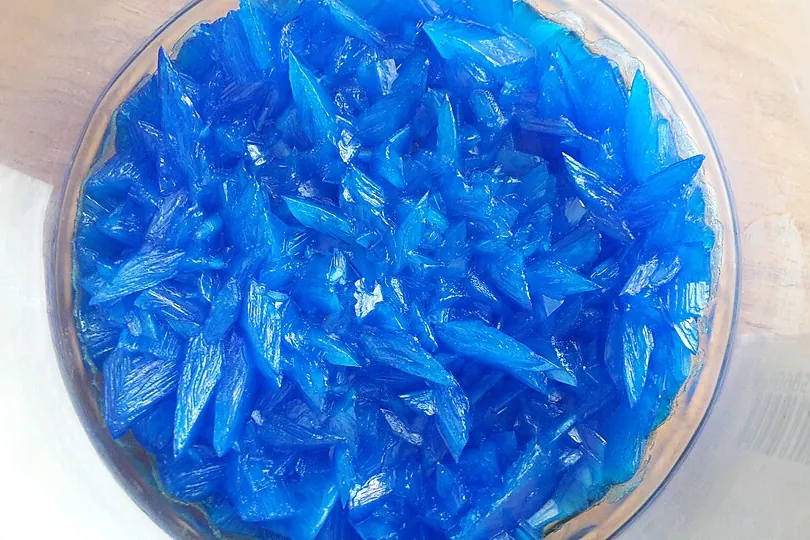
Crystallisation is slower and gives better results. Heat the solution just until it is saturated (crystals start to form on a cold glass rod dipped in it), then let it cool and stand for a few days. As the water slowly evaporates and the solution cools, the solute comes out as neat, regular, pure crystals. Copper sulfate forms beautiful blue diamond-shaped crystals this way.
Dissolve. Add water and stir. Salt is soluble, sand is not.
Filter. The sand stays on the paper as the residue. The salt water passes through as the filtrate.
Dry the residue to recover the sand.
Evaporate the filtrate (or crystallise it) to recover the salt.
Distillation
Evaporation throws the solvent away. If you want to keep the solvent, for example to make drinking water from sea water, you use distillation.
- The mixture is heated in a flask until the solvent boils.
- The vapour rises past a thermometer, which shows the boiling point of whatever is boiling off.
- The vapour passes into a condenser: a tube inside a cold-water jacket. Cold water flows in at the lower end and out at the top, so the jacket stays full. The vapour cools and condenses back to liquid.
- The pure liquid, called the distillate, drips into a beaker. The solute stays behind in the flask.
Add a few anti-bumping granules to the flask so it boils smoothly, and never heat it to dryness.
- Distil the salt water. What temperature does the thermometer stick at while the water boils?
- Turn the condenser water off. What happens to the vapour?
- Distil the inky water and look at the colour of the distillate. Where does the ink go?
- Try water and ethanol. What's different about the temperature, and which liquid comes over first?
Separating two liquids
Distillation also separates liquids that mix completely but have different boiling points. Ethanol (alcohol) boils at 78 °C and water at 100 °C, so when a mixture is heated, the ethanol boils off first. This is how spirits are made from fermented fruit or grain. Oil refineries use a tall fractionating column to split crude oil into many fractions with different boiling points: gases at the top, then petrol, kerosene (jet fuel), diesel, and thick oils and bitumen at the bottom.
Test yourself
Which method separates salt from salt water and keeps the water?
Distillation condenses the water vapour and collects it.
The job of the condenser is to
Cold water around the tube cools the vapour.
While pure water is being distilled, the thermometer reads
The temperature stays at the boiling point while the water boils.
Why does crystallisation give larger crystals than fast evaporation?
Slow growth makes large, regular crystals.
A mixture of ethanol (boiling point 78 °C) and water is distilled. The first liquid to be collected is mostly
The liquid with the lower boiling point boils off first.
Label the distillation apparatus.
Put the steps for separating salt from sand in order.
A ship's crew runs out of fresh water. They have sea water, a stove, a pot, a lid and a cup. Explain how they could make drinking water, naming the separation method and describing what happens to the water and the salt.
They could use distillation. Heat the sea water in the pot so the water boils and turns into water vapour, leaving the salt behind because it has a much higher boiling point. Hold the lid tilted above the pot so the vapour hits the cooler lid and condenses into droplets of pure water, which run down the lid and drip into the cup. The salt stays in the pot.