 Coaching Centre
Density
What density is, how particles explain it, calculating density = mass ÷ volume, measuring the volume of regular and irregular objects by displacement, floating and sinking, and why ice floats.
Which is heavier: a kilogram of feathers or a kilogram of steel? Neither, they both have a mass of one kilogram. But the feathers would fill a garbage bag and the steel would fit in your hand. That difference is density.
What density means
Density is how much mass is packed into a certain volume. A dense material has a lot of matter crammed into a small space. Steel is dense. Polystyrene foam is not.
Density is a physical property: you can measure it without turning the substance into something new. Every pure substance has its own density, which is why it can be used to identify materials, as you'll see in the gold crown story below.
Density explained with particles
Two things decide how dense a substance is.
- How closely the particles are packed. Gas particles are far apart, so gases have very low densities. One litre of air has a mass of only about 1.2 g, while one litre of water has a mass of 1000 g.
- How heavy each particle is. Lead and aluminium are both tightly packed metals, but a lead atom has about eight times the mass of an aluminium atom. So a block of lead is far denser than a block of aluminium the same size.
Calculating density
Mass is usually in grams (g). Volume is in cubic centimetres (cm³) for solids or millilitres (mL) for liquids. These two volume units are the same size: 1 mL = 1 cm³. So density comes out in g/cm³ or g/mL.
You can rearrange the formula when you know the density and need something else: mass = density × volume and volume = mass ÷ density.
A rock has a mass of 10 g and a volume of 2 cm³. Find its density.
10 mL of olive oil has a mass of 9.2 g. What is its density, and will it float on water?
Ice has a density of about 0.9 g/cm³. What volume does 18 g of ice take up?
Measuring mass and volume in the lab
- Mass: use an electronic balance. For a liquid, weigh the empty measuring cylinder first (or press "tare"), then weigh it again with the liquid in it.
- Volume of a regular block: measure it and multiply: length × width × height.
- Volume of an irregular object such as a rock or a key: use the displacement method. Half-fill a measuring cylinder with water and read the level. Gently lower the object in. The water rises by exactly the object's volume.
- Measure an object's mass and volume, then calculate its density yourself before you press Check.
- Predict where it will end up in the tank of liquids, then drop it in.
- Which two objects have almost the same density? What could they be made of?
Floating and sinking
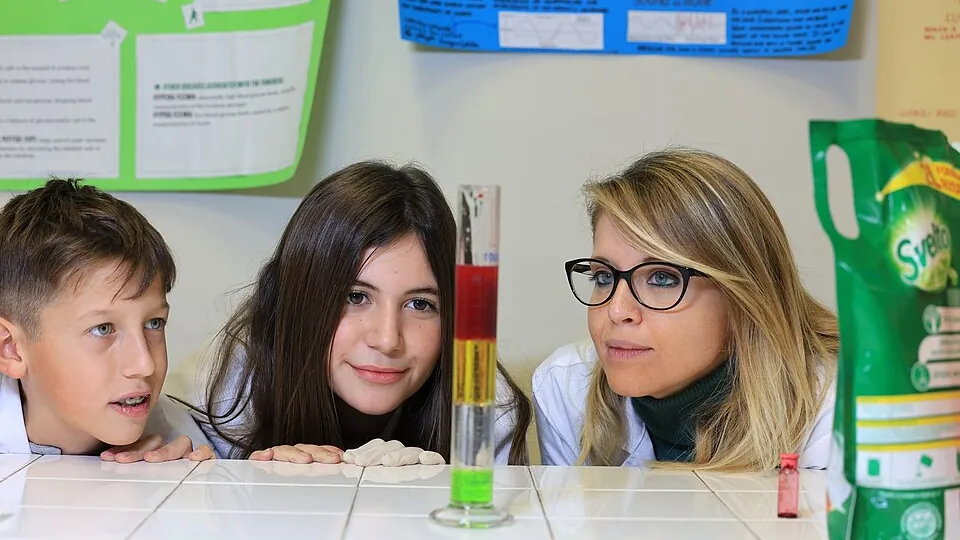
An object floats on a liquid if it is less dense than the liquid, and sinks if it is more dense. The same rule works for liquids and gases stacked on each other: oil floats on vinegar, and a helium balloon rises because helium is less dense than air.
| Substance | Density (g/cm³) |
|---|---|
| Air | 0.0012 |
| Polystyrene foam | 0.05 |
| Pine wood | about 0.5 |
| Cooking oil | 0.92 |
| Ice | 0.92 |
| Water | 1.00 |
| Seawater | 1.03 |
| Glass | 2.5 |
| Aluminium | 2.7 |
| Steel | 7.8 |
| Copper | 8.9 |
| Lead | 11.3 |
| Mercury (liquid) | 13.6 |
| Gold | 19.3 |
The odd one out: ice
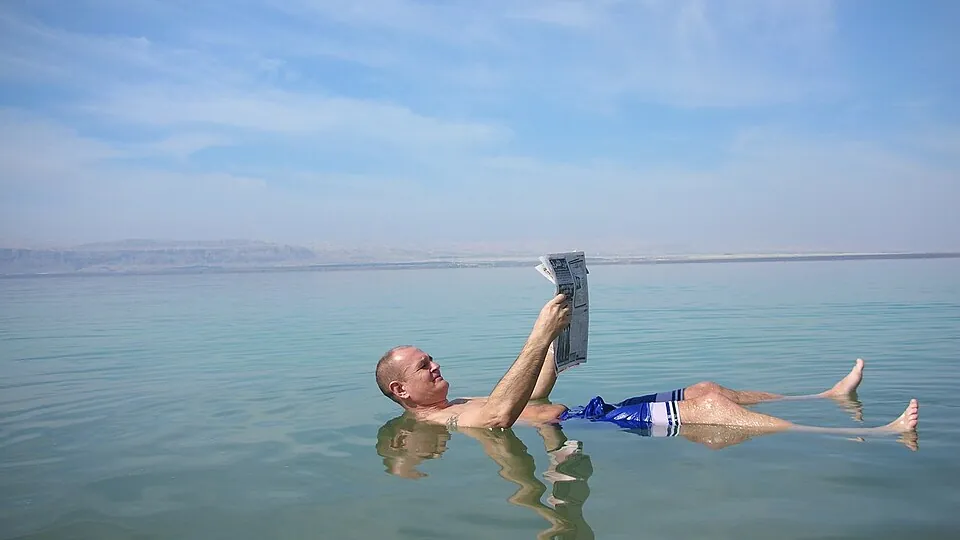
For almost every substance, the solid is denser than the liquid, because solid particles are packed tighter. Water breaks this rule. When water freezes, its particles lock into an open, honeycomb-like pattern called a lattice that has more space in it than liquid water. The mass stays the same but the volume grows by about 9%, so ice is less dense than water and floats. That's also why ice cubes bulge out of the tray and why frozen water pipes can burst.
Test yourself
Density is best described as
Density links mass and volume: mass per unit volume.
A block has a mass of 54 g and a volume of 20 cm³. Its density is
54 ÷ 20 = 2.7 g/cm³. That matches aluminium.
Lead is denser than aluminium even though both are tightly packed solids, because
Same tight packing, heavier particles: higher density.
The water in a measuring cylinder rises from 40 mL to 52 mL when a key is dropped in. The key's volume is
Volume = 52 − 40 = 12 mL = 12 cm³.
Which will float on water (density 1.0 g/cm³)?
Only the pine is less dense than water.
Ice floats on water because
Freezing spreads water particles into an open lattice: same mass, bigger volume.
What volume does 39 g of steel (density 7.8 g/cm³) occupy?
volume = mass ÷ density = 39 ÷ 7.8 = 5 cm³.
Put the steps for finding the density of a small rock in order.
Use the density table: will each one float or sink in water?
Liquid A: 10 cm³ has a mass of 5 g. Liquid B: 15 cm³ has a mass of 18 g. The two liquids don't mix. Calculate both densities and predict which liquid ends up on top when they are poured into the same jar.
Density of A = 5 ÷ 10 = 0.5 g/cm³. Density of B = 18 ÷ 15 = 1.2 g/cm³. Liquid A is less dense than liquid B, so A will float on top of B.
A goldsmith claims a ring is pure gold. It has a mass of 38 g and displaces 2.5 mL of water. Is the goldsmith telling the truth? Show your reasoning.
Volume = 2.5 mL = 2.5 cm³. Density = 38 ÷ 2.5 = 15.2 g/cm³. Pure gold has a density of 19.3 g/cm³, so the ring's density is too low. It must be mixed with a less dense metal, so the goldsmith is not telling the truth.