 Coaching Centre
The Bunsen burner
The parts of a Bunsen burner, how to light and turn it off safely, the yellow safety flame and the blue heating flame, where the hottest part of the flame is, and why the flame changes colour.
Turn a Bunsen burner's collar a quarter of a turn and the flame changes from a lazy, flickering yellow to a roaring blue cone more than 500 °C hotter. Nothing about the gas has changed. The only difference is how much air gets in.
The parts
The Bunsen burner was developed in 1855 by the German chemist Robert Bunsen and his technician Peter Desaga. Its clever idea is that the gas mixes with air inside the tube before it burns, which gives a hotter, cleaner flame than a candle or a gas lamp.
- Base: heavy, so the burner doesn't tip over.
- Gas hose and gas inlet: gas from the bench tap enters here.
- Jet: a tiny hole that squirts the gas up the barrel fast.
- Air hole and collar: the collar turns to open or close the air hole.
- Barrel: the tube where gas and air mix before burning at the top.
The gas is usually natural gas, which is mostly methane, or LPG in schools without mains gas. When it burns it reacts with oxygen from the air: methane + oxygen → carbon dioxide + water, giving out heat and light.
Lighting it safely
- Put the burner on a heatproof mat, away from books and the edge of the bench. Tie hair back and put on safety glasses.
- Connect the hose firmly to the gas tap. Check the hose has no cracks.
- Close the air hole, so the flame will be the easy-to-see yellow flame.
- Light the match (or use a lighter) and hold it at the side of the top of the barrel, not over it.
- Then turn the gas tap on. The burner lights.
- Open the air hole to get a blue heating flame when you're ready to heat. Turn it back to yellow when you're not heating.
Match first, then gas. If you turn the gas on first, gas collects around the burner while you fumble with the match, and lights with a whoosh. To turn it off, close the air hole to get a yellow flame, then turn off the gas tap.
Two flames
| Safety flame | Heating flame | |
|---|---|---|
| Air hole | Closed | Open |
| Colour | Bright yellow, wavy | Blue, with a pale inner cone. Hard to see in daylight |
| Sound | Quiet | Roars |
| Temperature | About 1000 °C (still burns you) | Up to about 1500 °C |
| Soot | Leaves black soot on anything held in it | Clean |
| Use | Lighting, and when the burner is on but not heating | Heating |
The safety flame gets its name because it is easy to see. A blue flame left on a bench in a bright room is almost invisible, and people have reached across one without noticing it. Never leave any flame unattended.
- Light the burner in the right order. What happens if you turn the gas on first and wait?
- Open the air hole bit by bit. Watch the flame colour, the sound and the temperature reading.
- Drag the temperature probe up and down through a blue flame. Where is it hottest? Then hold the porcelain in each flame.
Why is one flame yellow?
With the air hole closed, the gas only meets oxygen at the edge of the flame, and there isn't enough to burn all of it. This is incomplete combustion. Tiny specks of unburnt carbon (soot) form in the flame, get very hot and glow yellow, the same way a toaster element glows. That's why the yellow flame makes things black.
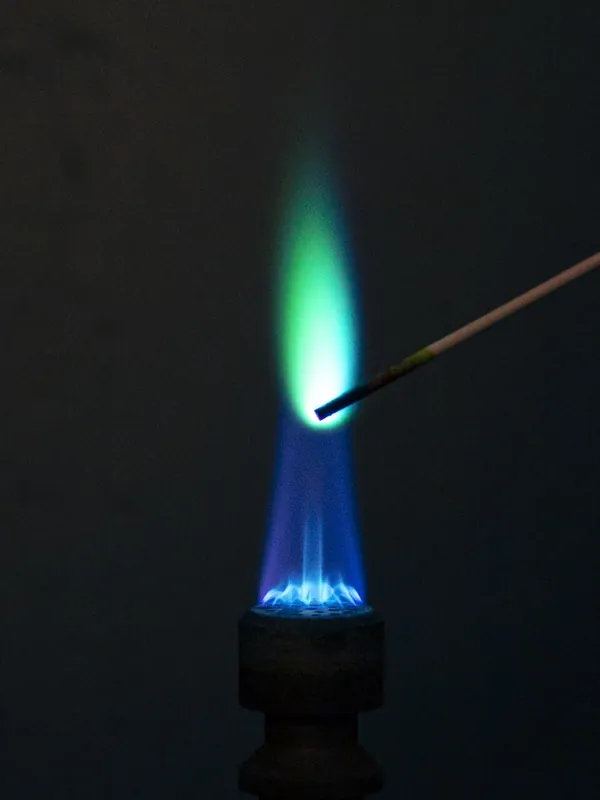
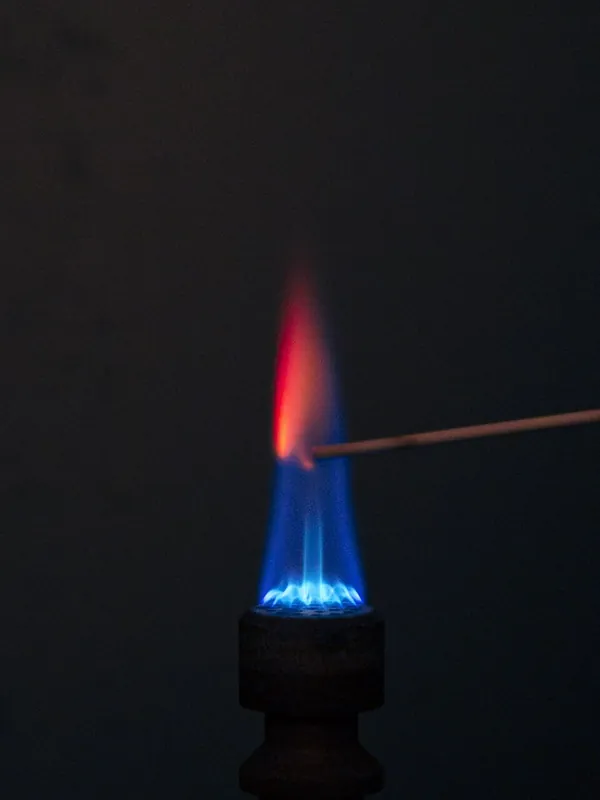
With the air hole open, gas and air are already mixed when they reach the top of the barrel, so the gas burns completely. No soot forms, so nothing glows yellow, and the energy is released faster in a smaller space, which makes the flame hotter. The blue colour comes from energised gas molecules in the flame giving off light.
Test yourself
When lighting a Bunsen burner, the air hole should be
Closed, so the burner lights with the easily seen yellow safety flame.
The correct order is
Match first so gas never builds up unlit.
Where is the hottest part of a blue Bunsen flame?
Combustion is most intense just above the inner cone.
The yellow flame leaves soot on a piece of porcelain because
Too little air means incomplete combustion and soot.
The yellow flame is called the safety flame mainly because
It is still about 1000 °C; its visibility is what makes it safer.
Which part of the burner lets air in?
Turning the collar opens and closes the air hole.
Label the parts of the Bunsen burner.
Put the steps for lighting a Bunsen burner in order.
With the air hole the burner gives a yellow flame. It is easy to see but leaves black on equipment. Opening the air hole lets more mix with the gas, giving a heating flame. Its hottest part is just the tip of the inner cone.
Explain why the blue flame is better than the yellow flame for heating a beaker of water. Give three reasons.
The blue flame is much hotter (up to about 1500 °C), so the water heats faster. It burns the gas completely, so it doesn't leave a layer of black soot on the beaker that would make it dirty and slow the heating. It is also a steady, focused cone, so the heat goes straight to the bottom of the beaker instead of flickering around it.
A student turns the gas tap on, then spends 15 seconds looking for matches. Explain why this is dangerous.
While the gas is on but not lit, unburnt gas pours out and collects in the air around the burner. When the match is finally lit, all that gas can catch fire at once in a sudden large flash, which could burn the student's hand, face or hair.