 Coaching Centre
Classifying plants
Grouping plants by stature, vascular and non-vascular plants (xylem and phloem), and the four main plant groups: mosses and liverworts, ferns, conifers and flowering plants, with Australian examples.
Moss on a shady rock grows only a few centimetres tall. A mountain ash in Victoria can grow taller than a 30-storey building. Both are plants, both make food from sunlight, and both need water. The difference in height comes down mainly to one thing: plumbing.
Grouping by stature
Gardeners and ecologists often group plants by stature, their height and shape: mosses (no true stems, usually under 10 cm), herbs (soft fleshy stems, usually under 1 m), ferns, shrubs (several woody stems, 1–5 m), trees (one main woody trunk, over 5 m) and vines (long stems that climb on other plants). This is handy for describing a patch of bush, but it doesn't show how plants are related: a eucalypt can be a tree in a forest and a low multi-stemmed shrub (a mallee) in a dry area.
Veins or no veins
Scientists group plants mainly by their internal structure and how they reproduce. The first split is whether the plant has vascular tissue, tubes that act like veins:
- Xylem carries water and dissolved minerals up from the roots.
- Phloem carries food (sugars made in the leaves) to every part of the plant.
Non-vascular plants (mosses and liverworts) have no such tubes. Water has to soak through them cell by cell, which is slow, so they stay small and live in damp places. They're attached by thread-like rhizoids rather than real roots.
Vascular plants can move water a long way, so they can grow tall and live in drier places. Ferns, conifers and flowering plants are all vascular.
Four main plant groups
| Group | Vascular? | Reproduce by | Other features | Australian examples |
|---|---|---|---|---|
| Mosses and liverworts (bryophytes) | No | Spores in capsules on stalks | Tiny; need water for fertilisation; rhizoids | Peat moss in alpine bogs |
| Ferns | Yes | Spores, in brown dots under the fronds | Roots, stems and fronds; new fronds uncurl from a "fiddlehead" | Soft tree fern, maidenhair fern |
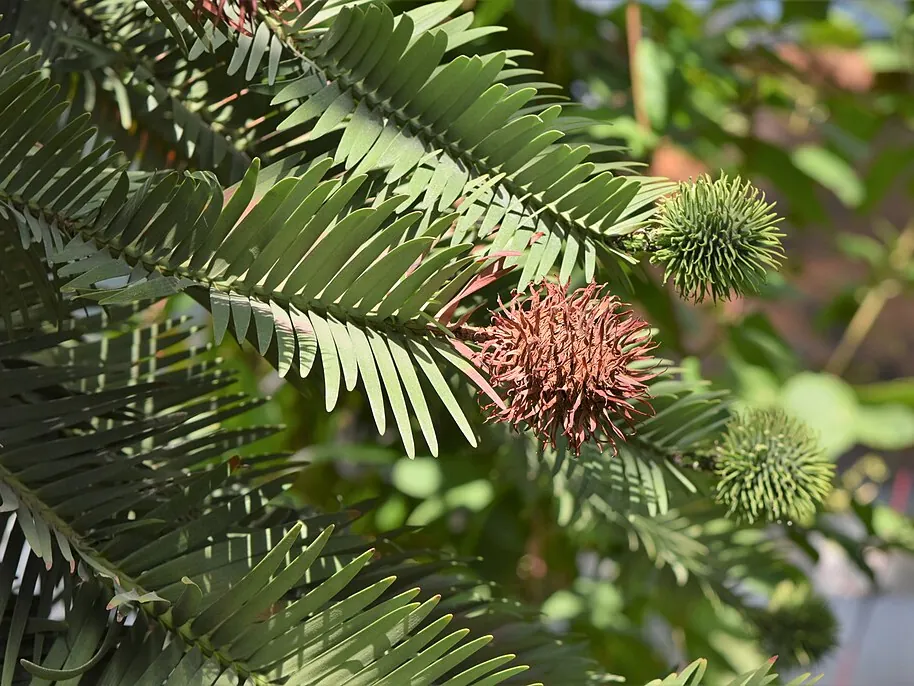
| Conifers | Yes | "Naked" seeds in woody cones | Needle or scale-like leaves; seeds often winged and wind-carried | Wollemi pine, hoop pine, white cypress pine |
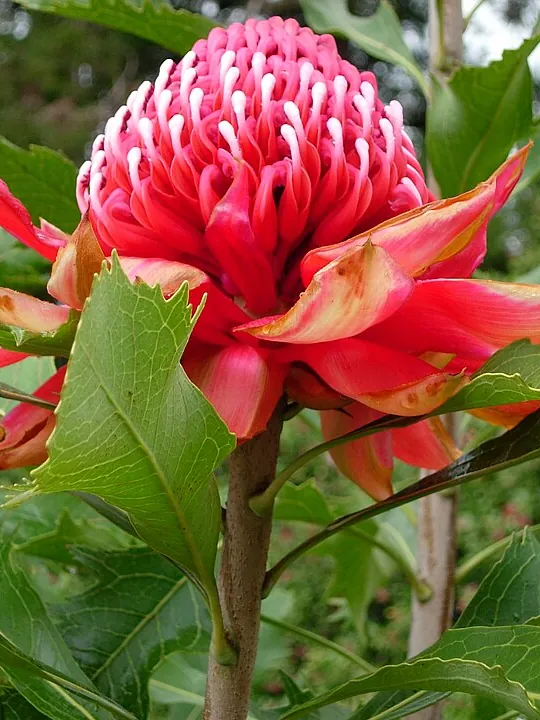
| Flowering plants | Yes | Seeds enclosed in a fruit, made in flowers | Flowers attract pollinators or use wind; about 90% of all plant species | Waratah, grevillea, wattles, eucalypts, grasses |
Spores are single cells, so tiny and light they drift on the air, but they carry no food store and need moisture to grow. Seeds contain a baby plant (an embryo) packed with food inside a tough coat, so they can wait in dry soil and give the seedling a head start. Seeds are one reason conifers and flowering plants dominate dry Australian landscapes.
Flowering plants go one step further: their seeds develop inside an ovary that becomes a fruit. A gumnut, a banksia follicle and a peach are all fruits, even if only one is good to eat.
Test yourself
Why are mosses usually small and found in damp places?
Without vascular tissue, water moves slowly from cell to cell.
Which tissue carries sugar from the leaves to the roots?
Phloem carries food; xylem carries water and minerals.
A plant has needle-shaped leaves and makes seeds in woody cones. It is a
Naked seeds in cones.
An advantage of seeds over spores is that seeds
Stored food and a tough coat help seeds survive dry conditions and give the seedling a head start.
Place each plant group in the right box.
Which group has each feature?
Explain why flowering plants and conifers are more common than mosses and ferns in dry parts of Australia.
Conifers and flowering plants have xylem and phloem, so they can carry water from deep roots up a tall plant, while mosses have no vascular tissue and dry out. They also reproduce with seeds, which contain stored food inside a tough coat and can wait in dry soil until it rains. Mosses and ferns rely on spores and need water for fertilisation, so they are restricted to damp places.