 Coaching Centre
The Moon and its phases
The Moon as Earth's natural satellite, moonlight as reflected sunlight, why we always see the same face, the eight phases of the Moon and the 29.5-day cycle, waxing and waning as seen from Australia, Galileo's observations, and human exploration from Apollo 11 to Artemis II.
On 21 July 1969 (Australian time), around 600 million people watched Neil Armstrong step onto the Moon. Many of the pictures they saw came through dishes in Australia: Honeysuckle Creek near Canberra and the Parkes radio telescope in central-west NSW. In April 2026, the four astronauts of NASA's Artemis II mission flew around the Moon, the first people to travel there in more than 50 years. The Moon is the only other world humans have visited, and it's still the easiest one to study from your backyard.
Earth's natural satellite
A satellite is an object that orbits a planet. The Moon is Earth's only natural satellite: a ball of rock about 3500 km across (just over a quarter of the Earth's width), about 384 000 km away. It has no air, no liquid water and only about one-sixth of Earth's gravity, which is why Apollo astronauts found it easier to bounce like kangaroos than to walk.
The Moon makes no light of its own. Moonlight is sunlight reflected off the Moon's grey rock, and even a full moon is about 400 000 times dimmer than the Sun.
Why we always see the same face
The Moon spins on its axis once every 27.3 days, which is exactly the time it takes to orbit the Earth once. This is called synchronous rotation, and it means the same side always faces us. The side we never see from Earth is often called the "dark side", but it's really the far side: it gets just as much sunlight as the near side, only at different times.
Phases of the Moon
The Moon is always round, and half of it is always lit by the Sun, just like the Earth has a day side and a night side. As the Moon orbits us, we see different amounts of its lit half. These changing shapes are the phases.
- New moon: the Moon is between the Earth and the Sun. Its lit side faces away from us, so we can't see it.
- Waxing (growing): over the next two weeks we see more and more of the lit side: crescent, first quarter (half lit), gibbous.
- Full moon: the Earth is between the Sun and the Moon, and we see the whole lit side. A full moon rises at sunset and sets at sunrise.
- Waning (shrinking): the lit part shrinks again through gibbous, last quarter and crescent, back to new moon.
One full cycle from new moon to new moon takes about 29.5 days. That's a bit longer than one orbit (27.3 days) because the Earth has moved along its own orbit in the meantime, so the Moon has to go a little further to line up with the Sun again. Our word "month" comes from "moon".
The Moon rises about 50 minutes later each day. So you can often see it in the daytime: a first quarter moon is up in the afternoon, and a last quarter moon is still in the sky in the morning.
- Drag the Moon slowly all the way round. At which position is it new moon? Full moon?
- Switch between "View from Australia" and "View from the north". What changes about a waxing crescent?
- Press "Quiz me" and find the right position for each Moon. Can you get five in a row?
The Moon from Australia
Most diagrams and story books are drawn in the Northern Hemisphere, where a waxing moon is lit on the right. In Australia we look at the Moon "upside down" compared with them, so a waxing moon is lit on the left and a waning moon on the right. The dark patches on its face are upside down too, so a picture of the Moon drawn in Europe looks wrong when you hold it up to our sky.
Exploring the Moon
For thousands of years people thought the Moon was a perfectly smooth sphere. In 1609, Galileo Galilei pointed one of the first telescopes at it and saw mountains, craters and dark, flat plains. He called the plains maria, Latin for "seas", although we now know they are old lava flows. Between 1969 and 1972, twelve astronauts walked on the Moon during six Apollo landings. Their footprints are still there, because there's no wind or water to wipe them away.
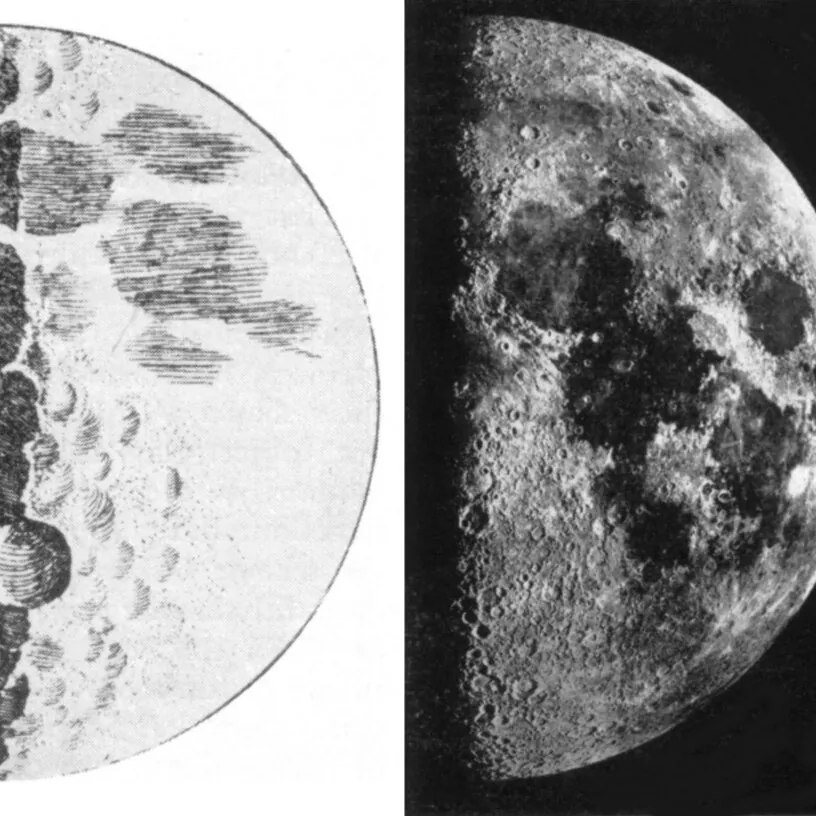
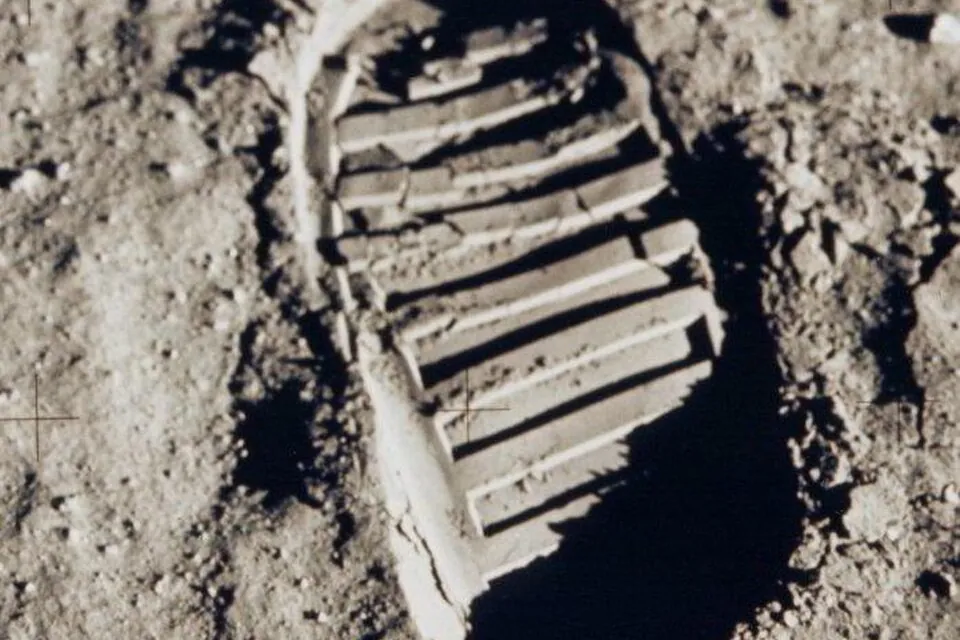
Today the Moon is busy again. India's Chandrayaan-3 landed near the Moon's south pole in 2023, robotic landers from China have brought back samples from the far side, and NASA's Artemis program plans to land astronauts near the south pole, where ice hidden in dark craters could supply water for a future base.
Test yourself
Moonlight is
The Moon makes no light of its own.
At new moon, the Moon is
Its lit side faces away from us.
We always see the same side of the Moon because
Synchronous rotation.
From Sydney, a waxing crescent moon is lit on the
In the Southern Hemisphere a waxing moon is lit on the left.
The time from one full moon to the next is about
The lunar (synodic) month.
Name each phase.
Put the phases in order, starting from new moon.
A student says the phases of the Moon happen because the Earth's shadow covers part of the Moon. Explain what really causes the phases.
The Sun always lights up half of the Moon. As the Moon orbits the Earth over 29.5 days, we see different amounts of that lit half. At new moon the Moon is between us and the Sun, so we face its dark half; at full moon it is on the far side of the Earth and we see the whole lit half. The Earth's shadow isn't the cause: if it were, the full moon (when the Moon is behind the Earth) would be dark. The Earth's shadow only falls on the Moon during a lunar eclipse.