 Coaching Centre
Separation in the real world
How Sydney's drinking water is treated, desalination by reverse osmosis at Kurnell, sewage and water recycling, separating blood, kidney dialysis, mining and oil spills. Planning a multi-step separation and weighing up the costs and benefits of separation technologies.
The water from your kitchen tap probably started as rain falling on bushland in the Blue Mountains or the Southern Highlands. On its way to you it passed through screens, had chemicals added to clump the dirt together, settled in tanks, trickled through beds of sand and gravel and was dosed with chlorine. That glass of water is the end product of a chain of separation techniques, each chosen for one job.
Making water safe to drink
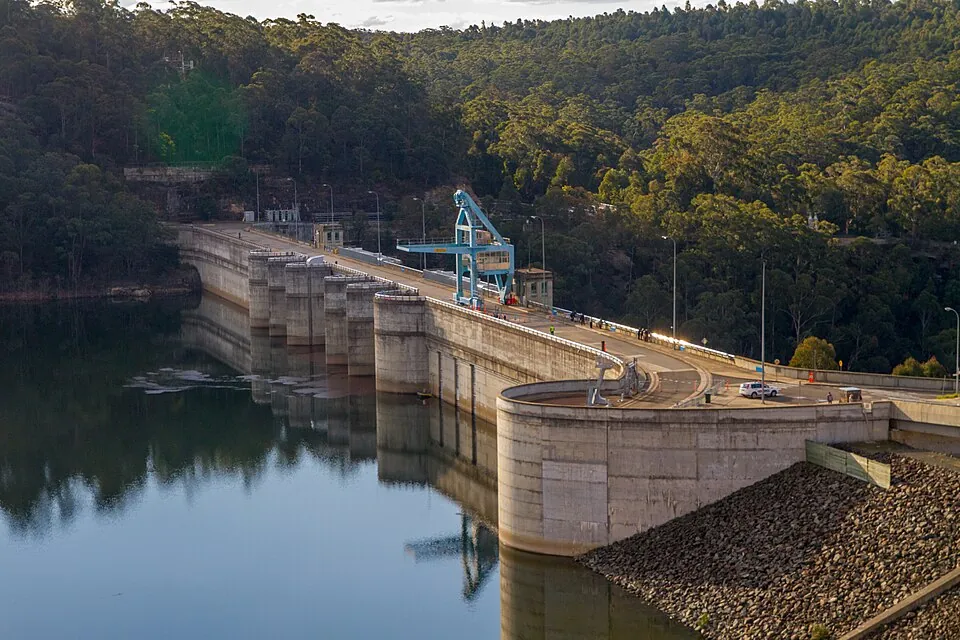
Most of Sydney's water comes from Warragamba Dam and is treated at the Prospect plant, one of the largest in the world. Every stage uses a separation method from this chapter.
| Stage | What it removes | Separation idea |
|---|---|---|
| Screens | Sticks, leaves, fish | Sieving (size) |
| Coagulation and flocculation | Fine clay and colour too small to settle | Chemicals make tiny particles stick together into bigger clumps called floc |
| Sedimentation | The floc | Density: it settles to the bottom |
| Filtration | Remaining small particles and some microbes | Filtering through sand and gravel (size) |
| Disinfection | Bacteria and viruses | Not a separation: chlorine kills them |
| Fluoride and pH adjustment | Nothing: these are added | Fluoride protects teeth; lime stops the water corroding pipes |
Coagulation is a clever trick. The particles in muddy water are so small they would take weeks to settle (the water is close to a colloid). Joining them into bigger clumps turns it into a suspension, which settles in hours and filters easily.
Desalination: drinking water from the sea
Australia is the driest inhabited continent, and long droughts have nearly emptied city dams. During the Millennium Drought, Sydney's dams fell below 35% full. The response was desalination: removing dissolved salt from sea water. The Sydney Desalination Plant at Kurnell opened in 2010 and can supply about 15% of Sydney's water. Perth, Adelaide, Melbourne and the Gold Coast also have large plants, and Perth now gets close to half its drinking water from the sea.
Distillation works but uses huge amounts of energy to boil water. Modern plants use reverse osmosis instead. Sea water is pushed at very high pressure against a membrane with pores so tiny that water molecules squeeze through but salt particles can't. It's filtering at the scale of particles. Even so, desalination uses a lot of electricity, so Sydney's plant buys its power from a wind farm, and the extra-salty water left over (brine) is spread out through diffusers so it doesn't harm sea life near the outlet.
- Choose steps in order to separate each mixture into pure substances. Every wrong order ruins the attempt.
- For sand, salt and iron: why must the magnet come first?
- For muddy sea water you need pure water too. Which method is the only one that keeps the water?
Sewage and recycled water
Waste water from homes goes to a sewage treatment plant. Screens and settling tanks remove solids; then bacteria are put to work in aerated tanks to break down dissolved waste; then the water settles again and may be filtered and disinfected. Some of it is treated further, using membranes and ultraviolet light, to make recycled water for watering parks, flushing toilets or industry. Mining companies recycle water too, cleaning it only as much as the job needs: water for cooling machinery doesn't have to be drinkable.
Separating in medicine
- Blood donations are centrifuged and split into red cells, plasma and platelets, so one donation can help several patients. Some donors give plasma directly: a machine takes blood, separates out the plasma and returns the red cells to the donor's arm.
- Kidneys filter about 180 litres of blood plasma a day, keeping useful substances and removing wastes into urine. When kidneys fail, a dialysis machine does the job: blood flows past a membrane, and small waste particles such as urea pass through into a cleaning liquid while blood cells and proteins stay in.
Mining and the environment
- Froth flotation is used to separate valuable minerals such as copper and lead from crushed rock. Chemicals make the mineral particles stick to air bubbles, which float them to the top as a froth that is skimmed off, while the waste rock sinks.
- Oil spills at sea are contained with floating booms and skimmed off the surface, using the fact that oil floats on water. Absorbent materials soak up what's left.
- Recycling plants combine magnets (steel), eddy-current separators that flick out aluminium, air blowers (light paper and plastic film), and optical sorters that use cameras and air jets to sort plastics by type.
Test yourself
In water treatment, chemicals are added during coagulation to
Bigger clumps (floc) settle and filter much more easily.
Reverse osmosis removes salt from sea water by
The membrane's pores let water molecules through and hold back the salt.
Which is a disadvantage of desalination?
The others are advantages.
A dialysis machine does the job of the
It removes wastes from the blood across a membrane.
Oil from a spill can be skimmed off the sea because oil
Floating oil can be contained by booms and skimmed.
Put the stages of drinking water treatment in order.
Name each stage of water treatment.
What does each step rely on?
Sydney gets most of its drinking water from dams, and some from the Kurnell desalination plant. Evaluate the use of desalination to supply drinking water in Australia.
Desalination removes dissolved salt from sea water, usually by reverse osmosis, where sea water is forced at high pressure through a membrane that lets water molecules through but not salt. Its biggest advantage is reliability: the sea never runs dry, so it protects cities from droughts like the Millennium Drought, when Sydney's dams fell below 35%. Most Australians live near the coast, so the water doesn't need to travel far. However, it uses a lot of electricity, which makes the water expensive and can add to greenhouse gas emissions unless renewable energy is used, as at Kurnell. It also produces concentrated brine that can harm sea life if it isn't spread out. On balance, desalination is a worthwhile back-up for a dry country, especially when powered by renewables, but saving and recycling water is cheaper and should come first.