 Coaching Centre
The particle model of matter
Where the idea of particles came from (Democritus and Dalton), the main ideas of the particle model, how particles are arranged and move in solids, liquids and gases, and what the model gets right and wrong.
Cut a grain of sugar in half. Then cut a half in half again, and keep going. Could you go on forever, or would you eventually reach a piece that can't be cut any smaller? People argued about this for over 2000 years before experiments settled it.
Where the idea came from
Around 2400 years ago the Greek thinker Democritus argued that you can't keep cutting forever. Eventually you would reach tiny pieces that can't be divided. He called them atomos, Greek for "uncuttable", which is where our word atom comes from. Democritus was a philosopher. He reasoned his way to the idea but had no way of testing it, and most people at the time didn't believe him.
About 2000 years later, in the early 1800s, the English chemist John Dalton looked at the results of many chemistry experiments and saw a pattern. Substances always combined in simple, fixed ratios. Water, for example, always forms from hydrogen and oxygen in the same 2 to 1 ratio. That only makes sense if matter is built from separate particles. Dalton's version of atomic theory said:
- All matter is made of tiny particles called atoms.
- Atoms can't be created, destroyed or split.
- All atoms of one element are identical, and different from the atoms of other elements.
- Atoms join in simple whole-number ratios to make compounds.
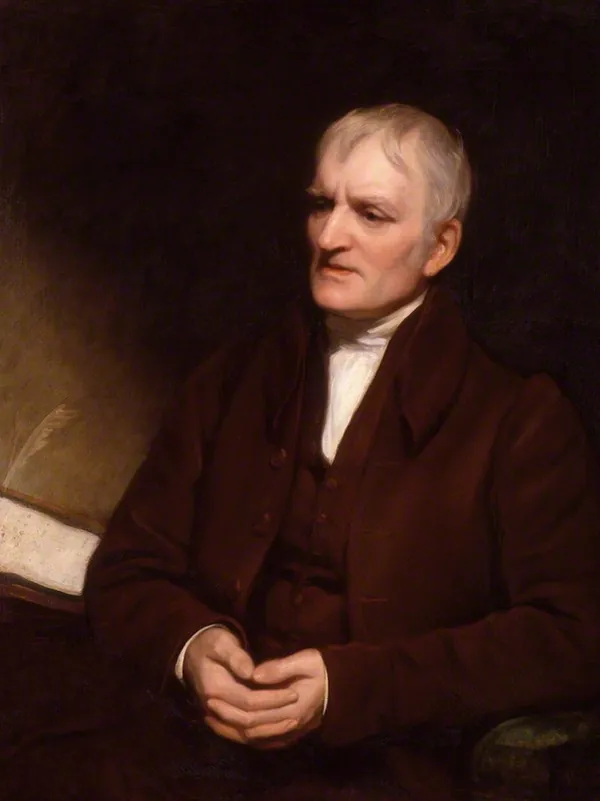
The difference between the two men matters. Democritus had an idea. Dalton had an idea backed by evidence, which is what turns a guess into science.
We now know Dalton was wrong about one thing: atoms can be split. Each atom has a tiny central nucleus made of protons (positive charge) and neutrons (no charge), with even smaller electrons (negative charge) moving around it. You'll study this properly in Year 9. For now, the important part is that atoms can join together into bigger particles called molecules, such as oxygen gas (O2) or carbon dioxide (CO2). In these notes "particle" means whatever the smallest unit of a substance is, whether that's a single atom or a molecule.
The particle model in five ideas
Scientists combined Dalton's work with later discoveries into the particle model of matter. Everything else in this chapter is explained with these five ideas, so they are worth learning word for word.
- All matter is made of tiny particles, far too small to see.
- Particles of the same substance are identical. Different substances have different particles.
- Particles are always moving. The hotter they are, the faster they move.
- Particles attract each other. These forces of attraction are strongest in solids and weakest in gases.
- There is empty space between particles. Not air: nothing at all.
Particles in solids, liquids and gases
| Solid | Liquid | Gas | |
|---|---|---|---|
| Arrangement | Packed tightly in a regular pattern | Close together, jumbled, no pattern | Far apart, random |
| Movement | Vibrate on the spot | Slide past each other | Zoom in straight lines until they hit something |
| Forces of attraction | Strong | Medium | Very weak |
| Which explains... | fixed shape, can't be squashed | flows, fixed volume, hard to squash | fills any container, easy to squash |
Analogies help. A solid is like a packed cinema: everyone fidgets in their seat, but nobody changes seats. A liquid is like the crowd leaving the cinema: still shoulder to shoulder, but everyone is shuffling past everyone else. A gas is like a hundred bouncy balls thrown into an empty classroom, flying in every direction and bouncing off the walls, except that gas particles never slow down and stop.
- Tap Follow a particle and watch its path in each state. How far does one particle travel in the solid compared with the gas?
- Turn on Show attractions. In which state are the particles almost never close enough to pull on each other?
- Push the walls in on each box. Which state lets you squash it, and why?
Why use a model at all?
Particles are too small to see with an ordinary microscope, so scientists use a model: a simplified picture that explains what we observe and lets us make predictions. The particle model is excellent at explaining things like squashing, flowing and spreading. But every model leaves things out, and good scientists know the limits of theirs.
| The model shows... | But really... |
|---|---|
| Particles as coloured balls | Particles have no colour. Colour only exists for big groups of them. |
| All particles as the same round shape | Molecules come in many shapes, from simple pairs to long chains. |
| Particles frozen in a drawing | They never stop moving, and there are billions of billions of them in a single drop. |
| Liquid particles noticeably more spread out than solid ones | Most liquids are only a little less tightly packed than their solids. |
Test yourself
What does the Greek word atomos mean?
Democritus thought atoms were the pieces you could not cut any further.
Why is Dalton's work counted as science when Democritus's mostly isn't?
Dalton explained real experimental results. Democritus reasoned without testing.
In which state do particles vibrate in fixed positions?
Solid particles are held in place by strong attractions, so they can only vibrate.
What is between the particles of a gas?
The gaps between particles are empty.
Which analogy best matches the particles in a liquid?
Close together but moving past each other: that is a liquid.
Gases can be compressed because their particles
Squashing a gas pushes the particles into the empty space between them. The particles themselves don't shrink.
Put these ideas about matter in the order they happened.
Which state does each analogy describe?
Use the particle model to explain why a liquid can be poured but a solid cannot.
In a solid, strong forces of attraction hold the particles in fixed positions, so they can only vibrate on the spot. The particles can't move past each other, so the solid keeps its shape and can't be poured. In a liquid the forces of attraction are weaker. The particles stay close together but can slide past one another, so the liquid can flow and be poured into a new shape.
Identify ONE strength and ONE limitation of drawing particles as small coloured circles.
A strength is that the circles clearly show how the particles are arranged and how far apart they are in each state. A limitation is that it shows particles as still and coloured, when real particles are always moving and have no colour.