 Coaching Centre
Expansion, conduction and heat capacity
Why solids, liquids and gases expand when heated and contract when cooled, expansion joints in bridges and rail lines, how heat is conducted through a solid, conductors and insulators, and heat capacity.
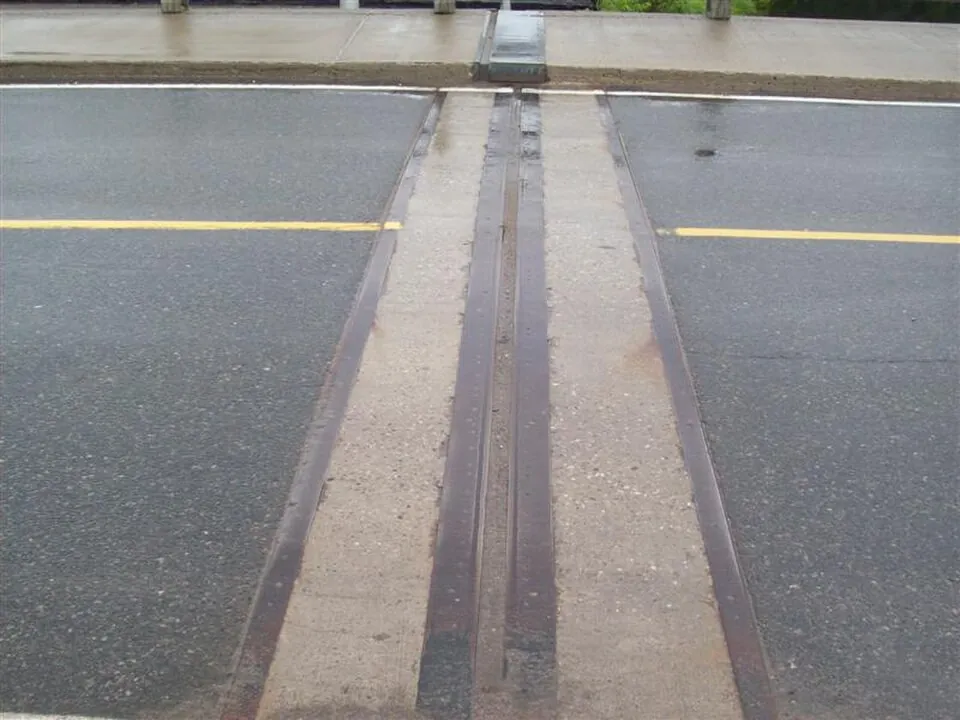
Walk along a long bridge and you'll cross a metal joint that looks like two interlocking combs. On a cold winter morning the teeth sit well apart. On a 40 °C afternoon they have almost closed up. The bridge has grown, and nobody added anything to it.
Heating makes things expand
Almost everything gets a little bigger when it is heated. This is called expansion. When it cools down again it shrinks back to its original size, which is called contraction.
The particle model explains why. Heating gives particles more kinetic energy. In a solid, the particles vibrate harder and further, so each one takes up more room and they push each other slightly further apart. Multiply that tiny extra gap by billions of particles in a row and the whole object grows.
Solids, liquids and gases all expand
- Solids expand the least. A steel ball that just fits through a metal ring won't fit after being heated in a flame, then slips through again once it cools.
- Liquids expand more. A liquid thermometer works this way: as the liquid warms up it expands and has nowhere to go but up the thin tube.
- Gases expand the most, because their particles are hardly held together at all. A balloon stretched over an empty bottle inflates when the bottle sits in hot water and shrivels in iced water. A sealed plastic bottle put in the fridge crumples inward as the air inside contracts.
- Try to pass the ball through the ring. Now heat the ball. What happens if you heat the ring instead?
- On the bridge tab, slide the temperature from a cold winter night to a heatwave. How much does the 30 m span grow?
- Remove the expansion gap and heat the bridge again. What do engineers have to prevent?
Designing around expansion
The amounts are small, roughly 1 cm for every 30 m of steel on a hot day, but the forces are huge. Engineers have to leave room for it:
- Bridges have expansion joints at their ends so the deck can lengthen and shorten freely.
- Railway tracks used to have small gaps between rail sections. Without room to expand, rails can buckle sideways in a heatwave.
- Concrete footpaths have grooves and flexible strips so slabs don't crack as they expand and contract.
- Power lines are hung with some slack, because they sag more in summer and pull tighter in winter.
Expansion can be useful too. If a metal lid is stuck on a glass jar, run the lid under hot water. The metal expands more than the glass, and the lid loosens.
Conduction: passing heat along
Hold one end of a metal spoon in a hot drink and soon the other end is hot too. Heat has travelled through the spoon by conduction. The particles at the hot end vibrate faster and bump into their neighbours, making them vibrate faster too, and the energy is passed along the line like a ripple through a crowd.
- Materials that pass heat on easily are conductors. Metals are the best: copper and aluminium especially.
- Materials that pass heat on poorly are insulators: plastic, wood, rubber, wool, glass and, best of all, trapped air.
Saucepans show both at once: a metal base to conduct heat into the food, and a plastic or wooden handle so you don't burn your hand. Doona and jacket fillings work by trapping air, which is a very poor conductor.
- A pin is stuck to each rod with wax. Heat the ends and see which pin drops first.
- Rank the materials from best conductor to best insulator.
- Which material would you choose for a saucepan handle? For the base?
Heat capacity
Some substances heat up quickly; others take a lot of energy to warm up. Heat capacity is a measure of how much heat energy is needed to raise the temperature of a substance. Metals have a low heat capacity: a frying pan gets hot in seconds. Water has a very high heat capacity: a full pot of water takes many minutes to boil on the same burner.
A high heat capacity also means a substance holds onto its heat and cools slowly. That's why the watery filling of a pie can burn your mouth while the pastry around it only feels warm, and why the ocean stays warm well into autumn after the air has cooled.

Test yourself
When a solid is heated and expands, its particles
Same particles, same number, more movement and bigger gaps.
Which state expands the most when heated by the same amount?
Gas particles are barely held together, so they spread out the most.
Why do bridges have expansion joints?
Without room to grow, the deck could buckle or crack.
A liquid-in-glass thermometer works because
The liquid expands much more than the glass, and the narrow tube makes the change easy to see.
Which is the best heat conductor?
Metals, especially copper, conduct heat best.
A frying pan heats up much faster than a pot of water on the same burner because metal has a
Low heat capacity: little energy needed to raise its temperature.
Sort each material.
When a substance is heated its particles gain kinetic and move further apart, so the substance . When it cools it . Heat travels through a solid by , as vibrating particles pass energy to their neighbours. Metals are good .
A metal lid is stuck tight on a glass jar. Explain, using the particle model, why running the lid under hot water helps to open it.
The hot water heats the metal lid, so its particles gain kinetic energy, vibrate more and move slightly further apart. This makes the lid expand. Metal expands more than glass for the same temperature rise, so the lid becomes a little looser on the jar and is easier to turn.
Explain how you can be sure that when a solid expands on heating, no extra particles have been added to it.
If you weigh the solid before and after heating, its mass is the same. If extra particles had been added the mass would increase, so the number of particles hasn't changed. The solid is bigger only because its particles are moving more and the spaces between them are larger.