 Coaching Centre
Exploring space
How technology has expanded what we know about space: refracting and reflecting telescopes, radio telescopes at Parkes and the Square Kilometre Array, the electromagnetic spectrum, spectroscopes and how starlight reveals what stars are made of, the Hubble and James Webb space telescopes, the Space Race, probes and rovers, satellites and the International Space Station.
Voyager 1 was launched in 1977, when your grandparents might have been at school. It flew past Jupiter and Saturn, kept going, and is now more than 25 billion kilometres away, outside the bubble of the Sun's wind, in interstellar space. Its radio signal, about as powerful as a fridge light, takes more than 23 hours to reach us, and giant dishes, including one at Tidbinbilla near Canberra, still listen to it every day.
Telescopes
For most of history, astronomy was done with the naked eye. A telescope collects far more light than your eye can, and focuses it to make faint, distant objects look brighter and bigger. There are two main kinds of optical (visible light) telescope:
- A refracting telescope uses a large lens to bend (refract) light to a focus. Galileo's telescopes of 1609 were refractors.
- A reflecting telescope uses a curved mirror to collect light, an idea Isaac Newton developed in 1668. Mirrors can be made much larger than lenses, so all large modern telescopes are reflectors. The Anglo-Australian Telescope at Siding Spring Observatory, near Coonabarabran in NSW, has a mirror 3.9 m across.
The bigger the mirror, the more light it collects and the fainter the objects it can see. Telescopes are built on mountains in dry, dark places, away from city lights and above as much of the blurring atmosphere as possible.
Light we can't see
Visible light is only a small part of the electromagnetic spectrum. Stars, galaxies and gas clouds also give off radio waves, infrared, ultraviolet, X-rays and gamma rays, and each type shows something different.
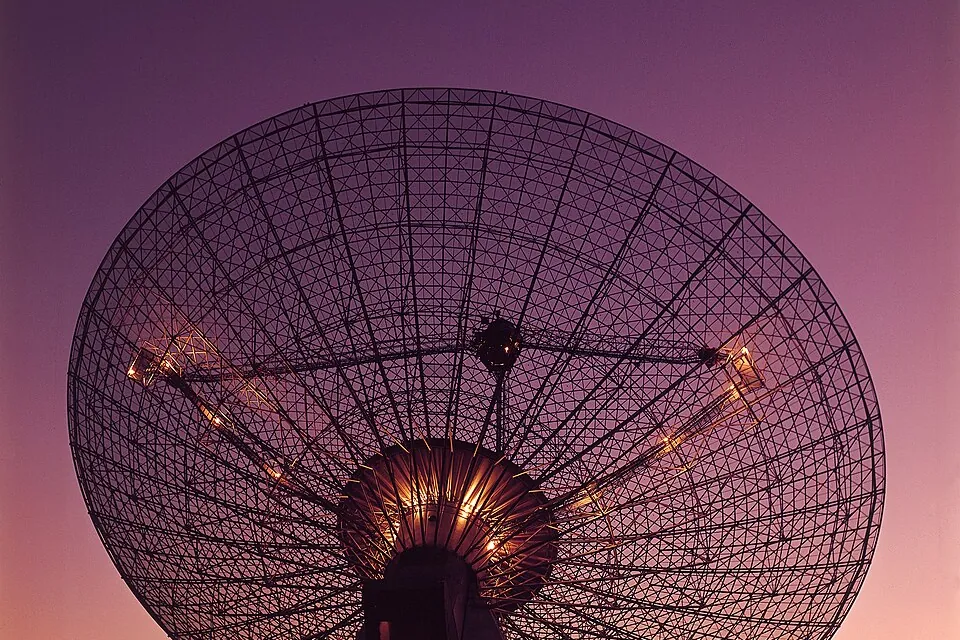
Radio telescopes are huge dishes that collect radio waves. The 64-metre dish at Parkes, known as Murriyang, relayed the Apollo 11 television pictures in 1969 and has discovered hundreds of pulsars (spinning dead stars). In the outback of Western Australia, on Wajarri Yamaji Country, thousands of antennas are being built as part of the Square Kilometre Array, which will be one of the most powerful radio telescopes ever made.
Reading starlight
We can't visit a star, yet we know what stars are made of. A spectroscope spreads light out into its colours, like a prism making a rainbow. When an element is heated, it gives off light of only certain exact colours, seen as bright lines. This emission spectrum is different for every element, like a fingerprint.
When we look at the spectrum of a star, it's a rainbow crossed by dark lines. Atoms in the star's outer layers absorb those exact colours. If the dark lines in a star's light match the bright lines of an element, that element is in the star. In 1868, astronomers found lines in the Sun's spectrum that matched no known element. They named the new element helium, after helios, the Greek word for Sun. It wasn't found on Earth until 27 years later.
- Choose the Sun. Turn on each element in turn. Which ones have bright lines exactly where the Sun has dark lines?
- Find all the elements in the Sun, then check your answer.
- Now try Rigel and the mystery star. Which element is in Rigel but not in the Sun?
Telescopes in space
Earth's atmosphere blurs starlight (that's why stars twinkle) and blocks most X-rays, ultraviolet and infrared. The solution is to put telescopes above it.
- The Hubble Space Telescope was launched in 1990 and orbits about 530 km above the Earth. Astronauts repaired and upgraded it five times. Its images helped measure the age of the universe (about 13.8 billion years) and showed that most large galaxies have a giant black hole at their centre. It is still working more than 35 years later.
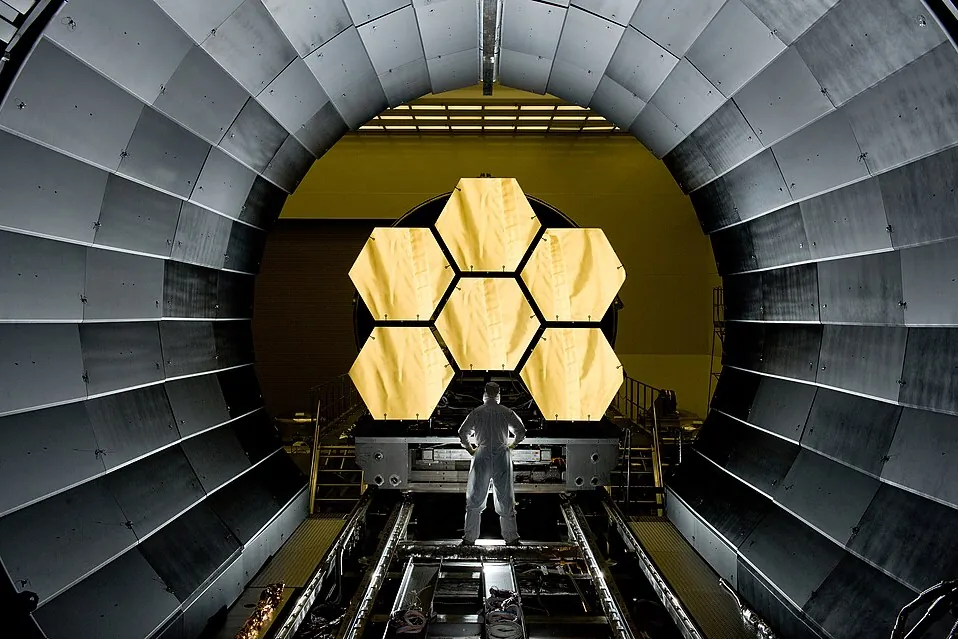
- The James Webb Space Telescope was launched on Christmas Day 2021 and sits about 1.5 million km from Earth. Its gold-coated mirror is 6.5 m across, and it sees in infrared, which lets it look through dust clouds where stars are being born and see some of the first galaxies that formed after the Big Bang.
The Space Race
From 1957 to 1975, the United States and the Soviet Union (Russia and its neighbours) raced each other into space. The Soviet Union launched the first satellite, Sputnik 1, in 1957, sent the dog Laika into orbit later that year, and launched the first person into space, Yuri Gagarin, in 1961. The United States answered with the Apollo program, which landed Neil Armstrong and Buzz Aldrin on the Moon in 1969.
A rocket works by pushing hot gas out of the back at enormous speed; the gas pushes the rocket forward. To reach orbit, a spacecraft needs to travel at about 28 000 km/h. Today, reusable rocket boosters that land themselves have made launches much cheaper.
Probes, rovers and satellites
- Space probes are uncrewed spacecraft sent to explore other worlds. Probes have now visited every planet, as well as the Sun, asteroids, comets and Pluto. The Parker Solar Probe, the fastest object ever built, flies through the Sun's outer atmosphere.
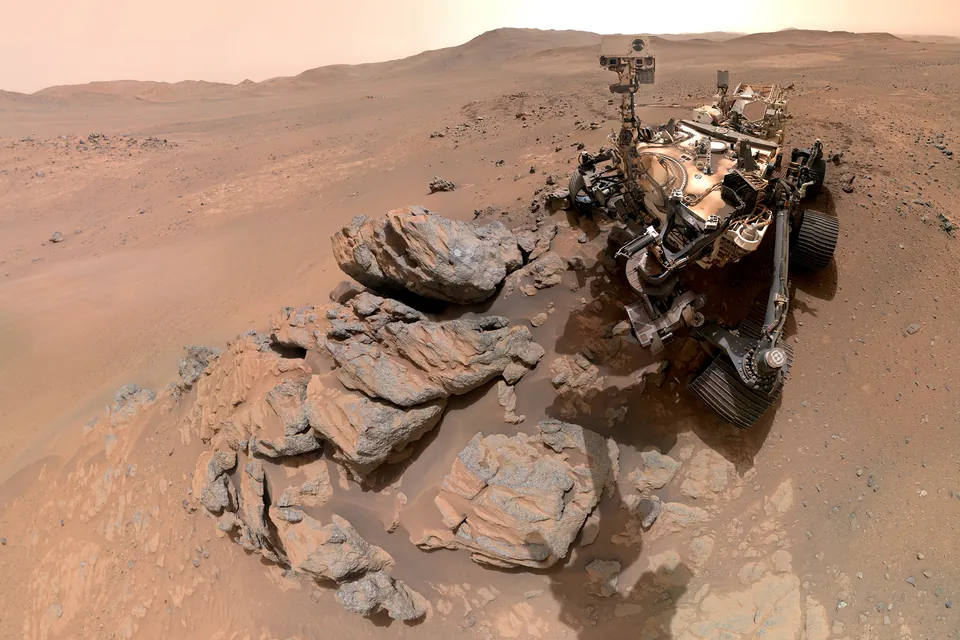
- Rovers drive across the surface. On Mars, Curiosity (landed 2012) found evidence of ancient lakes, and Perseverance (landed 2021) is collecting rock samples. It carried a small helicopter, Ingenuity, which made the first powered flight on another planet.
- Artificial satellites orbit the Earth. There are now more than 10 000 working satellites, used for weather forecasting, GPS navigation, TV and internet, and for mapping bushfires, floods, crops and the shrinking of sea ice.
- The International Space Station (ISS), built by the USA, Russia, Europe, Japan and Canada, orbits about 400 km up at about 28 000 km/h, circling the Earth about 16 times a day. People have lived on board continuously since November 2000. It is due to be retired and brought down into the ocean around 2030.
Space exploration needs every area of science: physics and engineering to design rockets, chemistry for fuels and materials, biology and medicine to keep astronauts healthy in weightlessness, geology to understand other worlds, and computing to control spacecraft and process their data.
Test yourself
A reflecting telescope collects light using a
All large modern optical telescopes are reflectors.
Scientists know what stars are made of by
Each element absorbs its own exact colours.
The main reason for putting telescopes in space is to
The distance gained is tiny compared with the distance to stars.
The first artificial satellite was
Launched by the Soviet Union in 1957.
Helium was first discovered
Unknown lines in sunlight in 1868, named after the Greek for Sun.
Label the two telescopes.
Put these events in time order.
Describe two examples of how advances in technology have increased our understanding of the solar system or the universe. For each, state the technology and what it revealed.
One example is the telescope. In 1610 Galileo used one of the first telescopes to discover four moons orbiting Jupiter and the phases of Venus, which was evidence that not everything orbits the Earth and helped the heliocentric model become accepted. A second example is the spectroscope, which splits starlight into a spectrum. The dark lines in a star's spectrum match the bright lines of particular elements, so astronomers can work out what stars are made of without visiting them. In 1868 this even led to the discovery of a new element, helium, in the Sun before it was found on Earth.