 Coaching Centre
Renewable energy
Wind, solar, hydro-electric, pumped hydro, tidal, wave, geothermal and biofuel energy, their advantages and disadvantages, storing energy with batteries, and how Australia's electricity grid is changing.
On some sunny spring days, solar panels and wind turbines now supply more than three-quarters of the electricity used across eastern Australia. More than 4 million Australian homes have solar panels on the roof, the highest rate of any country in the world. Ten years ago, almost all our power came from coal.
Why renewable energy?
Renewable energy sources won't run out, and once they're built they release almost no carbon dioxide. In 2025, renewables produced about 43% of Australia's electricity, and the national target is 82% by 2030. The challenge isn't finding renewable energy; it's catching it when it's available and having power when it isn't.
Wind
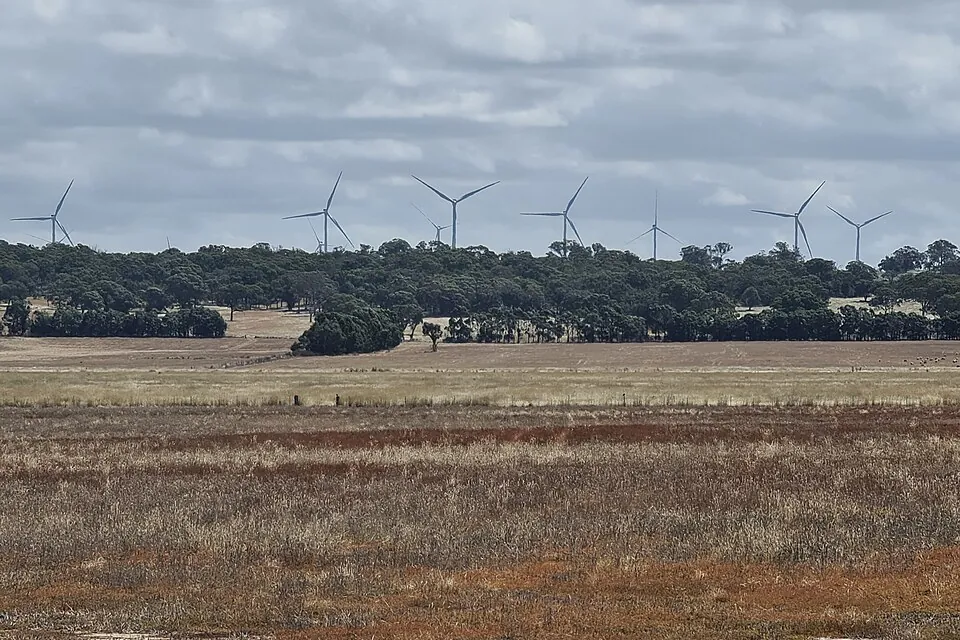
Wind turns the blades of a wind turbine. The blades turn a shaft, a gearbox speeds up the spin, and a generator turns the movement into electricity, just like in a power station but without any steam.
Turbines are grouped in wind farms on ridges, plains and coasts where the wind is strong and steady. Modern turbines are taller than a 50-storey building. Wind is free and clean, but it doesn't blow all the time, and some people object to how wind farms look, the noise, and the risk to birds and bats.
Solar
Solar panels (photovoltaic or PV cells) turn light straight into electricity: no turbine, no generator, no moving parts. Australia gets more sunlight than almost anywhere, so solar is now the cheapest electricity ever built here. It works on rooftops and in huge solar farms. Its obvious drawback is that it only works in daylight, and less on cloudy days.
Solar hot water systems use the Sun's heat directly to warm water in roof panels.
Hydro-electricity
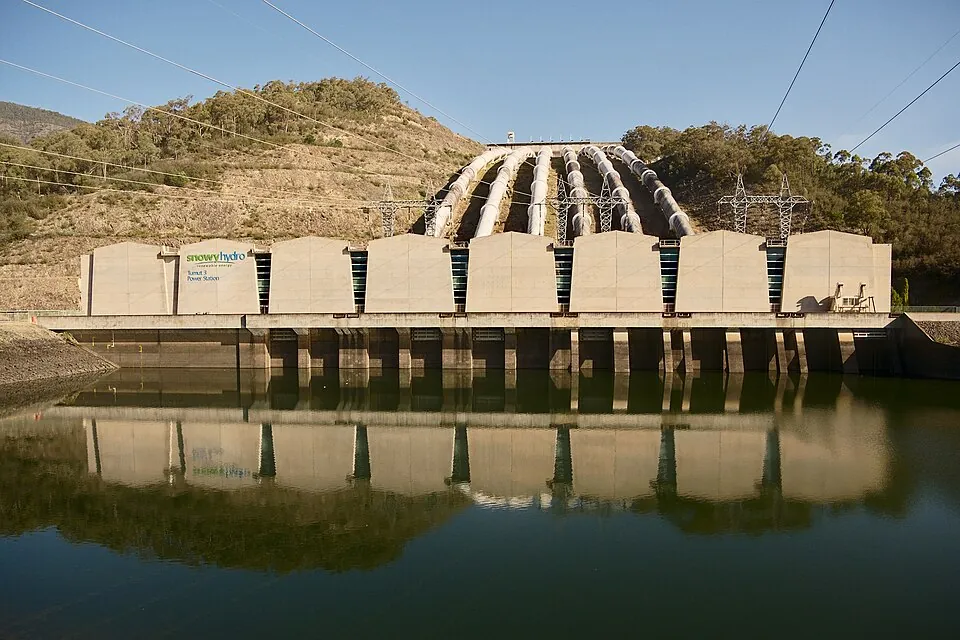
A dam holds water high up. When it is released, the falling water spins turbines at the bottom. The Snowy Mountains Scheme in NSW and the many dams in Tasmania make most of Australia's hydro-electricity. Hydro can be switched on in minutes, which makes it valuable when demand suddenly jumps. But it needs mountains and reliable rain, and dams flood valleys and change rivers.
Pumped hydro works like a giant rechargeable battery: when there's spare solar power, water is pumped uphill into a top reservoir; when power is needed, it flows back down through turbines. Snowy 2.0, being built under the Snowy Mountains, will be one of the largest in the world.
Tides, waves and hot rocks
- Tidal energy uses the rise and fall of tides to turn underwater turbines. Tides are perfectly predictable, but suitable places are rare and the structures can harm sea life. The largest tidal power stations are in South Korea and France.
- Wave energy uses the up-and-down motion of waves, for example to push air through a turbine. Small trials have run off King Island in Tasmania and Garden Island near Perth, but storms make it hard to build machines that survive.
- Geothermal energy uses heat from deep underground to make steam. Countries on active volcanic areas, like Iceland and New Zealand, use a lot of it. Australia has no active volcanoes on the mainland. A small geothermal plant at Birdsville in Queensland used hot water from the Great Artesian Basin for 25 years, and trials to pump water through hot granite deep below South Australia were abandoned because of the cost.
Biofuels
Biofuels are fuels made from plants, so the carbon they release was taken from the air only recently as the crop grew. E10 petrol contains 10% ethanol, made by fermenting sugar cane or grain. But growing fuel crops can take land and water away from food, and in some countries rainforest has been cleared for them.
Keeping the lights on
Electricity must be made at the very moment it's used. Demand is highest on winter and summer evenings, just as solar stops. So a renewable grid needs a mix: solar and wind spread across many places (the wind is usually blowing somewhere), plus storage such as large batteries and pumped hydro to shift midday solar into the evening, and some gas for long cloudy, still spells. Australia built a record number of big batteries in 2025, and more than 250 000 homes now have their own battery.
- Run the starting mix on a "Sunny and windy" day. When does each source supply the most?
- Reduce coal to zero. What do you need to add to avoid a blackout in the evening?
- Find a mix that reaches 82% renewable without a blackout, then test it on a "Cloudy and still (winter)" day.
Test yourself
Which renewable source makes electricity without a turbine or generator?
Light is turned directly into electricity.
In hydro-electricity, the energy of the water comes from
Falling water spins the turbine.
Why does Australia use very little geothermal energy?
Iceland and New Zealand sit on volcanic areas.
Pumped hydro is mainly used to
Water is pumped uphill using spare power, then released later.
The hardest time of day for a mostly solar grid is
Storage shifts midday energy into the evening.
Label the wind turbine.
Is it always available?
Solar panels turn directly into electricity. In a wind turbine, the blades turn a . Fuel made from crops, such as ethanol, is a . Batteries and pumped hydro energy for later.
A town in western NSW wants to get all its electricity from renewable sources. Recommend a combination of sources and storage for the town, and justify your choices, including how the town would have power at night and on still days.
I would recommend a solar farm plus rooftop solar, because western NSW gets a lot of strong sunshine and solar is now the cheapest form of electricity. Solar stops at night, so the town also needs wind turbines on nearby ridges, since the wind often blows at night and in winter when solar is weaker. To cover the evening peak and still, cloudy days, the town should install a large battery that charges from spare solar in the middle of the day and releases it after sunset. Staying connected to the state grid would act as a backup during long still, cloudy spells, because the wind is usually blowing somewhere else in the state. This mix gives power at all times without burning fossil fuels.