 Coaching Centre
Friction and air resistance
What causes friction, why it produces heat, when friction is useful and when it is a problem, the factors that affect friction, ways of reducing it (lubricants, rollers, bearings, air cushions, maglev), air resistance, drag and streamlining.
Imagine a world with no friction at all. You couldn't walk: your feet would slide out from under you like on oiled glass. Your shoelaces would untie themselves. A pen would glide over paper without leaving a mark. Cars couldn't start or stop. You couldn't even pick up a cup. Friction gets a bad name for slowing things down, but without it almost nothing would work.
What friction is
Friction is a contact force that acts when two surfaces rub or try to slide past each other. It always acts against the motion (or against the direction something is trying to move), so it is a slowing-down force.
Friction happens because no surface is perfectly smooth. Under a microscope, even polished metal is covered in tiny bumps and hollows. When two surfaces press together, the bumps catch and stick to each other, and they have to be dragged over or broken off for the surfaces to slide.
There are two kinds to know. Static friction holds a still object in place, like a book on a sloping desk. It can only grip up to a certain limit. Once you push harder than that, the object starts to slide, and sliding friction takes over, which is a bit weaker. That's why it takes a big shove to get a heavy box moving, but less to keep it going.
Friction makes heat
Rub your hands together fast and they warm up. Whenever friction slows something down, the energy of the motion is turned into heat (and often sound). That is useful when you light a match or warm your hands. It's a problem in engines, where moving parts would overheat and wear out without oil, and in brakes, which can glow red-hot on a racing car. Meteors streak across the sky because they slam into the air so fast that the air in front of them is squashed and heated, and the rock glows and burns up.
What affects friction?
- The surfaces: rough surfaces like sandpaper or rubber grip far more than smooth ice or oiled metal.
- How hard the surfaces press together: a heavier box, or a box with another box on top, has more friction. A heavier object has more grip but also more weight to move, which is why a heavy and a light block of the same material start to slide down a ramp at the same angle.
- What's in between: water, oil, wax, sand or dust can change friction a lot. Wet roads are slippery; sand on an icy footpath stops people falling.
- For each surface, raise the ramp slowly and note the angle where the block slips. Put the results in a table.
- Which surface has the most friction? Which has the least?
- Does a 2 kg block slip at a different angle from a 1 kg block? Why?
Useful friction and unwanted friction
| Friction helps us… | Friction causes problems… |
|---|---|
| walk and run without slipping (shoe soles have grippy rubber and tread) | by wearing out shoes, tyres and brake pads |
| stop a car or bike (brakes squeeze pads against the wheel) | by heating up and wearing engine parts |
| hold a racquet or bat (gymnasts and climbers use chalk for grip) | by wasting fuel in cars and trucks |
| write with a pen or pencil | by making doors and drawers stick |
| keep nails and screws in wood | by giving painful carpet burns |
To increase friction: use rough or grippy materials, add tread to tyres, sprinkle sand or grit, put chains on tyres in snow.
To reduce friction:
- Lubricants such as oil, grease, wax or soap coat the surfaces so the bumps slide over each other. Surfers wax their boards for grip, but skiers wax their skis to slide faster: different waxes, opposite jobs.
- Rollers, wheels and ball bearings roll instead of sliding. The ancient Egyptians may have moved giant stone blocks on rollers; today, tiny steel balls in bearings let bike wheels and skateboard wheels spin freely.
- A cushion of air or magnetism keeps surfaces apart completely. A hovercraft floats on air. Maglev trains hover above the track using powerful magnets; a test maglev in Japan reached 603 km/h in 2015.
Air resistance and streamlining
Air resistance (also called drag) is friction between a moving object and the air. The faster you go and the bigger your front surface, the more air you have to push out of the way, so the bigger the drag. Water resistance works the same way, only more strongly.
- Parachutes have a huge surface to make as much drag as possible.
- Cars, planes, racing bikes and swimsuits are streamlined: smooth and rounded so air or water flows around them easily. Dolphins, penguins and sharks are naturally streamlined; a slow-moving seahorse isn't.
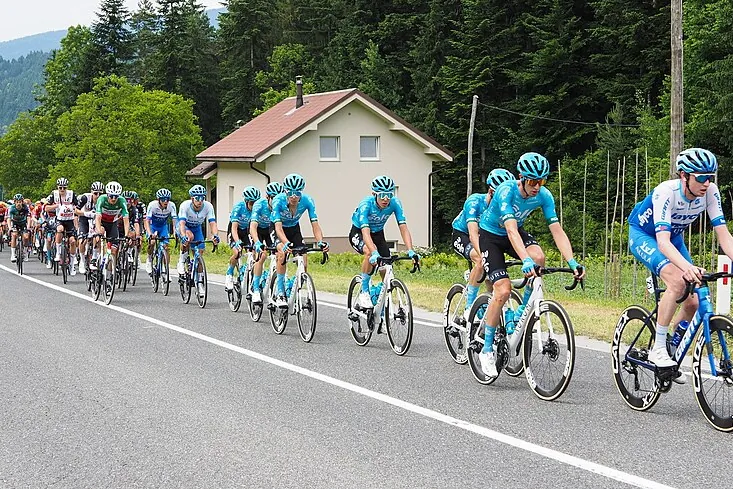
- Cyclists in a race ride close behind each other in a pack. The rider behind is shielded from the wind and can use about 30% less energy, which is why teams take turns at the front.
Test yourself
Friction always acts
It opposes sliding.
Your hands get warm when you rub them together because friction turns movement energy into
All friction produces heat.
Oil is put in a car engine to
It is a lubricant.
Which reduces air resistance?
Air flows smoothly around it.
Climbers put chalk on their hands to
Chalk dries sweat, which would act as a lubricant.
Label the friction diagram.
More friction or less?
Friction is a force. Oil and grease are that reduce friction. Friction between an object and the air is called air . A smooth, rounded shape that reduces drag is called . Friction always produces .
Matilda drives 100 km along a smooth freeway, then 100 km along rough country roads. Explain how friction affects her car, giving one way friction is useful and one way it is a problem on this trip.
Friction always acts against the car's motion, so the engine has to keep providing a driving force just to balance it, and the energy that friction removes ends up as heat. Friction is useful because the grip between the tyres and the road lets the car speed up, steer around corners and stop when Matilda brakes; without it the wheels would just spin. Friction is also a problem: the rough country roads cause more friction and bumping than the smooth freeway, so the car uses more fuel to travel the same 100 km, and the extra rubbing wears down the tyres faster.