 Coaching Centre
Gravity, mass and weight
Gravity as a non-contact force acting through a field, the Earth's gravity pulling towards its centre, the difference between mass and weight, calculating weight on other planets, falling, air resistance and terminal velocity, floating in orbit, and buoyancy.
On the Moon you could jump six times higher than on Earth, carry a friend on your back with ease, and throw a cricket ball out of sight. Yet you would be made of exactly the same amount of stuff as you are now. You wouldn't have lost any mass at all, only weight. Understanding the difference is one of the big ideas of science.
Gravity
The story goes that in 1665 or 1666, a young Isaac Newton watched an apple fall from a tree in his family's garden and wondered why it fell straight down. Nothing was pushing it. He realised that the Earth must be pulling it, and that the same pull might reach all the way to the Moon and hold it in orbit.
Gravity is a force of attraction between any two objects that have mass. It is a non-contact force that acts through a gravitational field, the region around an object where its gravity can be felt. Gravity:
- only ever attracts; it never pushes away
- is stronger for objects with more mass. Your pull on the Earth is real, but tiny; the Earth's pull on you is big because the Earth's mass is enormous.
- gets weaker with distance
- pulls everything towards the centre of the Earth. That's why "down" in Australia and "down" in England point in nearly opposite directions, and nobody falls off the bottom of the planet.
Gravity holds the atmosphere around the Earth, keeps the Moon orbiting us and the planets orbiting the Sun, and pulls rain down and rivers downhill. The Sun has so much mass that its gravity holds all eight planets, even Neptune, 4.5 billion kilometres away.
Mass and weight
These two words get mixed up all the time, but in science they mean different things:
| Mass | Weight | |
|---|---|---|
| What it is | How much matter (stuff) is in an object | The force of gravity pulling on an object |
| Unit | kilogram (kg) or gram (g) | newton (N) |
| Measured with | a beam balance (compares with known masses) | a spring balance or scales |
| Changes on the Moon? | No, it's the same everywhere | Yes, about one-sixth of Earth weight |
To calculate weight, multiply the mass by the strength of gravity:
weight (N) = mass (kg) × gravity (N/kg)
On Earth, gravity pulls with 9.8 N on every kilogram (often rounded to 10). So a 50 kg student weighs 50 × 9.8 = 490 N. On the Moon, where gravity is 1.6 N/kg, the same student still has a mass of 50 kg but weighs only 80 N.
When you stand on bathroom scales, they actually measure your weight force pushing down, then show it as kilograms because they assume you're on Earth. Take them to Mars and they'd give the wrong answer.
| Place | Gravity (N/kg) | Weight of a 50 kg person |
|---|---|---|
| Earth | 9.8 | 490 N |
| Moon | 1.6 | 80 N |
| Mars | 3.7 | 185 N |
| Venus | 8.9 | 445 N |
| Jupiter (at the cloud tops) | 24.8 | 1240 N |
| Pluto | 0.6 | 30 N |
- Set your mass, then visit each world. Which numbers change and which stay the same?
- Press Jump on Earth, the Moon and Ceres. How high can you jump on each?
- On Jupiter, what would an Earth bathroom scale say your mass was? Why is it wrong?
Falling
When you drop something, gravity is an unbalanced force, so the object speeds up as it falls. If you throw a ball upwards, gravity is still pulling down the whole time: it slows the ball on the way up, stops it for an instant at the top, then speeds it up on the way down.
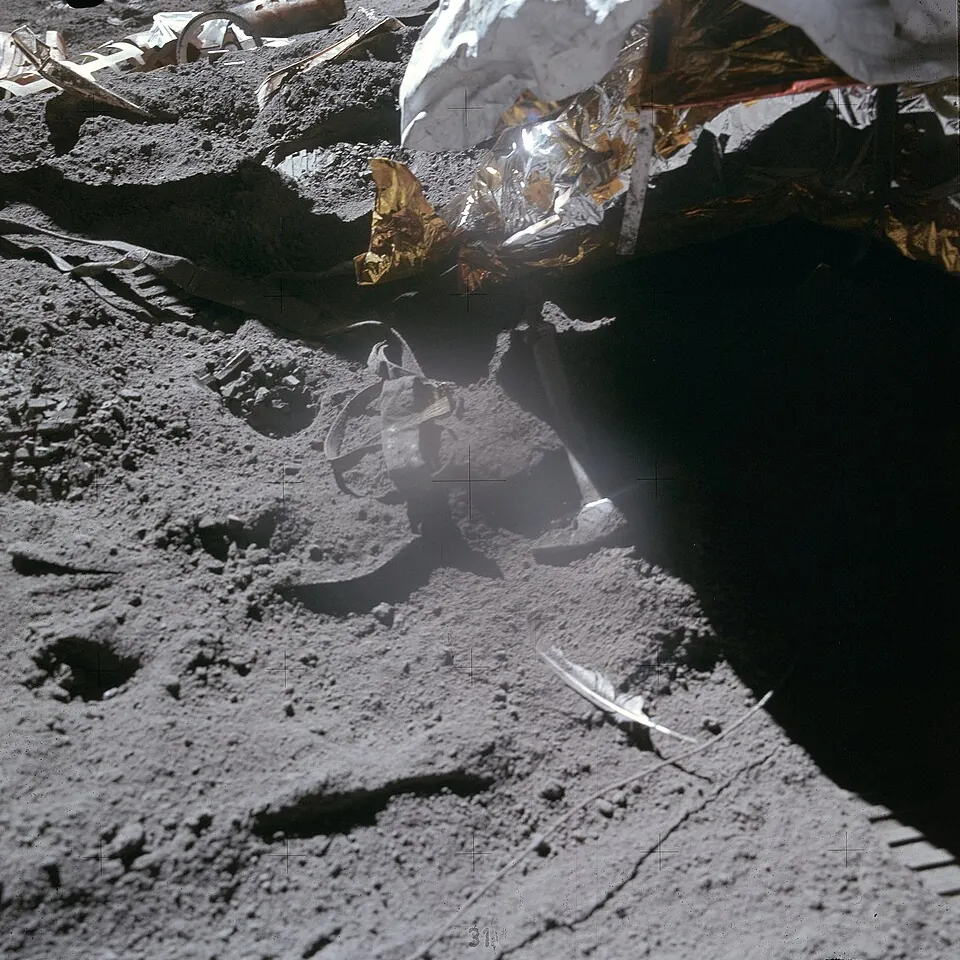
Without air, everything falls at the same rate. In 1971, astronaut David Scott dropped a hammer and a feather together on the Moon, which has no air, and they hit the ground at the same moment. On Earth, the feather floats down slowly because air resistance is large compared with its weight.
A skydiver shows how gravity and air resistance work together. Just after jumping, weight is much bigger than air resistance, so they speed up. As they go faster, air resistance grows, until it equals their weight. Now the forces are balanced and they fall at a steady top speed called terminal velocity, about 200 km/h. When the parachute opens, air resistance suddenly becomes much bigger than weight, so they slow down until the forces balance again at a gentle 15–20 km/h.
Buoyancy: why some things float
Drop a rock and a ping pong ball into a bucket of water. Gravity pulls on both, but the ping pong ball pops up. That's because water pushes up on anything in it with a force called buoyancy (or upthrust). If buoyancy is bigger than the object's weight, the object floats up; if weight is bigger, it sinks. Objects that are less dense than water (like wood, ice and ping pong balls) float. A friend in a swimming pool feels light because buoyancy is holding up most of their weight, even though their mass hasn't changed. Air has buoyancy too: helium balloons and hot-air balloons rise because they are less dense than the air around them.
Test yourself
Mass is measured in
Weight is in newtons.
An astronaut with a mass of 80 kg goes to the Moon. Her mass on the Moon is
Mass doesn't change; weight does.
What is the weight of a 20 kg dog on Earth (gravity 9.8 N/kg)?
20 × 9.8 = 196 N.
A skydiver falls at a steady terminal velocity. The forces on them are
Steady speed means balanced forces.
Gravity on Earth pulls objects
So "down" is always towards the centre.
Label the forces on the skydiver.
Mass or weight?
Gravity is a force that only . The pull of gravity on an object is its , measured in . A falling object reaches a steady top speed called terminal . The upward push of water on a floating object is called .
Leo has a mass of 45 kg. Calculate his weight on Earth and on Mars (gravity 3.7 N/kg), and explain why his mass is the same on both planets but his weight is not.
On Earth: weight = 45 kg × 9.8 N/kg = 441 N. On Mars: weight = 45 kg × 3.7 N/kg ≈ 167 N. Leo's mass is 45 kg on both planets because mass is the amount of matter he is made of, and travelling to Mars doesn't add or remove any of it. His weight is the force of gravity pulling on that mass. Mars has much less mass than the Earth, so its gravity is weaker and pulls on each kilogram with only 3.7 N instead of 9.8 N. So Leo weighs less than half as much on Mars.