 Coaching Centre
Static electricity
Electric charge, how objects become charged by rubbing as electrons move, attraction and repulsion between charges, attraction of neutral objects, insulators and conductors, static discharge, lightning and thunder, and uses and dangers of static electricity.
A lightning bolt heats the air around it to about 30 000 °C, five times hotter than the surface of the Sun, in a fraction of a second. The air explodes outwards, and that's the thunder you hear. Yet a lightning bolt is the same thing as the tiny spark that zaps your finger when you touch a door handle after walking across carpet, just billions of times bigger.
Where charge comes from
Everything is made of atoms, and atoms contain even smaller particles that carry electric charge:
- protons, in the nucleus at the centre of the atom, have a positive charge
- electrons, which move around the outside of the atom, have a negative charge
Normally an object has exactly as many protons as electrons. The charges cancel and the object is neutral. But electrons are tiny, light and on the outside of atoms, so they can be wiped off one material onto another. Protons are locked deep in the nucleus and never move this way.
When you rub two different materials together, some electrons move from one to the other:
- the material that gains electrons now has more negative than positive charge, so it becomes negatively charged
- the material that loses electrons is left with more protons than electrons, so it becomes positively charged
Charge isn't created when you rub: it's moved. The two objects always end up with equal and opposite charges. This build-up of charge sitting on a surface is called static electricity ("static" means not moving). It stays put on insulators such as plastic, rubber, glass and wool, which don't let charge flow. On a conductor such as metal, charge flows away straight away, which is why you can't charge a metal spoon by rubbing it in your hand. Moving charge flowing through a wire is current electricity, which you'll study in later years.
Forces between charges
Charges push and pull each other through an electric field, without touching, just like magnets:
- like charges repel: two negative balloons push apart
- unlike charges attract: a negative balloon and a positive jumper pull together
- a charged object attracts a neutral one: a charged comb picks up tiny scraps of paper
- the forces are stronger when the objects are closer
Why does a charged object pull on something neutral? Hold a negative balloon near a wall. The balloon's negative charge pushes the electrons in the wall's surface slightly away and leaves the positive charges nearer. Opposite charges are now closer than like charges, so the attraction wins and the balloon sticks.
- Rub the plastic ruler with wool. Is the ruler positive or negative? Now rub the glass rod with wool.
- Test each charged object near the negative balloon and the positive balloon. Write a rule.
- Try the paper scraps and the stream of water with a positive object and then a negative one. What do you notice?
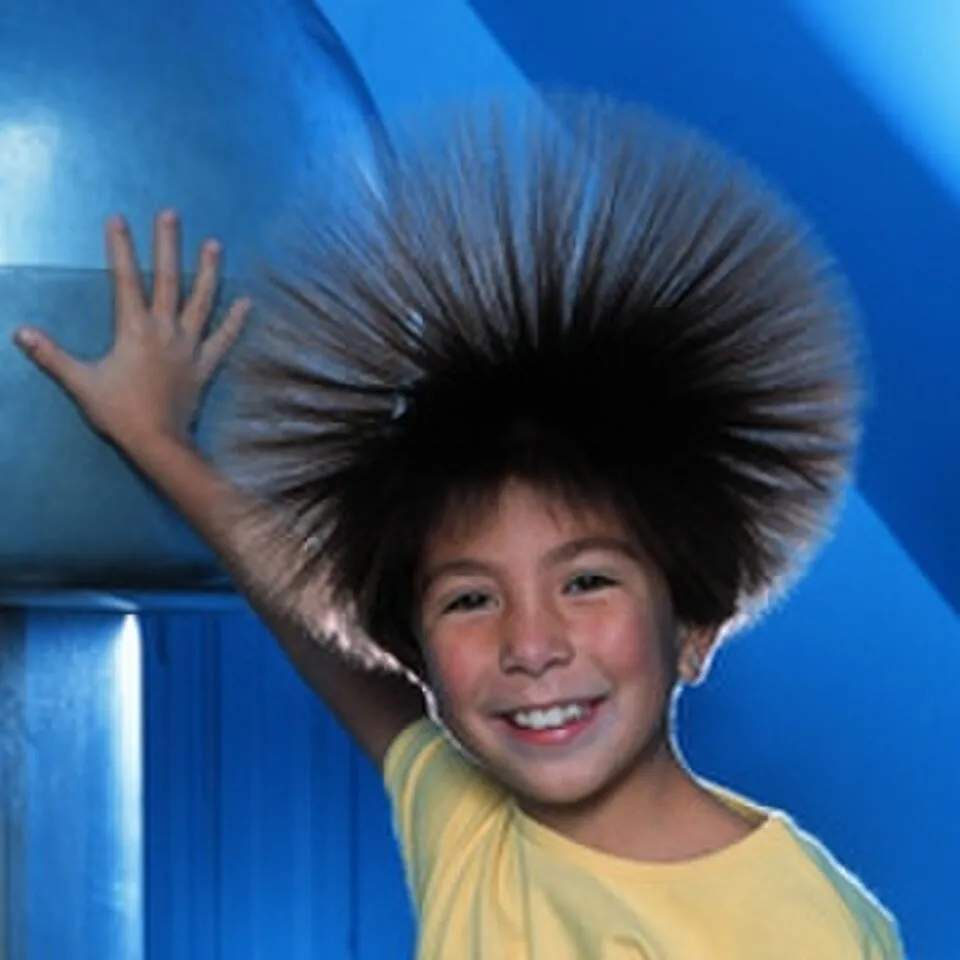
- Rub the balloon on your hair. Why does your hair then stand up and stick to the balloon?
Which material ends up negative depends on how tightly each one holds its electrons. Scientists list materials in order in a triboelectric series. Materials near the top, like glass and hair, tend to lose electrons; those near the bottom, like plastics, tend to gain them. The order can change with things like humidity and how clean the surfaces are.
Sparks and lightning
If enough charge builds up, it can jump across a gap to a conductor or to the ground as a spark, called a static discharge. You feel the zap because charge flows through your body and stimulates your nerves. Static is worse in dry weather; in humid weather, moisture in the air slowly carries charge away.
Lightning is a giant discharge. Inside a thunderstorm, ice crystals and soft hail collide as strong winds toss them up and down. The collisions move charge so that the top of the cloud becomes positive and the base becomes negative. The negative base repels electrons in the ground below, leaving it positive. When enough charge has built up, it jumps between the cloud and the ground (or within the cloud) as lightning.
A lightning rod is a metal spike on top of a tall building, connected by a thick wire to the ground. If lightning strikes, the charge flows safely down the wire instead of through the building. If you're caught outside in a storm, stay away from tall trees and open fields, and get into a building or a hard-topped car.

Static at work, and static as a danger
| Useful | Problem or danger |
|---|---|
| Laser printers and photocopiers: charged toner powder sticks only to charged parts of a drum, making the image | Static cling: clothes stick together in the dryer (dryer sheets and fabric softener reduce it) |
| Spray painting cars: charged paint droplets are attracted to the car body, so less paint is wasted and it coats evenly | Dust sticks to TV screens and records |
| Air filters and chimneys: charged plates pull smoke and dust particles out of the air | Sparks near fuel can start fires, so fuel tankers are earthed with a wire before unloading |
| Dusting cloths that attract dust by static | Electronics: a spark can damage computer chips, so parts are stored in anti-static bags |
Test yourself
A plastic ruler becomes negatively charged when rubbed with wool because it
More electrons than protons = negative.
Two positively charged balloons hanging near each other will
Like charges repel.
Why can't you charge a metal spoon by rubbing it while holding it in your hand?
Charge only stays on insulators.
Thunder is caused by
The heated air explodes outwards.
Static electricity is useful in
Charged paint droplets are attracted to the car.
Label the thunderstorm.
Attract or repel?
Rubbing two materials moves from one to the other. An object that loses electrons becomes charged. Unlike charges . Static charge stays on materials called . Lightning is a giant .
After rubbing a balloon on her hair, Aisha finds that the balloon sticks to the wall and her hair stands on end. Explain both observations in terms of electrons and charges.
When Aisha rubs the balloon on her hair, electrons move from her hair onto the balloon. The balloon now has extra electrons, so it is negatively charged, and her hair has lost electrons, so it is positively charged. Every hair has the same positive charge, and like charges repel, so the hairs push away from each other and stand on end. When she holds the negative balloon near the neutral wall, it repels electrons in the wall's surface, so the positive charges are left closest to the balloon. Opposite charges attract, and because they are closer than the like charges, the attraction wins and the balloon sticks to the wall.