 Coaching Centre
Simple machines
How simple machines change the size or direction of a force, levers and the fulcrum, load and effort, the trade-off between force and distance, the woomera, wheels and axles, pulleys, gears and ramps.
More than 2200 years ago, the Greek scientist Archimedes worked out how levers multiply force, and is said to have boasted, "Give me a place to stand and a lever long enough, and I will move the Earth." He wasn't joking about the physics. With a long enough lever, a small push really can shift an enormous load. You just have to push it a very long way.
What a simple machine does
A simple machine is a device that makes a job easier by changing the size or the direction of a force. The force you put in is the effort; the force the machine has to overcome is the load. The six classic simple machines are the lever, the wheel and axle, the pulley, the inclined plane (ramp), the wedge and the screw. Gears are linked wheels that work like levers.
No machine gives you something for nothing. If a machine lets you use a smaller force, you have to push through a bigger distance. That trade-off is the rule behind every machine.
Levers
A lever is a rigid bar that turns about a pivot called the fulcrum. Push down on one end of a seesaw-shaped lever, and the other end lifts the load.
The closer the fulcrum is to the load, the less effort you need. A lever balances when:
effort × its distance from the fulcrum = load × its distance from the fulcrum
In the diagram, the 600 N rock is 1 m from the fulcrum and the effort is 3 m away, so only 200 N is needed: 200 × 3 = 600 × 1. The lever multiplies your force by 3. But to lift the rock 10 cm, your end has to move down 30 cm.
Levers are everywhere: crowbars, scissors, pliers, bottle openers, wheelbarrows, tongs, oars, a claw hammer pulling a nail, and the bones and muscles of your own arms and legs. Your forearm is a lever with the elbow as its fulcrum.
- With the rock, move the fulcrum and watch the "push needed". Where should the fulcrum go to make lifting easiest?
- Set your push to 200 N. Find the fulcrum position that just lifts the rock. Check it with effort × distance = load × distance.
- Can you lift the small car with a push of only 400 N? What is the catch?
The woomera
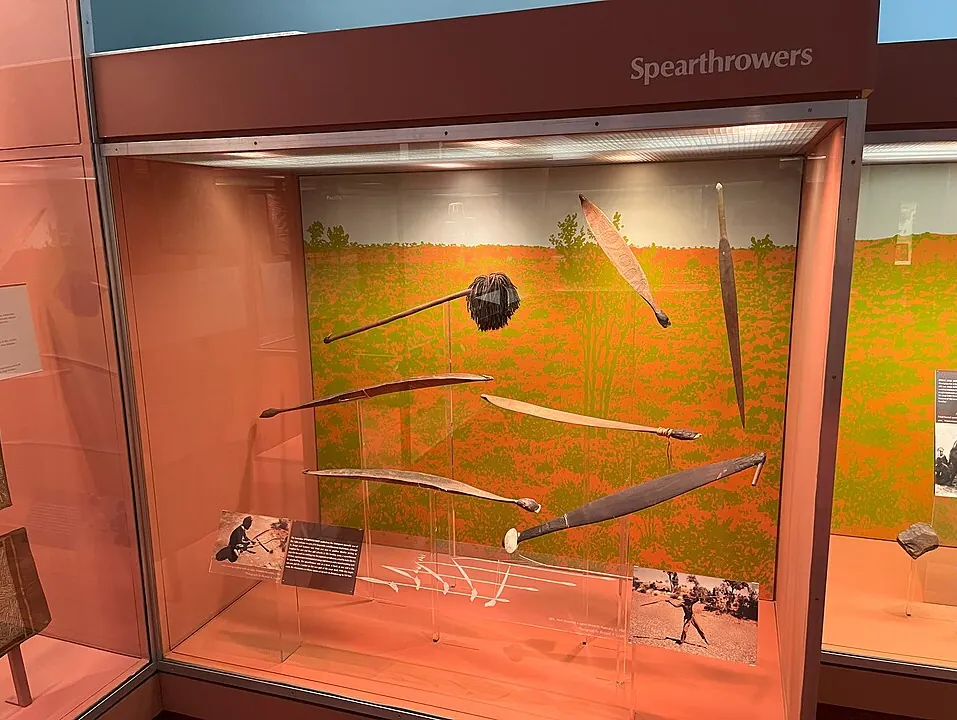
Aboriginal peoples across much of Australia developed the woomera (also called a spear-thrower; its name comes from the Dharug language of the Sydney region). The hunter holds one end, and the butt of the spear sits against a hook or peg at the other end. When the arm swings forward, the woomera acts as an extension of the arm, a lever with the shoulder as the fulcrum.
This lever works the opposite way to a crowbar. It doesn't make the force bigger. Instead, because the end of the woomera is further from the shoulder, it sweeps through a much bigger arc in the same time, so it moves much faster than the hand. The spear leaves at a far higher speed and can fly much further and hit harder than one thrown by hand. Many woomeras were also multi-purpose tools, with a stone blade for cutting, a hollow for mixing ochre, or an edge for making fire by friction.
Other simple machines
- Wheel and axle: a big wheel fixed to a thin axle. Turning the big wheel a long way turns the axle a short way with more force: a door knob, a screwdriver handle, a steering wheel, a tap.
- Pulley: a rope over a wheel. A single fixed pulley changes the direction of a force: you pull down to lift a flag up a pole. Several pulleys together reduce the effort, as in a crane or a sailing boat's rigging, but you must pull more rope.
- Gears: toothed wheels that turn each other. A small gear driving a large one gives more turning force but less speed; a large gear driving a small one gives more speed. That's what changing gears on a bike does.
- Inclined plane: a ramp. Pushing a wheelchair up a long, gentle ramp takes less force than lifting it straight up the stairs, but you travel further. A wedge (an axe, a knife, a doorstop) is a moving ramp; a screw is a ramp wrapped around a rod.
Test yourself
The pivot point of a lever is called the
The lever turns about it.
To lift a heavy rock with a crowbar using the smallest effort, the fulcrum should be
Short load distance, long effort distance.
A 900 N load sits 0.5 m from the fulcrum. What effort is needed 1.5 m from the fulcrum on the other side?
900 × 0.5 = 450 = 300 × 1.5.
A woomera helps a hunter by
The end of the lever moves faster than the hand.
A single fixed pulley at the top of a flagpole
You pull down to lift the flag up.
Label the lever.
Which simple machine is it?
A simple machine can change the size or of a force. A lever turns around a . The force you apply is called the and the force it overcomes is the . A smaller effort must move through a bigger .
Explain why it is easier to push a loaded trolley up a long gentle ramp than up a short steep ramp to the same height, and identify the disadvantage of the long ramp.
A ramp is an inclined plane, a simple machine. On a gentle ramp, only a small part of the trolley's weight pulls it back down the slope, so a smaller pushing force is needed than on a steep ramp, where more of the weight acts down the slope. The disadvantage is that to reach the same height, the trolley must be pushed much further along the gentle ramp, which takes longer. The machine trades a smaller force for a longer distance.