 Coaching Centre
Particle energy and diffusion
Kinetic energy and the kinetic theory of matter, what diffusion is, why it is fast in gases, slow in liquids and almost absent in solids, how temperature speeds it up, and how to write a particle explanation.
Someone opens a packet of salt and vinegar chips at the back of the bus. Thirty seconds later you can smell them at the front, even though the windows are shut and nobody moved. How did the smell get to you?
Particles carry energy
Another name for the particle model is the kinetic theory of matter. "Kinetic" means to do with movement, and the energy something has because it is moving is called kinetic energy. Every particle has some, because every particle is always moving.
- Particles in a solid have the least kinetic energy. They only vibrate.
- Particles in a liquid have more. They can slide around each other.
- Particles in a gas have the most. They fly about freely.
Temperature is really a measure of how fast the particles are moving on average. Hot tea has faster particles than cold tea. Nothing else about the particles changes: they don't get bigger and they don't get hotter one by one. They just move faster.
Diffusion
Diffusion is the spreading out of particles from where there are lots of them to where there are fewer, caused only by their own movement. No wind, stirring or pouring is needed. The chip smell on the bus is diffusion: smell particles escape from the packet and keep bumping their way through the air particles until some reach your nose.
You have seen diffusion many times without naming it: a tea bag colouring hot water, a drop of food colouring slowly spreading through a glass, a room filling with the smell of toast.
Why the speed depends on the state
| State | Diffusion | Why |
|---|---|---|
| Gas | Fast (seconds to minutes) | Particles move quickly and have lots of empty space to travel through. |
| Liquid | Slow (minutes to hours) | Particles are crowded together, so each one only moves a tiny distance before bumping into another. |
| Solid | Practically none | Particles are locked in place and can only vibrate, so they can't wander into each other. |
Why temperature speeds it up
Heat gives particles more kinetic energy, so they move faster and spread out sooner. That's why a tea bag colours a cup of boiling water within seconds but takes ages in cold water, and why food smells travel further when the food is hot.
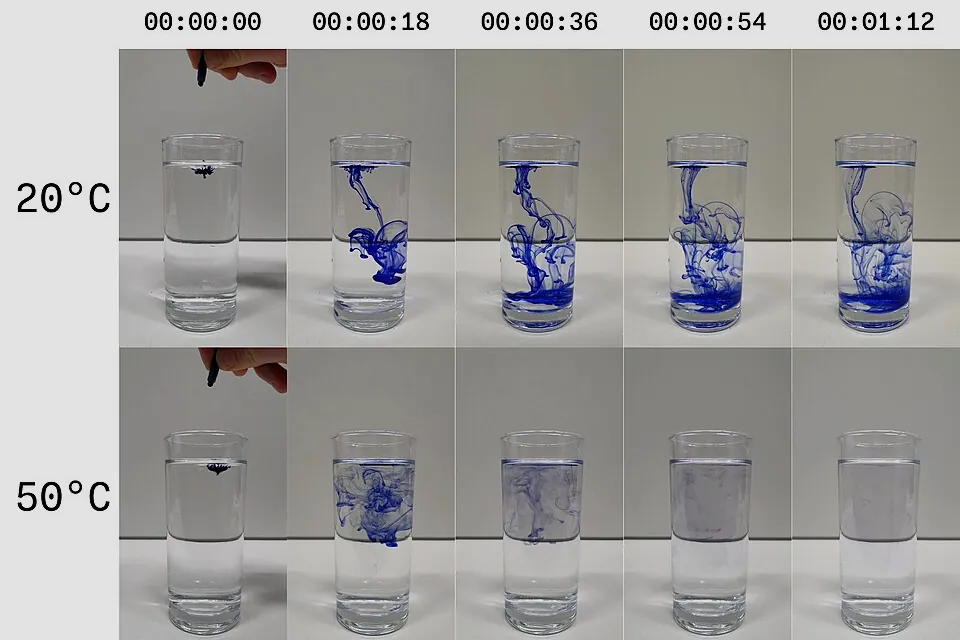
- Drop the dye into cold water and time how long until it is evenly mixed. Now try hot water. How many times faster is it?
- Switch to air. Why is diffusion so much faster?
- Try the solid. What do the particles do, and why does the colour stay put?
How to write a particle explanation
Many test questions say "Use the particle model to explain...". Markers look for three things, in this order. Use this pattern every time.
- Say what you observe. "The smell of perfume spreads across the room."
- Say what the particles are doing. "Perfume particles are gas particles that move quickly and randomly, bumping into air particles."
- Link the two. "Because they keep moving, they spread from where there are many of them near the bottle to where there are few, until they reach the far side of the room. This is diffusion."
Test yourself
The word "kinetic" refers to
Kinetic energy is the energy of movement.
Which list ranks the states from LEAST to MOST particle energy?
Solid particles only vibrate; gas particles move fastest.
Which is an example of diffusion?
Diffusion happens on its own, without stirring, wind or pouring.
Diffusion is slower in liquids than in gases mainly because liquid particles
Crowded particles can only travel a short distance before bumping into another.
A tea bag is placed in cold water and another in hot water. The hot water colours faster because its particles
Higher temperature means more kinetic energy and faster particles.
Brownian motion is important because it was evidence that
The specks were jiggled by water molecules too small to see.
Diffusion is the spreading out of particles from an area of concentration to an area of concentration. It happens because particles are always . Diffusion is fastest in and does not really happen in . Raising the temperature makes diffusion .
Put the three parts of a particle explanation in the right order.
Use the particle model to explain why you can smell a cake baking from the other side of the house.
Particles escape from the hot cake into the air as a gas. Gas particles move quickly and randomly, and there is lots of space between air particles for them to move through. They keep moving and bumping into air particles, so they spread out from where there are many of them, near the oven, to where there are few. Eventually some reach your nose on the other side of the house. This spreading is called diffusion.
Predict whether a drop of food colouring will spread faster in water at 10 °C or water at 60 °C. Justify your prediction.
It will spread faster in the 60 °C water. At a higher temperature the water and dye particles have more kinetic energy and move faster, so the dye particles spread out through the water more quickly.