 Coaching Centre
Strength, hardness, pressure and melting points
Physical properties explained with particles: tensile and compressional strength, hardness and brittleness, gas and water pressure from particle collisions, and melting and boiling points.
A glass window is harder than a steel nail, yet a cricket ball can smash the glass and would barely dent the nail. How can something be hard but not strong?
Density isn't the only physical property worth knowing. Engineers choosing a material for a bridge, a phone screen or a car tyre care about how it handles being stretched, squashed, scratched, heated and pumped full of air. Every one of these comes back to the particles and how strongly they hold on to each other.
Strength: stretching and squashing
"Strong" can mean two different things.
- Tensile strength is how much pulling (stretching) force a material can take before it breaks. Steel cable has a very high tensile strength. Most metals are also ductile, meaning they can be drawn out into wire without snapping.
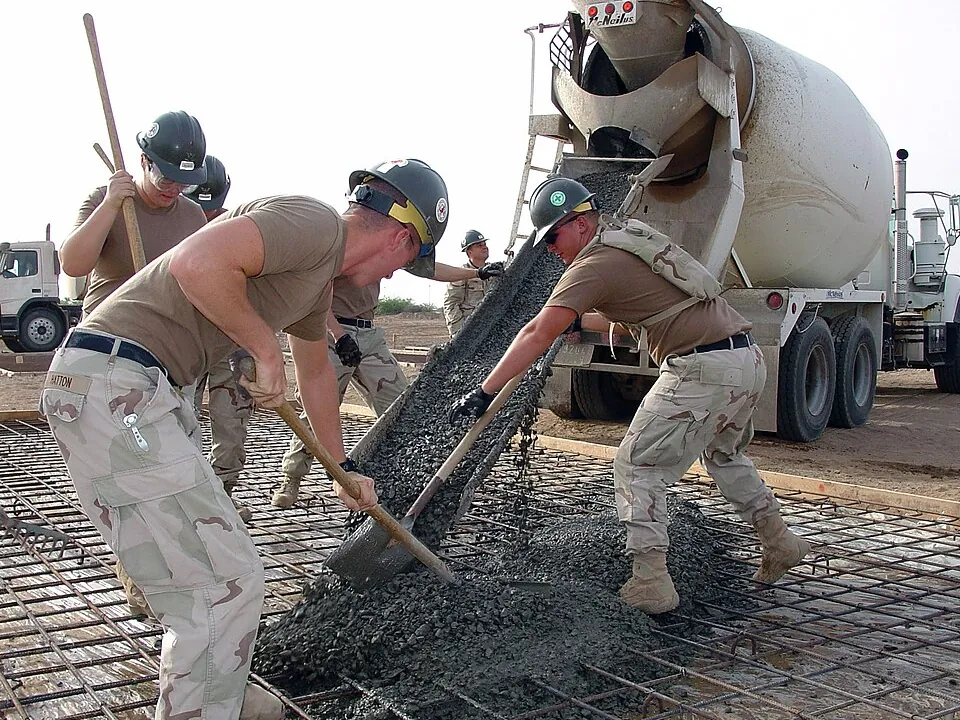
- Compressional strength is how much squashing force a material can take before it crushes. Concrete, brick and stone are excellent at this but snap easily when stretched.
Builders combine the two in reinforced concrete: steel rods set inside the concrete. The concrete handles the squashing and the steel handles the stretching, which is how we can build long bridges and tall towers.
Hardness and brittleness
Hardness is the ability of a material to scratch another material, or to resist being scratched. The rule is simple: the harder material scratches the softer one, never the other way round. A steel nail scratches a plastic ruler, but the nail can't scratch glass, so the order is glass, then steel, then plastic.
Hardness is not the same as strength. Glass is hard, but it is also brittle: instead of bending, it shatters suddenly. A rubber band is soft, but it's tough and doesn't shatter at all.
In particle terms, hard materials have particles held together very strongly, so it is difficult to scrape any away. In a soft material like plastic or chalk, particles are held more weakly and can be rubbed off.
- Drag one material across another. If it leaves a scratch, it is the harder of the two.
- Use your results to build a hardness ladder from softest to hardest.
- Toothpaste contains a mild scratching agent. Using your ladder, why is chalk a better choice than sand?
Pressure from particles
Blow up a balloon and it stays round. What holds the rubber out? Billions of air particles inside are flying around and smashing into the inside of the balloon every second. Each hit is a tiny push. Together they add up to a steady force spread over the rubber, which we call gas pressure (or air pressure).
There are two ways to increase the pressure of a gas in a closed container:
- Add more particles. Pumping a tyre forces more air in, so there are more collisions with the walls each second.
- Heat it up. Hotter particles move faster, so they hit the walls more often and harder. That's why a car tyre's pressure rises on a hot day without any air being added, and why aerosol cans warn you not to leave them in the sun.
- Pump in more particles. What happens to the number of wall hits and the pressure reading?
- Now heat the container without adding particles. Does the pressure rise faster or slower than when pumping?
- Push the wall in to make the container smaller. Explain the change in pressure using particles.
Water pressure
Liquids press too. Underwater, the water above you is pushing down because of its weight. The deeper you go, the more water there is above you, so the pressure increases. That's why your ears hurt at the bottom of a deep pool, and why bubbles from a diver grow bigger as they rise: the pressure squeezing them gets smaller near the surface.
Melting point and boiling point
The melting point is the temperature at which a solid turns into a liquid. The boiling point is the temperature at which a liquid boils into a gas. Pure water melts at 0 °C and boils at 100 °C at sea level. Each pure substance has its own fixed values, so like density they can help identify a substance.
Melting points connect to hardness. Both depend on how strongly the particles hold together. Stronger attractions mean a harder substance and more heat energy needed to shake the particles free, so hard substances usually have high melting points. Iron melts at about 1540 °C; candle wax melts at around 60 °C.
A substance melts at −46 °C and boils at 25 °C. What state is it in at −60 °C, 0 °C and 40 °C?
Test yourself
Which property describes how much stretching force a material can take before it breaks?
Tension is pulling; tensile strength resists pulling.
A steel nail scratches plastic but cannot scratch glass. Which list goes from hardest to softest?
Glass resists the nail; the nail beats plastic.
A material that is hard but shatters easily is described as
Brittle materials break suddenly without bending.
Gas pressure inside a balloon is caused by
Billions of collisions per second add up to a steady push.
Why does the pressure in a car tyre rise on a hot day?
Same number of particles, more energetic collisions.
A substance melts at 80 °C and boils at 218 °C. At 100 °C it is a
100 °C is between its melting and boiling points.
Bubbles released by a scuba diver get larger as they rise because
Less water above means less pressure squeezing the bubble.
What does each job need most?
Gas pressure is caused by particles with the walls of their container. Pumping more air into a tyre adds more , so the pressure increases. Heating a gas makes its particles move , so they hit the walls harder and more often. Under water, pressure increases with .
A sealed aerosol can is left on the dashboard of a car on a hot day. Use the particle model to explain why this is dangerous.
The sun heats the can, so the gas particles inside gain kinetic energy and move faster. They collide with the inside walls of the can more often and with more force, so the pressure inside rises. Because the can is sealed, the pressure keeps building and the can could burst or explode.
Toothpaste uses chalk to scrub teeth. The hardness order is: sand (hardest), tooth enamel, chalk, plaque (softest). Explain why chalk is used instead of sand.
Chalk is harder than plaque, so it can scrape the plaque off, but it is softer than tooth enamel, so it won't scratch the teeth. Sand is harder than enamel and would scratch and damage the teeth.