 Coaching Centre
Protection from forces
Why stopping suddenly causes big forces, cushioning by stopping over a longer distance, seat belts, airbags, crumple zones, helmets and other technologies that reduce the impact of forces in everyday life.
In 1970, Victoria became the first place in the world to make wearing a seat belt the law. That year, more than 1000 people died on Victoria's roads. Today the state has about twice as many people and far more cars, but the road toll is around a quarter of what it was. Seat belts, airbags, crumple zones and helmets all rely on one simple piece of physics.
It's the stopping that hurts
People say "speed kills", but speed by itself doesn't hurt anyone: in Sydney you are travelling at more than 1000 km/h right now as the Earth spins, and you feel nothing. What causes injuries is stopping too quickly.
To stop a moving body, a force must act on it. The shorter the distance (and time) the body has to stop in, the bigger that force must be. Stop in 1 metre instead of 10 centimetres, and the force is about 10 times smaller.
You already know this. When you catch a fast cricket ball, you let your hands move back with it ("soft hands"). When high jumpers land, they fall onto a thick, squashy mat, not the ground. Both stretch out the stop so the force is smaller.
Safety in cars
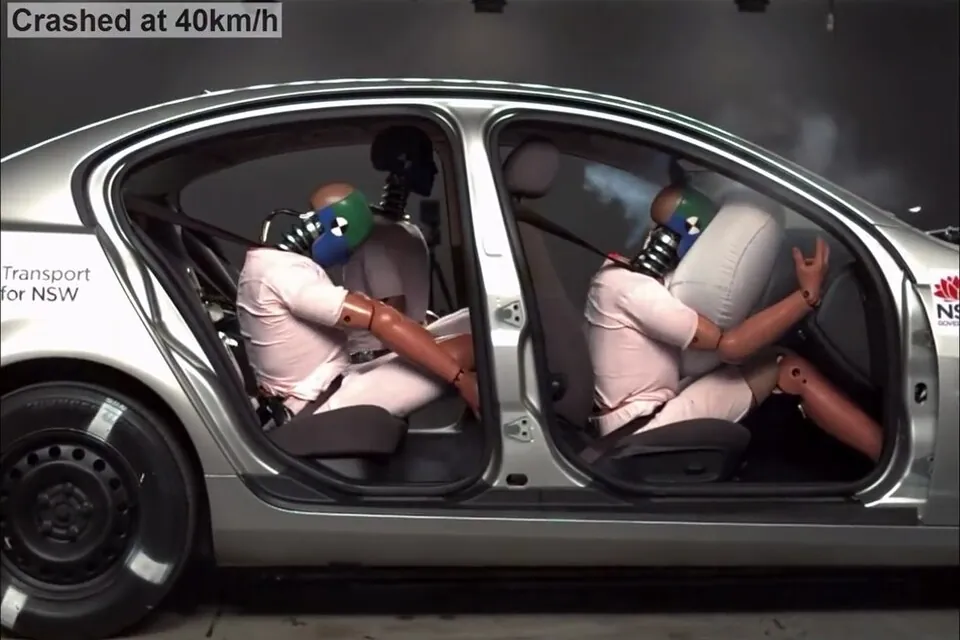
- Seat belts stop your body flying forward when the car stops suddenly. Without one, you keep moving at the car's speed until you hit the dashboard, the windscreen or another person, and stop in just a few centimetres. The belt also stretches slightly and spreads the force across the strong bones of your chest and hips. The three-point belt was designed by Nils Bohlin, an engineer at Volvo, in 1959. Volvo shared the design freely with other car makers, and it is estimated to have saved more than a million lives.
- Crumple zones at the front and back of a car are designed to crush in a crash. As the metal folds, the car takes longer to stop, so the people inside feel a smaller force.
- Rigid safety cell: the part around the people is made very strong so it doesn't collapse onto them.
- Airbags inflate in about 1/30 of a second, then let gas out through small holes as your head and chest sink into them, cushioning you over a longer distance.
- Head restraints stop your head whipping backwards in a crash from behind, which prevents whiplash injuries to the neck.
In Australia, new cars are crash-tested by ANCAP, which drives them into barriers with dummies inside packed with sensors, and gives each car a safety rating out of five stars.
- At 60 km/h, compare the old rigid car and the modern car, both with seat belts. How much smaller is the force?
- In the modern car, take away the seat belt. Why doesn't the crumple zone help much now?
- Keep the safety features the same and go from 50 km/h to 100 km/h. What happens to the force? (It's more than double!)
Helmets and padding
Bike, motorbike and construction helmets have a hard outer shell that stops sharp objects getting through and spreads a blow over a wider area, and a thick layer of foam inside that crushes on impact so your head stops more gently. Once the foam has been crushed, it can't protect you again, so a helmet must be replaced after a crash, even if it looks fine. Victoria was also the first place in the world to make bike helmets compulsory, in 1990, and the rest of Australia followed.
The same idea is used in shin pads, mouthguards, running shoes, gym mats, the padded posts at football grounds and the crash barriers beside motorways (some are full of water or sand, or are designed to fold up).
Test yourself
Most injuries in a car crash are caused by
A quick stop needs a big force.
A crumple zone makes a crash safer because it
Longer stop, smaller force.
Why must a bike helmet be replaced after a crash?
It works by crushing.
Catching a hard ball with "soft hands" means
The ball stops over a longer distance.
Label the car safety features.
Order these from the biggest force on the driver to the smallest (all crashes at 60 km/h).
A seat belt stops your body flying when the car suddenly stops. An inflates to cushion your head. Safety features work by making you stop over a longer , so the on you is smaller.
A student says, "Old cars were safer because they were made of thick steel and hardly dented in a crash." Evaluate this claim using your understanding of forces.
The claim is wrong. If a car is so rigid that it hardly dents, it stops almost instantly when it hits something, and the people inside are brought to a stop in a very short distance, so the force on their bodies is huge. Modern cars have crumple zones at the front and back that crush on purpose. As the metal folds, the car takes longer to stop, so the people inside are slowed more gently and feel a much smaller force. Modern cars also keep a rigid safety cell around the passengers so it doesn't collapse onto them, and seat belts and airbags stretch out the stop even further. So a car that crumples in the right places is far safer than one that doesn't dent.