 Coaching Centre
Separating by size, density and magnetism
Choosing a separation method by the property that differs: hand sorting, sieving and filtering (particle size), magnetic separation, decanting, sedimentation and flotation (density), centrifuging, and electrostatic separation. Setting up a filtration correctly.
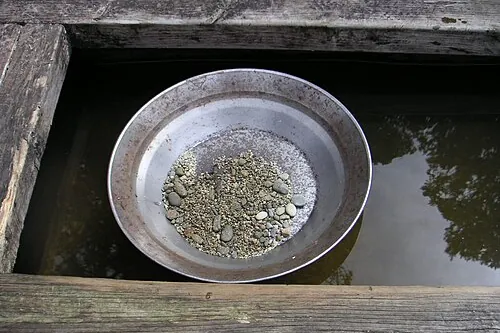
In the 1850s, thousands of miners in Ballarat and Bendigo spent their days swirling gravel and water in shallow pans. Gold is about seven times denser than sand, so as they swirled and tipped away the water, the light sand washed over the edge and any gold sank to the bottom of the pan. That's a separation technique, and it works because of one property where the gold and the sand are very different.
Find the property that's different
Every separation method uses a physical property that's different for the substances in the mixture. Choosing a method means asking: what's different about these substances?
| Property that differs | Method | Example |
|---|---|---|
| Size of pieces | Hand sorting, sieving, filtering | Sorting recycling; sieving stones from garden soil; filtering coffee |
| Magnetism | Magnetic separation | Pulling steel cans out of recycling; iron from sand |
| Density (sinks or floats) | Decanting, sedimentation, flotation, panning | Pouring water off settled rice; gold panning; skimming fat off soup |
| Density, sped up | Centrifuging | Separating blood; cream from milk |
| Electric charge | Electrostatic separation | Photocopiers; cleaning smoke from power station chimneys |
| Solubility | Dissolve one part, then filter | Salt from sand (see topic 5E) |
Size: sieving and filtering
A sieve lets small pieces fall through its holes and keeps bigger ones. Filtering is the same idea with much smaller holes: it separates an insoluble solid from a liquid. Filter paper is a mat of fibres with gaps about 0.01 mm wide, small enough to catch sand but not dissolved particles.
- The solid caught in the paper is the residue.
- The liquid that passes through is the filtrate.
Fold the filter paper in half and then in half again, open it into a cone with three layers on one side, and wet it so it sticks to the funnel. Pour slowly down a glass rod, and keep the liquid below the top of the paper or it will run down the outside and skip the filter.
- Pour the same muddy, salty water through each filter in turn. Which particles does each one catch?
- Why does filtered water from filter paper still contain bacteria?
- Which filter is the only one that removes salt? Where is this used?
Density: decanting, sedimentation and flotation
Things that are denser than water sink; things that are less dense float.
- Sedimentation: leave a suspension to stand and the heavy particles settle to the bottom as a sediment.
- Decanting: carefully pour the liquid off the top, leaving the sediment behind. It's quick but never perfect: some liquid stays with the solid.
- Flotation: substances less dense than water, such as sawdust, wood chips or oil, float and can be skimmed off.
- Two liquids that don't mix, such as oil and water, form layers and can be separated with a separating funnel, which has a tap at the bottom to drain off the lower layer.
Centrifuging
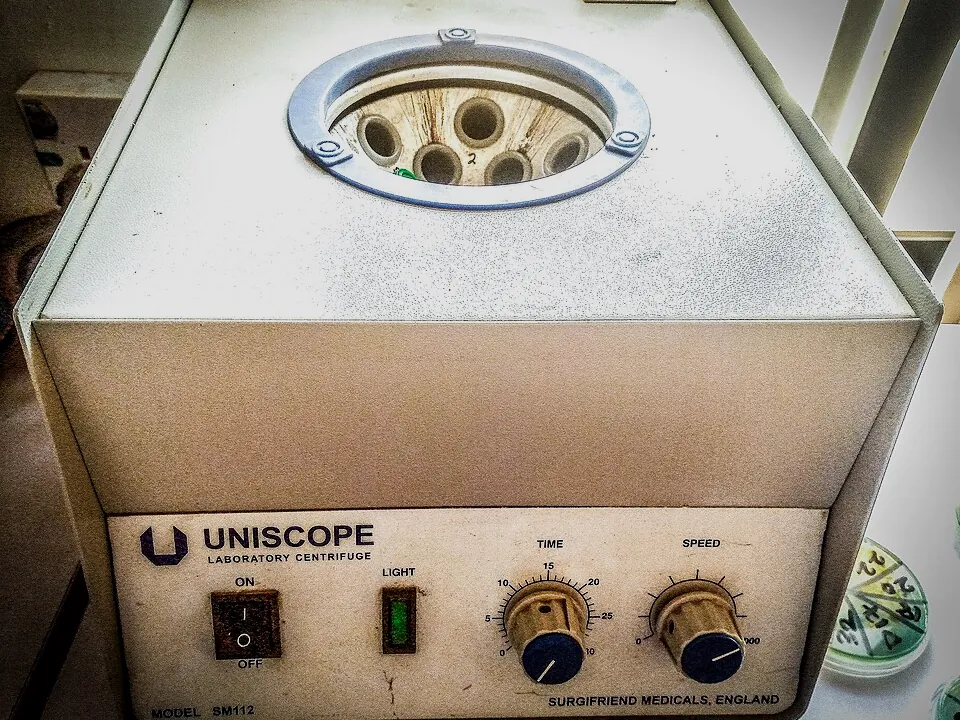
Some particles are so small they take days to settle, or never do. A centrifuge spins test tubes at thousands of revolutions per minute, which pushes the denser parts to the bottom of the tube in minutes. Blood banks spin donated blood to separate it into red blood cells (bottom), a thin layer of white cells and platelets, and yellow plasma (top), so each part can go to the patient who needs it. Dairies use centrifuges to separate cream from milk, and a washing machine's spin cycle is a centrifuge that flings water out of your clothes.
Magnetism and electrostatics
A magnet pulls out iron, nickel and cobalt and most kinds of steel. Recycling centres use huge electromagnets to lift steel cans out of mixed recycling, then switch them off to drop the cans. In an electrostatic separator, particles are given an electric charge and attracted to a charged plate. Electrostatic precipitators in power station chimneys remove most of the ash from the smoke before it reaches the air.
Test yourself
In filtration, the solid left in the filter paper is called the
Residue stays behind; filtrate passes through.
Gold panning works because gold
The dense gold sinks while lighter sand washes away.
Which method would separate blood into plasma and red blood cells quickly?
Spinning pushes the denser cells to the bottom.
A recycling centre needs to separate steel cans from aluminium cans. The best method is
Steel is magnetic; aluminium is not.
Why does a student keep the liquid level below the top of the filter paper?
Otherwise some mixture bypasses the paper.
Label the filtration set-up.
Which property does each method use?
A student filters muddy creek water through filter paper and gets a clear filtrate. They say it is now safe to drink. Evaluate this claim.
The claim is wrong. Filter paper only catches particles bigger than its holes, about 0.01 mm, so it removes soil and sand and makes the water look clear. But bacteria and other microbes are much smaller and pass straight through, and so do any dissolved salts or chemicals. Clear water can still make you sick. It would need to be boiled or disinfected, or passed through a much finer filter, before it was safe to drink.