 Coaching Centre
Classifying animals
Vertebrates and invertebrates, endoskeletons and exoskeletons, the five classes of vertebrates, ectotherms and endotherms, monotremes, marsupials and placental mammals, and the main invertebrate phyla with a tabular key.
When the first platypus skin reached London in 1799, some scientists thought it was a fake: a duck's bill stitched onto a mole. It had fur and fed its young milk like a mammal, but people later learned it laid eggs like a reptile and had a venomous spur like nothing else. The platypus forced scientists to ask exactly which features make an animal a mammal.
Backbone or not?
The first question for any animal is: does it have a backbone?
- Vertebrates have an internal skeleton (an endoskeleton) with a backbone made of small bones called vertebrae, which protect the spinal cord. Fish, frogs, lizards, birds and mammals. They all belong to the phylum Chordata.
- Invertebrates have no backbone. Some have a hard outer skeleton (an exoskeleton), like beetles, crabs and spiders. Others have no skeleton at all, like worms, jellyfish and octopuses.
Vertebrates get most of the attention, but about 96% of all known animal species are invertebrates. Insects alone make up more than half of all named species.
The five vertebrate classes
Vertebrates are split into classes using four features: body covering, how they breathe (gills or lungs), how their young are born, and how they control body temperature.
Endotherms make their own body heat and keep a fairly constant temperature (birds and mammals). Ectotherms get their heat from their surroundings, so their body temperature changes with the environment (fish, amphibians, reptiles). A lizard basking on a rock at noon can be warmer than you; scientists avoid "cold-blooded" for exactly that reason.
| Class | Covering | Breathing | Young | Temperature | Australian example |
|---|---|---|---|---|---|
| Fish | Scales; most have fins | Gills | Most lay soft eggs in water | Ectotherm | Murray cod, Port Jackson shark |
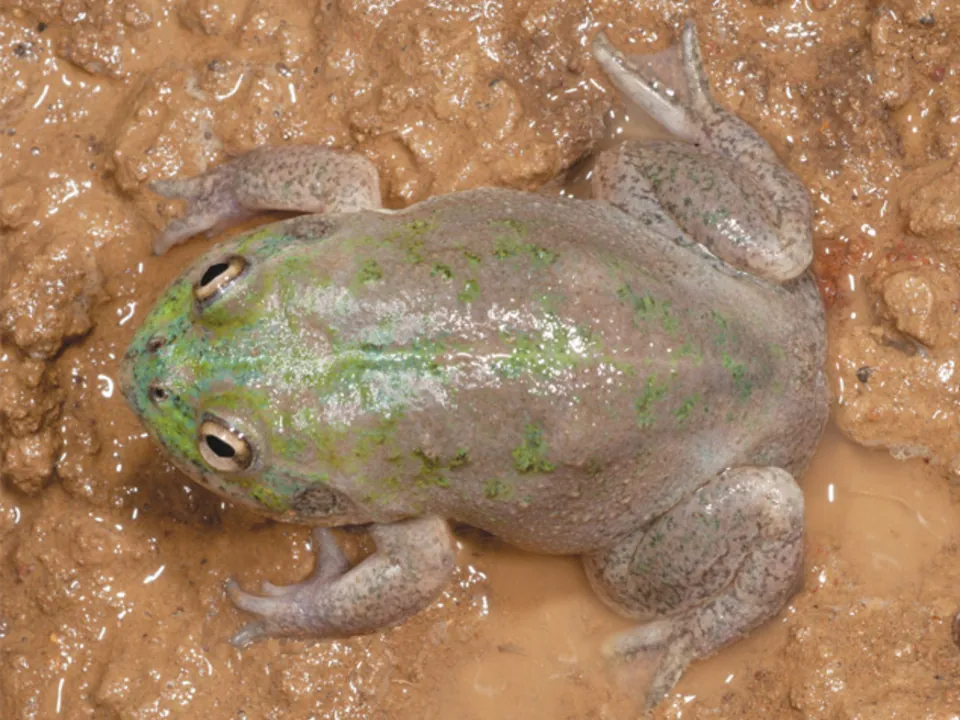
| Amphibians | Moist skin, no scales | Gills as young, then lungs and skin | Soft eggs in water; tadpoles | Ectotherm | Green tree frog |
| Reptiles | Dry scales | Lungs (even sea snakes) | Leathery-shelled eggs on land, or live young | Ectotherm | Lace monitor, saltwater crocodile |
| Birds | Feathers; scaly legs | Lungs | Hard-shelled eggs | Endotherm | Kookaburra, emu |
| Mammals | Hair or fur | Lungs | Fed milk from mammary glands | Endotherm | Wombat, dingo, flying fox |
Sharks and rays have skeletons made of rubbery cartilage, while other fish have bony skeletons, so biologists now treat "fish" as more than one class. For Year 7, the five groups above are what you need.
Three kinds of mammal
All mammals have hair and feed their young milk. They're split by how the young develop, and Australia is the only continent with all three groups living naturally:
- Monotremes lay soft, leathery eggs. The young hatch tiny and lick milk from patches on the mother's skin (monotremes have no nipples). Only the platypus and four species of echidna survive, all in Australia and New Guinea.
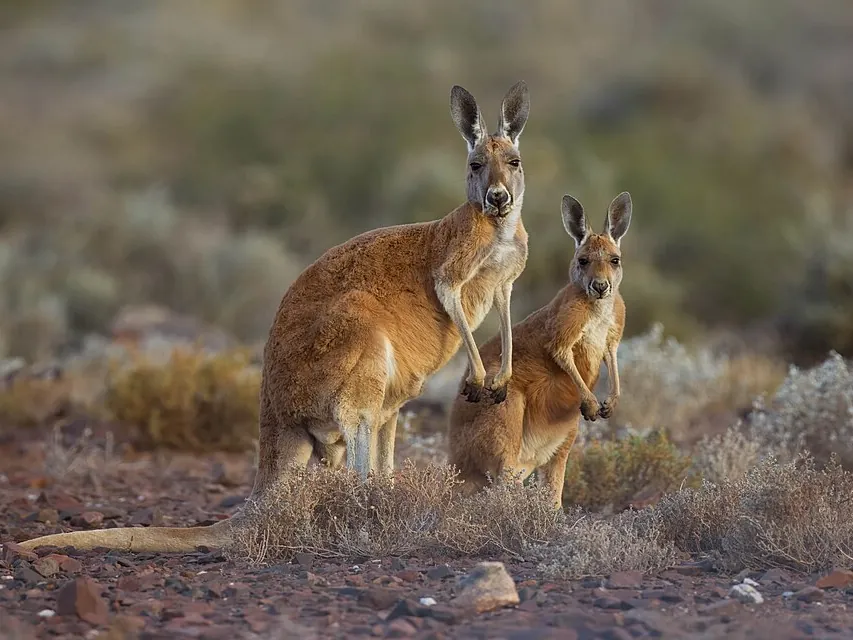
- Marsupials give birth to tiny, undeveloped young. A newborn red kangaroo is about the size of a jellybean; it crawls into the pouch, attaches to a teat and stays there for months.
- Placental mammals grow their young inside the womb, fed through a placenta, so they're well developed at birth. Dingoes, bats, rodents, whales and humans.
- A mystery vertebrate gives you one clue at a time. Name its class with as few clues as possible.
- Watch for the tricksters: animals that live in water but aren't fish, fly but aren't birds, or lay eggs but aren't reptiles.
- After each one, read which clue was the deciding feature and which ones were red herrings.
Invertebrates
Invertebrates are split into many phyla using features such as body shape, whether the body is in segments, whether it has a shell or hard cover, tentacles, and spiny skin. These are the main ones:
| Phylum | Key features | Examples |
|---|---|---|
| Porifera (sponges) | Spongy body full of holes; attached to rocks underwater | Bath sponge, glass sponge |
| Cnidaria | Soft, hollow body; ring of stinging tentacles around the mouth | Coral, sea jelly, sea anemone, box jellyfish |
| Platyhelminthes (flatworms) | Flat, ribbon-like body; mouth but no anus; many are parasites | Tapeworm, liver fluke |
| Nematoda (roundworms) | Long, smooth, round body; often microscopic | Heartworm, threadworm |
| Annelida (segmented worms) | Long body divided into ring-like segments | Earthworm, leech |
| Mollusca | Soft body, muscular foot; most have a shell | Snail, oyster, slug, octopus, squid |
| Echinodermata | Spiny skin; body parts arranged in fives around a centre | Sea star, sea urchin, sea cucumber |
| Arthropoda | Exoskeleton; segmented body; jointed legs in pairs | Insects, spiders, crabs, centipedes |
Arthropods are the most successful animals on Earth: about four out of every five animal species. The name means "jointed foot" (think arthritis, joint pain, and podiatrist, foot doctor). Insects have six legs and three body parts; spiders have eight legs and two body parts.
Many of the biggest invertebrates live in the sea, where water supports their weight. The giant squid can reach about 12 m, and the Japanese spider crab measures nearly 4 m from claw tip to claw tip. On land, an exoskeleton gets too heavy to carry beyond a certain size.
Test yourself
A seal has fins and spends a lot of time in water, but it has whiskers and feeds its pup milk. It is
Hair and milk define mammals; fins and swimming are adaptations to water.
Which pair are both endotherms?
Birds and mammals make their own body heat.
Which animal is a monotreme?
Egg-laying mammals: platypus and echidnas.
A beetle has a segmented body, jointed legs and an exoskeleton. Its phylum is
Jointed legs + exoskeleton = arthropod.
Why do the largest invertebrates live in the ocean?
Buoyancy means less need for a strong skeleton.
Sort each animal.
Animals with a backbone are called . Birds and mammals are because they make their own body heat, while reptiles are . Mammals that lay eggs are ; those whose young develop in a pouch are . Young placental mammals are fed inside the womb through the .
A flying fox can fly like a bird. Explain which class of vertebrates it belongs to, using at least two features as evidence, and explain why flying is not used to classify it.
A flying fox is a mammal. It is covered in fur, and females feed their young with milk from mammary glands. Flying isn't used to classify it because many unrelated animals fly (birds, bats and insects); it is an adaptation for a way of life, not a feature shared by every member of one class.
Compare how the young develop in a marsupial and a placental mammal.
Both give birth to live young and feed them milk. A marsupial's young is born very small and undeveloped, then crawls into the pouch, attaches to a teat and finishes developing there. A placental mammal's young stays in the womb much longer, fed through the placenta, so it is well developed when born.