 Coaching Centre
Magnets and magnetic fields
Magnetic materials, kinds of magnets, north and south poles, attraction and repulsion, mapping magnetic fields with iron filings and compasses, the Earth as a giant magnet, compasses, the wandering magnetic poles and the aurora australis.
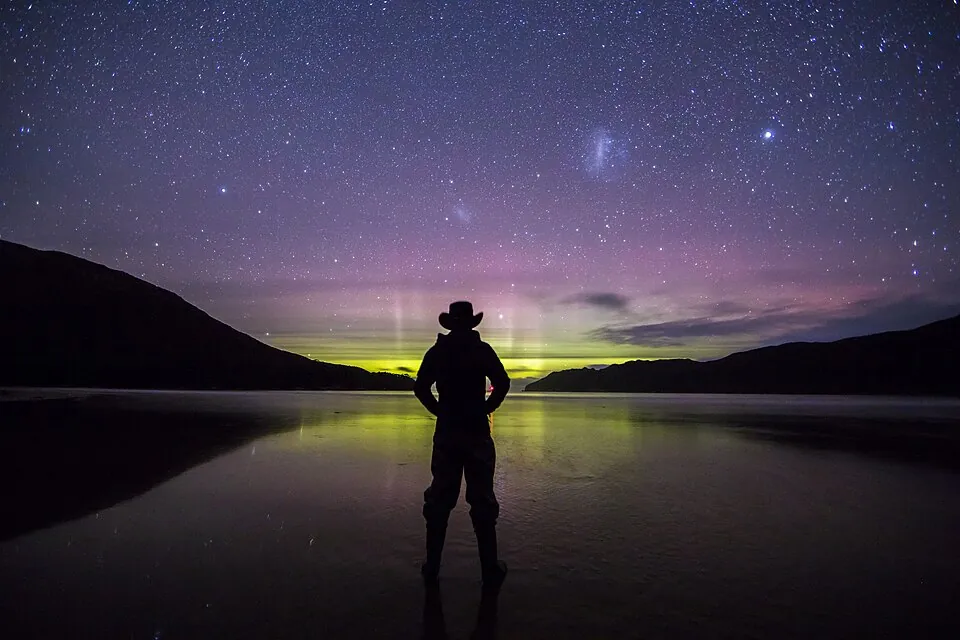
In May 2024, a huge storm of particles from the Sun crashed into the Earth's magnetic field. That night, people across southern Australia, even in parts of Sydney and Perth, looked up and saw the sky glowing pink and green. The aurora australis is usually only seen from Tasmania or Antarctica. That night, the Earth's invisible magnetic field became visible for millions of people.
Magnetic materials
A magnet attracts some metals but not others. The magnetic materials are iron, nickel and cobalt, and many mixtures of metals (alloys) that contain them, especially steel, which is mostly iron. A magnet won't pick up aluminium cans, copper wire, gold, plastic, wood or paper. A quick way to sort recycling: steel cans stick to a magnet, aluminium drink cans don't.
Different kinds of magnets suit different jobs:
- Alnico magnets (aluminium, nickel and cobalt with iron) are the red-and-silver bar magnets in school labs. They can lose some magnetism if dropped or heated.
- Ferrite magnets (iron oxide mixed with other elements) are cheap and light: fridge magnets and the magnets in speakers.
- Rare earth magnets, made with neodymium, are the strongest permanent magnets. A tiny one can hold a stack of paper to a fridge. They're used in earbuds, phone speakers, cordless drills, electric car motors and wind turbine generators. They are brittle and are coated to protect them.
Poles: attract and repel
A magnet's force is strongest at its ends, called poles. Every magnet has a north pole and a south pole. If you hang a bar magnet from a thread, it swings until its north pole points north, which is how the poles got their names.
- Unlike poles attract: N and S pull together.
- Like poles repel: N and N, or S and S, push apart.
Only a magnet can repel another magnet. A piece of plain iron is always attracted to either pole, so the only sure test for a magnet is repulsion. And you can never get a magnet with only one pole: snap a bar magnet in half, and you get two smaller magnets, each with a north and a south pole.
Magnetic fields
Around every magnet is a magnetic field, the region where its force acts. You can't see or feel it, but you can map it:
- Iron filings sprinkled on paper over a magnet line up like tiny compass needles and show the pattern of the field.
- A small plotting compass points along the field wherever you put it. Mark the direction, move the compass along, and you can trace a field line.
Field lines are drawn from the north pole to the south pole. Where the lines are close together, near the poles, the field is strongest. Magnetic fields are three-dimensional: they spread out in all directions around a magnet, not just across the page.
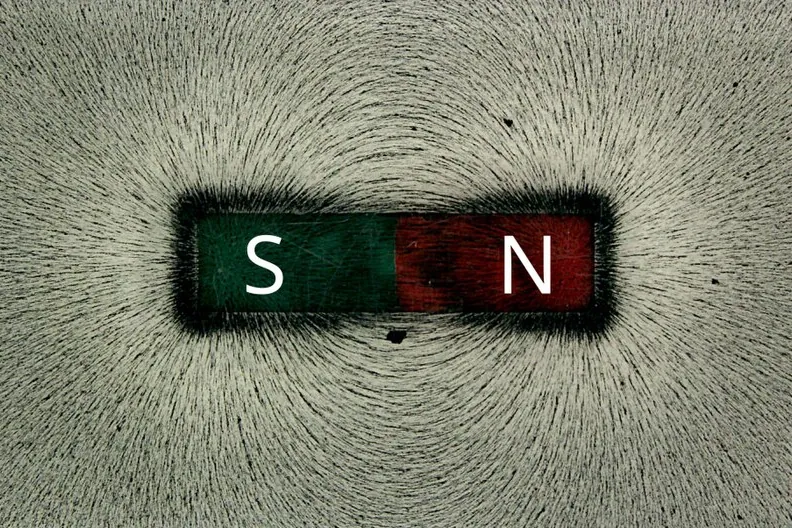
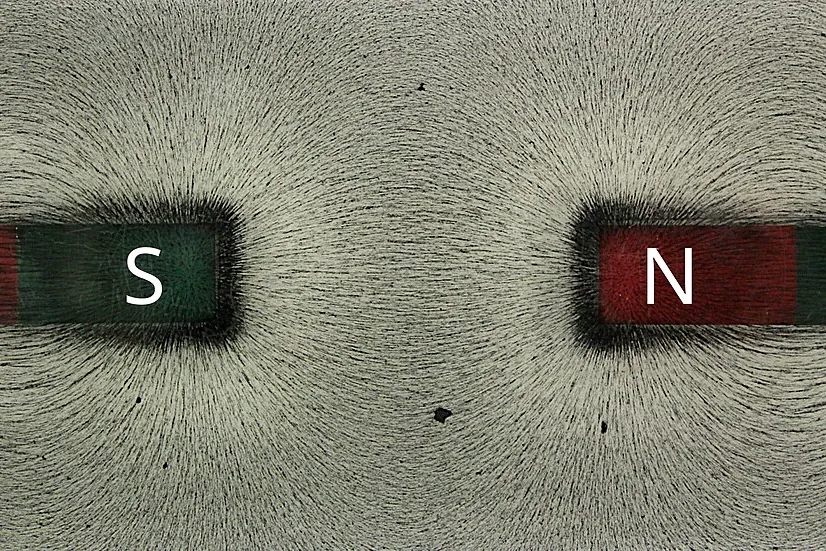
- Drag the compass slowly all the way around the magnet. Which way does the red end point near each pole?
- Sprinkle the iron filings. Where is the field strongest?
- Try two magnets with N facing S, then N facing N. Sketch both patterns. Find the spot between two north poles where the compass hardly knows which way to point.
The Earth is a giant magnet
The Earth has a magnetic field, made by electric currents in its liquid iron outer core. It stretches tens of thousands of kilometres into space, where it's called the magnetosphere.
- A compass is a small magnet that lines up with the Earth's field, so its north end points to the Earth's magnetic north pole. The first compasses, used in China more than 2000 years ago, were spoons carved from a naturally magnetic rock called lodestone. By about 1000 years ago, sailors were navigating with them.
- The magnetic north pole is not at the geographic North Pole, and it wanders. Since the 1990s it has moved from northern Canada towards Siberia, at times more than 50 km a year, so maps and phone compasses must be updated regularly.
- The magnetosphere shields us from the solar wind, a stream of charged particles from the Sun. Some of these particles are steered down near the poles, where they make the upper atmosphere glow: the aurora australis (southern lights) and the aurora borealis (northern lights).
- Every few hundred thousand years, the Earth's field flips, so north and south swap. The last flip was about 780 000 years ago. Scientists know this from the direction of magnetism frozen into ancient volcanic rocks.
Many animals use the Earth's field to find their way, including sea turtles, migrating birds and, it seems, Australia's Bogong moths, which fly up to 1000 km each spring from Queensland and New South Wales to caves in the Australian Alps, using the stars and possibly the magnetic field to steer.
Test yourself
Which of these is attracted to a magnet?
Steel contains iron.
Two south poles are pushed together. They will
Like poles repel.
The magnetic field around a bar magnet is strongest
Field lines bunch together there.
The Earth's magnetic field is made by
The moving molten iron acts like a giant electromagnet.
The aurora australis is caused by
The magnetosphere steers them towards the poles.
Label the magnetic field diagram.
Will a magnet pick it up?
The two ends of a magnet are called . Like poles and unlike poles . The shape of a magnetic field can be shown with iron . A needle lines up with the Earth's magnetic field.
You are given two identical-looking metal bars. One is a magnet and one is plain iron. Using only the two bars, describe how you could find out which one is the magnet. Explain your reasoning.
Hold one end of bar A against the middle of bar B. Then swap and hold one end of bar B against the middle of bar A. A magnet's force is strongest at its poles and very weak in its middle. If A is the magnet, its pole will strongly attract the middle of the iron bar B. But when the end of iron bar B touches the middle of magnet A, there will be little or no pull, because the magnet is weakest there. So the bar whose end pulls strongly on the other bar's middle is the magnet.