 Coaching Centre
Changes of state
Melting, freezing, evaporation, boiling, condensation and sublimation explained with particles, evaporation versus boiling, steam versus water vapour, latent heat and how to read a heating curve.
Put a pot of water on the stove with a thermometer in it. The temperature climbs steadily: 40 °C, 70 °C, 95 °C, 100 °C. Then, even though the burner is still on full, it stops. It sits at 100 °C for as long as there is water left to boil. Where is all that heat going?
The changes and their names
Any substance can change state if it is heated or cooled enough. Water does it at temperatures we live with, but iron becomes a liquid at about 1540 °C and nitrogen, a gas in the air you breathe, turns liquid at −196 °C. Each change has its own name.
| Change | From → to | Heat | Everyday example |
|---|---|---|---|
| Melting | solid → liquid | taken in | Ice cream dripping in the sun |
| Freezing (solidifying) | liquid → solid | given out | Making ice blocks |
| Evaporation | liquid → gas, at the surface, any temperature | taken in | A puddle drying up |
| Boiling | liquid → gas, all through the liquid, at the boiling point | taken in | A kettle boiling |
| Condensation | gas → liquid | given out | Drops on a cold can from the fridge |
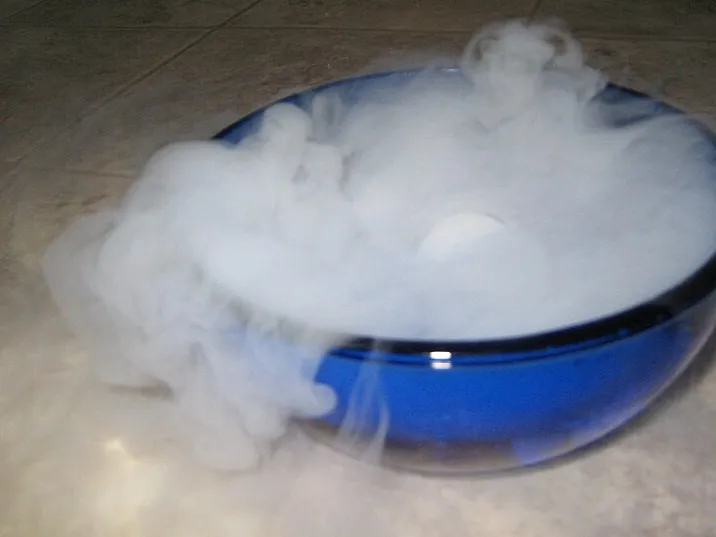
| Sublimation | solid → gas, skipping liquid | taken in | Dry ice "smoking"; mothballs shrinking in a wardrobe |
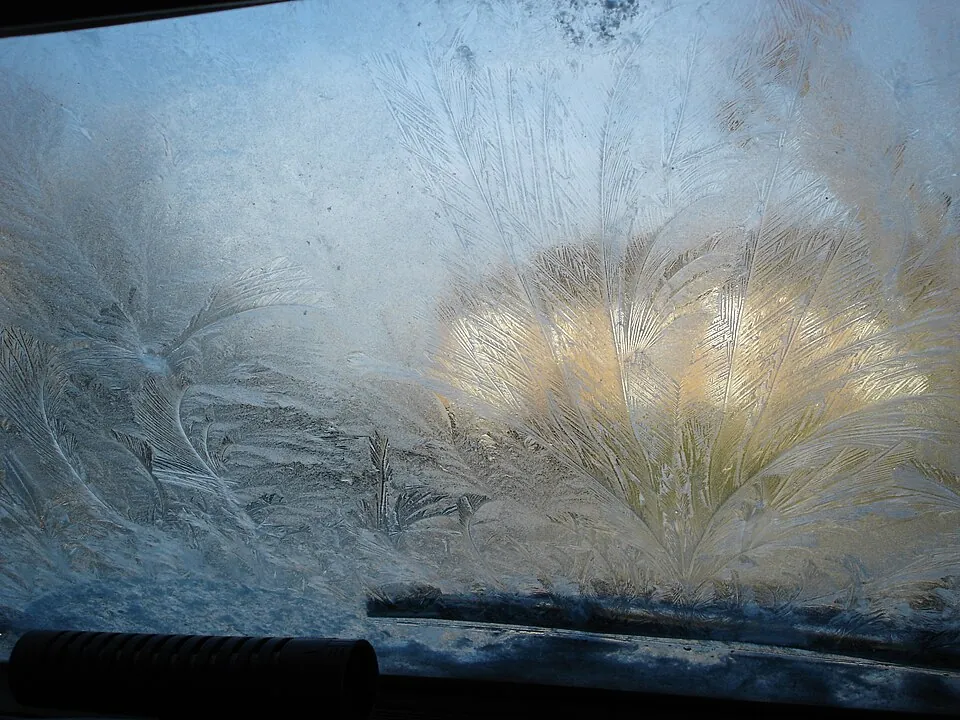
| Deposition | gas → solid, skipping liquid | given out | Frost forming on a car windscreen |
Evaporation and boiling are both types of vaporisation (liquid to gas).
What the particles are doing
Melting. As ice is heated, its particles vibrate harder and harder in their fixed positions. At the melting point they have enough energy to break free from the rigid pattern. They are still close together and still attracted to each other, but now they can slide past one another: the ice has become water.
Boiling. Keep heating and the water particles move faster still. At the boiling point, particles all through the liquid have enough energy to escape the attraction of their neighbours completely. Pockets of gas form inside the liquid and rise as bubbles.
Condensation and freezing are the same story in reverse. Cooling takes energy away, the particles slow down, and the forces of attraction pull them back together: first into a liquid, then locked into a solid.
Evaporation versus boiling
Wet clothes on a line dry at 20 °C, nowhere near 100 °C. How? The particles in a liquid don't all move at the same speed. A few at the surface are moving fast enough to break away into the air, even at room temperature. That is evaporation. It is slow, it happens only at the surface, and it happens at any temperature. Wind, warmth and spreading the liquid out thinly all speed it up.
Boiling is fast, happens throughout the liquid (that's what the bubbles are) and only happens at one temperature, the boiling point.
Steam is not what you think
Water vapour, the gas, is completely invisible. Just outside a kettle spout there is a small clear gap where you can't see anything. That's the hot vapour. As it moves into the cooler air it condenses into millions of tiny liquid droplets, and those are the white cloud we usually call "steam". Clouds and fog are the same thing: liquid droplets, not gas.
Latent heat and the heating curve
Now back to the pot stuck at 100 °C. While a substance is changing state, the heat being added doesn't make the particles move faster, so the temperature doesn't rise. Instead, the energy goes into pulling the particles apart from each other, breaking them out of the solid pattern or out of the liquid altogether. Because this heat seems to disappear without raising the temperature, it's called latent heat ("latent" means hidden).
If you heat ice at a steady rate and plot its temperature against time, you get a heating curve with two flat sections, one at each change of state.
- Start with ice at −20 °C and turn on the burner. Watch the particles and the graph together.
- Pause during a flat section. What state, or states, is the water in?
- Turn the burner up. Do the flat sections happen at a different temperature, or just for a shorter time?
- Switch to cooling mode and watch steam turn back into ice. Where are the flat sections now?
A pure substance is heated steadily. Its temperature rises from 20 °C to 80 °C, stays at 80 °C for 4 minutes, then rises again. What is happening at 80 °C?
Test yourself
Frost forming on a windscreen from water vapour in the air is an example of
Gas to solid, skipping the liquid: deposition.
Which is TRUE about evaporation?
Fast surface particles escape even at room temperature.
The white cloud above a boiling kettle is
Vapour is invisible; the cloud is vapour that has condensed.
On a heating curve, a flat section shows that
The temperature holds steady while energy separates the particles.
Which has more energy: liquid water at 100 °C or water vapour at 100 °C?
The vapour has also absorbed the latent heat needed to separate its particles.
Mothballs slowly disappear in a wardrobe without leaving any liquid. This is
Solid straight to gas. The gas then spreads by diffusion, which is why you can smell them.
Drag each name onto the right arrow.
Does each change take in heat or give it out?
When ice is heated, its particles faster until they break out of their fixed positions and the ice . During melting the temperature stays the , because the energy is used to separate the particles. This hidden energy is called heat. When water vapour touches a cold surface it turns back into a liquid. This is called .
Ice at −10 °C is heated steadily until it becomes water vapour at 110 °C. Describe the shape of the heating curve and explain it in terms of particles.
The temperature rises from −10 °C to 0 °C, stays flat at 0 °C, rises from 0 °C to 100 °C, stays flat at 100 °C, then rises again above 100 °C. In the rising sections the heat gives the particles more kinetic energy, so they move faster and the temperature increases. At 0 °C the ice is melting: the energy is used to break the particles out of their fixed positions, so the temperature doesn't change. At 100 °C the water is boiling: the energy is used to overcome the attraction between the particles so they can escape as a gas. This energy is latent heat.
Explain why a puddle dries up on a warm day even though the water never reaches 100 °C.
The water evaporates. The particles in the puddle are moving at different speeds, and some at the surface have enough energy to break away from the others and escape into the air as water vapour. This happens at any temperature, and faster on a warm day because more particles have enough energy. Over time all the water escapes and the puddle dries up.