 Coaching Centre
Fuels and combustion
Comparing fuels by energy per kilogram, energy per litre and carbon dioxide per megajoule, complete and incomplete combustion, carbon monoxide, soot, sulfur dioxide and nitrogen oxides, combustion and respiration as the same reaction at very different rates, and fuels for a low-carbon future.
A 50 litre tank of petrol holds about 1700 megajoules of chemical energy, enough to boil about 3000 full kettles. That energy is released one tiny squirt at a time, thousands of times a minute, in explosions inside the engine. Your body uses the same kind of reaction to keep you alive, but so gently you never notice.
What makes a good fuel?
A fuel is a substance that releases useful energy when it reacts, usually by burning in oxygen (combustion). Choosing a fuel is a trade-off between several things:
- Energy per kilogram matters when weight counts, as in aircraft and rockets.
- Energy per litre matters when space counts, as in a car's fuel tank.
- Carbon dioxide per megajoule tells you how much the fuel adds to climate change for each unit of energy you get.
- Other pollutants such as soot, carbon monoxide, sulfur dioxide and nitrogen oxides.
- Safety, storage, cost and supply. Is it a liquid, a gas that must be compressed, or a solid? Is it renewable?
Hydrogen releases the most energy per kilogram and makes only water, but it is a very low-density gas, so even squeezed to 700 times atmospheric pressure a litre holds only about a sixth of the energy of a litre of petrol. Methane (natural gas) releases the least CO₂ of the fossil fuels for the same energy, because each molecule has four hydrogens for every carbon, and making water releases a lot of energy without making CO₂. Coal is mostly carbon, so it is the worst. Wood and ethanol also release CO₂, but the carbon was taken out of the air by plants only recently.
Petrol releases about 34.2 MJ per litre; ethanol about 23.4 MJ per litre. E10 is up to 10% ethanol and 90% petrol.
0.9 × 34.2 + 0.1 × 23.4 = 30.8 + 2.3 = 33.1 MJ per litre.
33.1 ÷ 34.2 = 0.97, so a litre of E10 holds about 3% less energy. A car that uses 7.0 L of petrol per 100 km would use about 7.0 ÷ 0.97 = 7.2 L of E10.
E10 is usually a few cents a litre cheaper, so it costs about the same per kilometre. Its ethanol is made in Australia from waste wheat starch and sorghum, and the plants it came from absorbed CO₂ as they grew.
Complete and incomplete combustion
Petrol, diesel, natural gas and LPG are hydrocarbons: compounds of only hydrogen and carbon. With plenty of oxygen they burn completely, making only carbon dioxide and water:
2C₈H₁₈ + 25O₂ → 16CO₂ + 18H₂O (octane, in petrol)
When oxygen is short, combustion is incomplete. Some carbon ends up as carbon monoxide (CO) or as tiny particles of soot (carbon):
2CH₄ + 3O₂ → 2CO + 4H₂O CH₄ + O₂ → C + 2H₂O
Incomplete combustion wastes fuel, because less energy is released. It is also dangerous:
- Carbon monoxide is colourless and odourless. It binds to haemoglobin in red blood cells more than 200 times more strongly than oxygen, so the blood can't carry oxygen. Never run a generator, barbecue or unflued gas heater indoors or in a closed garage, and get gas heaters serviced. A CO alarm can save lives.
- Soot particles are small enough to get deep into the lungs and are linked to heart and lung disease. Diesel engines and wood heaters are major sources in Australian cities.
Fuels can also make other pollutants:
- Sulfur dioxide (SO₂) forms from sulfur impurities, especially in coal and some fuel oils. It dissolves in rain to make acid rain. Australia now limits the sulfur in petrol and diesel to 10 parts per million.
- Nitrogen oxides (NO and NO₂, "NOx") are not made from the fuel at all. At the very high temperatures inside an engine, nitrogen and oxygen from the air react (an endothermic reaction you met in 4A). NOx makes smog and acid rain.
- Choose octane with 100% of the air it needs. What are the products, and what colour is the flame?
- Turn the air down to 60%. Which new products appear, and what happens to the energy released?
- Switch the chart to energy per litre. Which fuel wins now, and where has hydrogen gone? Why?
- Switch to CO₂ per MJ. Rank the fossil fuels from least to most CO₂. Use the formulas to explain why methane is lowest.
- Pick a fuel for a passenger plane, a backyard barbecue and a city bus. Justify each choice using at least two of the charts.
Combustion and respiration
Cellular respiration in your cells has exactly the same overall equation as burning glucose:
C₆H₁₂O₆ + 6O₂ → 6CO₂ + 6H₂O ΔH = −2803 kJ per mole of glucose
Both are exothermic, and both release the same total energy, because the reactants and products are the same. The difference is the rate and how the energy is used:
| Combustion | Respiration | |
|---|---|---|
| Rate | Very fast: a teaspoon of sugar (about 4 g, 64 kJ) burns in a few seconds | Slow and steady: your resting body uses about 100 W, so the same 64 kJ lasts about 10 minutes |
| Temperature | Hundreds of degrees; needs a flame to start | Body temperature, 37 °C |
| How it is controlled | Uncontrolled once started; limited only by fuel and oxygen | About 20 steps, each controlled by an enzyme that lowers the activation energy |
| Where the energy goes | Heat and light | About a third is captured in ATP molecules that power the cell; the rest keeps you warm |
If your cells released all the energy of glucose at once, the heat would cook them. Releasing it in small steps lets the cell capture the energy in useful amounts, which is why living things rely on enzymes rather than flames.
Fuels for a low-carbon future
About three-quarters of the world's greenhouse gas emissions come from burning fuels for energy. Some of the alternatives:
- Biofuels such as ethanol and biodiesel are made from plants, so the CO₂ they release was recently absorbed. But growing crops for fuel uses farmland, water and fertiliser, and can push up food prices or lead to forests being cleared. Biofuels made from wastes (used cooking oil, crop residues, wheat starch left over from making flour) avoid most of these problems. Airlines are starting to use sustainable aviation fuel made this way, because batteries are too heavy for long flights.
- Hydrogen burns or reacts in a fuel cell to make only water. But almost all hydrogen today is made from natural gas, which releases CO₂. "Green" hydrogen is made by splitting water with electricity from solar and wind. It is expected to be most useful for heavy industry, such as making steel and fertiliser, rather than cars.
- Electricity from renewable sources can replace fuels in cars, buses and home heating. Electric vehicles carry the energy as chemical energy in a battery (4C) rather than in a fuel.
Test yourself
The products of the complete combustion of a hydrocarbon are
With enough oxygen, all the carbon becomes CO₂ and all the hydrogen becomes H₂O.
Carbon monoxide is dangerous because it
CO binds to haemoglobin far more strongly than oxygen. It has no smell, which makes it more dangerous.
Respiration and the combustion of glucose differ because respiration
Same equation and same total energy; respiration is slower and controlled.
Which fossil fuel releases the least CO₂ for each megajoule of energy?
Methane has the highest ratio of hydrogen to carbon.
Nitrogen oxides from car engines mainly come from
N₂ + O₂ → 2NO is endothermic and needs very high temperatures.
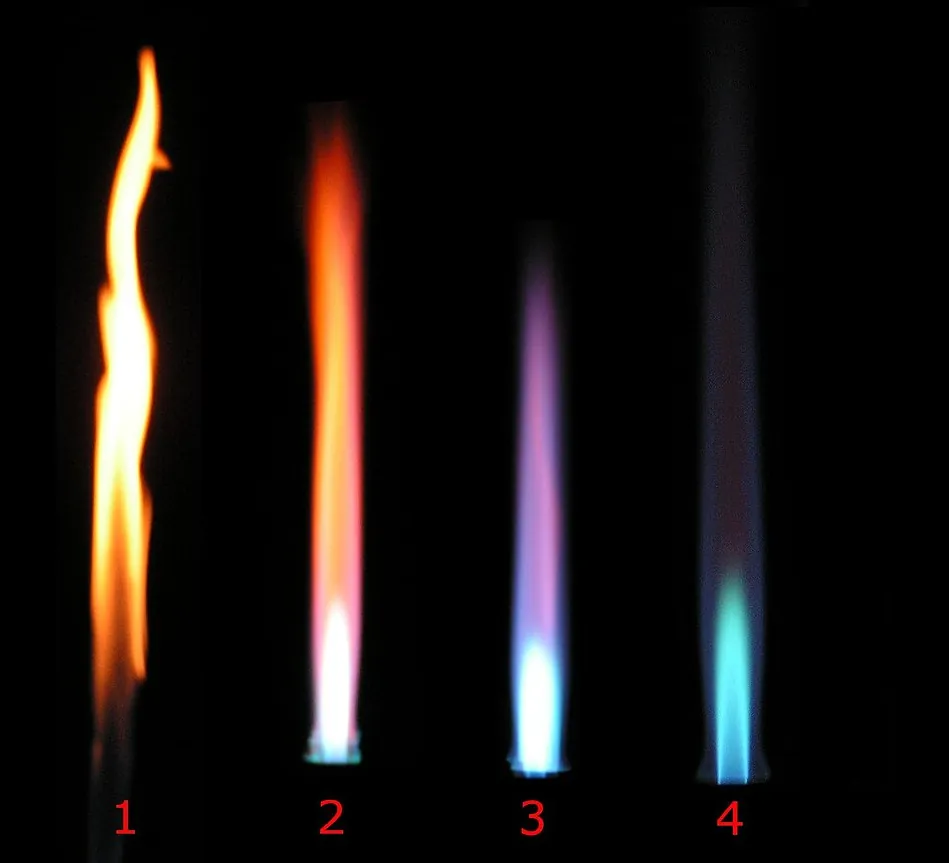
Label the two Bunsen flames.
Which kind of combustion does each describe?
Compounds of only hydrogen and carbon are called . When oxygen is limited, combustion is and forms carbon monoxide and soot. Sulfur impurities in coal produce sulfur , which causes acid rain. Respiration releases energy much more than combustion, and some of it is captured in molecules of .
A city council is choosing between diesel, compressed natural gas, green hydrogen and battery-electric buses. Evaluate at least two of these options, using data about energy and emissions, and recommend one.
Diesel stores the most energy per litre (about 39 MJ), so buses can travel far on one tank, but it releases about 70 g of CO₂ per MJ and its exhaust contains soot and NOx that harm city air. Compressed natural gas releases less CO₂ (about 50 g per MJ) and almost no soot, but it is still a fossil fuel, and its tanks are bulky because a gas holds less energy per litre. Green hydrogen releases only water at the tailpipe and its production uses renewable electricity, but it is expensive and needs high-pressure tanks because even at 700 atmospheres it holds only about a sixth of the energy of petrol per litre. Battery-electric buses have no exhaust at all, which most improves city air, and their emissions depend on the electricity used to charge them; as the grid adds more solar and wind, their emissions fall. They are heavier and take time to charge, but city routes are short and they can charge overnight at the depot. I recommend battery-electric buses because they remove pollution where people breathe it and become cleaner as the grid improves, while diesel and gas will always release CO₂.