 Coaching Centre
Speed and velocity
Average and instantaneous speed, converting between km/h and m/s, velocity as speed in a direction, average velocity from displacement, measuring motion with ticker timers, light gates and motion sensors, and analysing ticker tapes.
When Usain Bolt set the 100 m world record of 9.58 s in 2009, his average speed was just over 10 m/s. But for part of the race he was moving at more than 12 m/s, and for the first fraction of a second he was barely moving at all. "How fast?" has more than one answer.
Average speed
Speed is how fast distance is covered. The average speed over a journey is the total distance divided by the total time taken.
average speed = total distance ÷ total time
v = d ÷ t so d = v × t and t = d ÷ v
The SI unit of speed is metres per second (m/s). On the road we use kilometres per hour (km/h). Since 1 km/h = 1000 m ÷ 3600 s:
km/h ÷ 3.6 = m/s m/s × 3.6 = km/h
v = d ÷ t = 100 ÷ 9.58 = 10.4 m/s. In km/h: 10.4 × 3.6 = 37.6 km/h.
A bus travels 24 km to school at an average speed of 36 km/h. Time = d ÷ v = 24 ÷ 36 = 0.667 h = 40 minutes.
A car travels for 10 minutes at 60 km/h. 10 minutes = 1/6 h, so d = v × t = 60 × 1/6 = 10 km.
Instantaneous speed
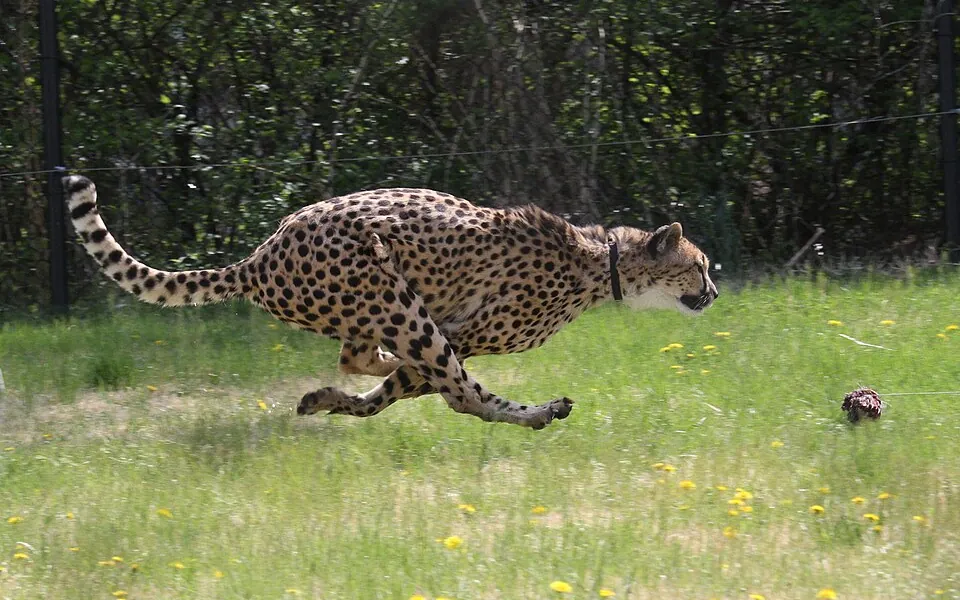
The instantaneous speed is the speed at one particular moment: the reading on a car's speedometer. Over a trip the instantaneous speed rises and falls, while the average speed is a single number for the whole trip. A bus that averages 36 km/h might reach 74 km/h on a clear stretch of highway and be stopped at the lights for a minute. Speed cameras measure instantaneous speed; point-to-point (average speed) cameras time a vehicle between two places and calculate its average speed.
Velocity
Velocity is speed in a particular direction, so it is a vector. Two cars driving at 60 km/h in opposite directions have the same speed but different velocities. A car going round a roundabout at a steady 30 km/h has a constant speed but a changing velocity, because its direction keeps changing.
average velocity = displacement ÷ time
A student walks 5 m north, 4 m west and 2 m south (from 5A) in 20 s. Find the average speed and average velocity.
Distance = 11 m, so average speed = 11 ÷ 20 = 0.55 m/s.
Displacement = 5 m on a bearing of 307°, so average velocity = 5 ÷ 20 = 0.25 m/s on a bearing of 307°.
A runner finishing one 400 m lap in 80 s has an average speed of 5 m/s but an average velocity of zero.
Measuring motion
A stopwatch is fine for long, slow journeys, but your reaction time (about 0.2 s) is a large error when an event lasts only a second or two. Better instruments include:
- a ticker timer, which marks dots on a paper tape at regular time intervals
- light gates, which time an object as it breaks a light beam, to a thousandth of a second
- a motion sensor, which sends out ultrasound pulses and times the echoes to measure position many times a second, plotting graphs live
- video analysis: film the motion beside a ruler and step through the frames (most phones film at 30 or 60 frames per second, or 240 in slow motion).
Because the dots are made at equal time intervals, the gaps between them show the motion: equal gaps mean constant speed, growing gaps mean speeding up, and shrinking gaps mean slowing down. Five gaps take 5 × 0.02 = 0.1 s, so tapes are usually cut into 5-gap strips.
- Choose Steady 0.5 m/s and pull the tape. How long is each 0.1 s strip? Check: 0.5 m/s × 0.1 s = 0.05 m = 5 cm.
- Repeat with Steady 1.5 m/s. How do the dots and strips compare?
- Choose Speeding up. Turn on Cut into 0.1 s strips. The strips are 1, 3, 5, 7, 9 and 11 cm long. Find the speed of each strip and the acceleration.
- Choose Slowing down. Why does the sim give a negative acceleration?
Test yourself
A cyclist rides 18 km in 45 minutes. The average speed is
45 min = 0.75 h, so 18 ÷ 0.75 = 24 km/h.
A speed of 90 km/h is the same as
90 ÷ 3.6 = 25 m/s.
Which describes velocity rather than speed?
Velocity must include a direction.
On a ticker tape from a 50 Hz timer, a strip of 5 gaps is 8 cm long. The average speed for that strip is
5 gaps = 0.1 s; 0.08 m ÷ 0.1 s = 0.8 m/s.
The dots on a ticker tape get closer together along the tape (in the order they were printed). The object was
Each gap takes the same time, so smaller gaps mean less distance per 0.02 s.
Label the ticker timer.
Order these from slowest to fastest.
Average speed equals total divided by total time. To change km/h into m/s, divide by . Velocity is speed in a given . A 50 Hz ticker timer prints a dot every .
A school bus leaves at 7:35 a.m. and travels 24 km to school at an average speed of 36 km/h. On one stretch its speedometer reads 74 km/h. (a) At what time does it arrive? (b) Explain the difference between the bus's average speed and its instantaneous speed, using the data. (c) In the afternoon the bus returns to exactly where it started. State its displacement for the whole day.
(a) Time = distance ÷ speed = 24 ÷ 36 = 0.667 h = 40 minutes, so the bus arrives at 8:15 a.m. (b) The average speed of 36 km/h is the total distance divided by the total time for the whole trip. The instantaneous speed is the speed at one particular moment, shown on the speedometer. The bus reached 74 km/h on the clear stretch, so to average only 36 km/h it must have travelled much more slowly, or been stopped at lights and bus stops, for other parts of the trip. (c) The displacement for the whole day is zero, because the bus finishes at exactly the place it started, even though it has travelled a long distance.