 Coaching Centre
Catalysts in industry
How catalysts work on surfaces, catalytic converters in cars, the Haber process for ammonia and the compromise between yield, rate and cost, enzymes as industrial catalysts, and how chlorine from CFCs catalysed the destruction of the ozone layer.
Thieves in Australia saw catalytic converters off the bottom of parked cars. They aren't after the steel. Each converter holds a few grams of platinum, palladium and rhodium, metals that can be worth more than gold. Those few grams clean the exhaust of a car for its whole life without being used up, because they are catalysts.
How catalysts work
A catalyst speeds up a reaction without being used up. It provides a different reaction pathway with a lower activation energy (4A), so a much larger fraction of collisions succeed (4D). Because it is not used up, a small amount can make a huge amount of product.
- Surface catalysts (heterogeneous catalysts) are usually solid metals or metal oxides. Gas or liquid molecules stick to the surface, their bonds are weakened, they react with molecules next to them, and the products leave, freeing the surface for the next molecules. Catalysts are often spread as a thin coating or tiny particles to give the biggest surface area.
- Enzymes are biological catalysts made of protein. Each has an active site that fits particular reactant molecules.
You can see a catalyst at work by adding a pinch of black manganese dioxide, or a piece of raw liver (which contains the enzyme catalase), to hydrogen peroxide. Oxygen fizzes out rapidly: 2H₂O₂ → 2H₂O + O₂. The manganese dioxide can be filtered out, dried and weighed afterwards: its mass hasn't changed.
Catalytic converters
Every new petrol car sold in Australia since 1986 has a catalytic converter. Inside is a ceramic honeycomb with thousands of tiny channels, coated with a rough, porous layer holding tiny particles of metal catalyst. The total surface area inside is bigger than a football field. A three-way converter removes three pollutants:
- carbon monoxide is oxidised to carbon dioxide: 2CO + O₂ → 2CO₂
- unburnt hydrocarbons are oxidised to carbon dioxide and water
- nitrogen oxides are reduced to nitrogen: 2NO + 2CO → N₂ + 2CO₂
The converter only works once it is hot (above about 250 °C), so most pollution from a car comes in the first minute or two after a cold start. Lead coats and "poisons" the catalyst, which is one reason leaded petrol had to go (4B). Older textbooks call the exhaust from a converter "clean", but it still contains carbon dioxide, the main greenhouse gas: a converter reduces air pollution, not climate change.
The Haber process: feeding the world
Plants need nitrogen to make proteins, and nitrogen is often what limits how well crops grow. Air is 78% nitrogen, but N₂ molecules are held by a very strong triple bond (945 kJ/mol), so plants can't use it. In 1909 the German chemist Fritz Haber found how to combine nitrogen with hydrogen to make ammonia, and the engineer Carl Bosch scaled it up to industrial size:
N₂ + 3H₂ ⇌ 2NH₃ ΔH = −92 kJ
The ⇌ sign means the reaction is reversible: ammonia also breaks back down into nitrogen and hydrogen. In a closed reactor the forward and backward reactions eventually go at the same rate and the mixture stops changing; this is called equilibrium. The percentage of ammonia in the mixture at equilibrium is the yield.
Choosing the conditions is a classic chemical engineering compromise:
| Condition | Effect on yield | Effect on rate | Choice |
|---|---|---|---|
| Temperature | The forward reaction is exothermic, so lower temperatures give a higher yield | Lower temperatures make it far too slow | A compromise: 400–450 °C |
| Pressure | Four gas molecules become two, so higher pressure gives a higher yield | Higher pressure also increases the rate | About 150–250 atmospheres; higher costs too much in energy and thick-walled equipment |
| Catalyst | No effect on yield | Much faster | Iron, with small amounts of other oxides to make it more active |
| Removing ammonia | Ammonia is condensed to a liquid; unreacted N₂ and H₂ are recycled | Only about 15% reacts in one pass, but nearly all of it ends up as ammonia eventually | |
- Set 300 °C and 200 atm with the catalyst on. What is the equilibrium yield? How much ammonia do you actually make per pass, and why so little?
- Raise the temperature to 450 °C. The equilibrium yield falls, so why does the daily production go up?
- Find the temperature that gives the most ammonia per day at 200 atm.
- Turn the catalyst off. What happens to production at 450 °C?
- Raise the pressure to 300 atm. Production rises, but what happens to the compressor energy and the equipment cost? Why don't real plants run at 1000 atm?
About 80% of ammonia is used to make fertilisers such as urea and ammonium nitrate. Without Haber–Bosch fertiliser, the world could feed only about half of today's population. But the process uses 1–2% of all the world's energy, and the hydrogen is usually made from natural gas, which releases more CO₂ than any other chemical process. Australia's largest ammonia plants include Orica's at Kooragang Island in Newcastle, which makes ammonium nitrate for fertilisers and for mining explosives. Several Australian projects plan to make "green ammonia" using hydrogen from water split with solar and wind electricity.
Haber's legacy is mixed. He won the 1918 Nobel Prize in Chemistry, but during World War I he also led Germany's poison gas program, opposed by his wife Clara Immerwahr, the first woman to earn a chemistry PhD at the University of Breslau. Ammonia from his process was also used to make explosives. His life is often used to ask what responsibility scientists have for how their discoveries are used.
Enzymes at work
Enzymes work at mild temperatures and are very specific, so they save energy and make few unwanted by-products. Industries use them in:
- laundry detergents: proteases, lipases and amylases break down protein, fat and starch stains in cold water, saving the energy needed to heat it;
- food: lactase makes lactose-free milk, and chymosin, now made by genetically modified microbes, curdles milk for cheese;
- fuels and fibres: cellulases break down plant waste to sugars that can be fermented to ethanol, and other enzymes soften denim or bleach paper with fewer harsh chemicals.
When a catalyst does harm: the ozone layer
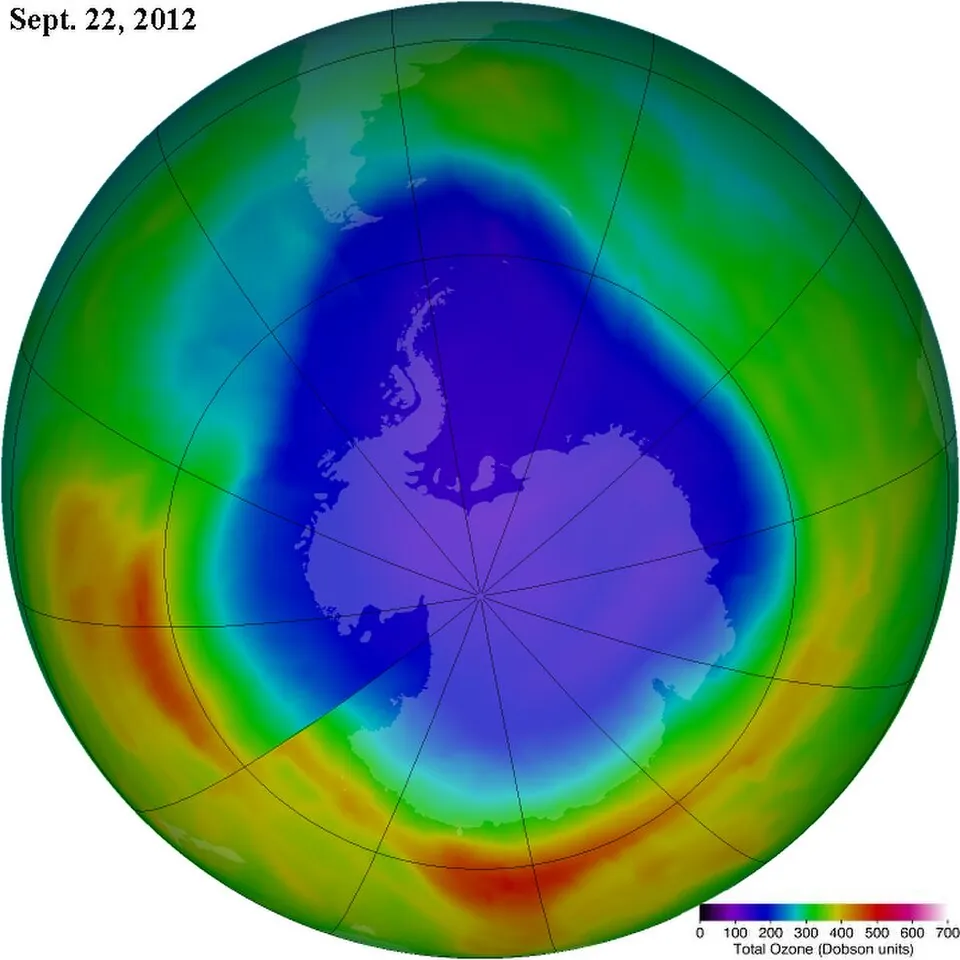
Chlorofluorocarbons (CFCs) were once used in fridges, air conditioners and spray cans because they are unreactive and non-toxic. In the 1970s chemists Mario Molina and Sherwood Rowland showed that in the stratosphere, UV light breaks CFCs apart and releases chlorine atoms. Chlorine catalyses the breakdown of ozone (O₃), which shields Earth from harmful UV radiation. Because the chlorine atom is regenerated, one atom can destroy thousands of ozone molecules.
In 1985 British scientists reported a huge seasonal "hole" in the ozone over Antarctica. Australian scientists at CSIRO and the Bureau of Meteorology helped measure it, and it matters here because of our very high rates of skin cancer. The Montreal Protocol of 1987 phased out CFCs, and every country in the world has signed it. The ozone layer is now recovering: the Antarctic ozone hole is expected to close by about the 2060s. The replacements, HFCs, don't harm ozone but are powerful greenhouse gases, so in 2016 countries agreed to phase them down too.
Test yourself
A catalyst speeds up a reaction by
More collisions then have enough energy to react.
Which pollutant is reduced in a catalytic converter?
NOx loses its oxygen to become N₂; CO and hydrocarbons are oxidised.
The Haber process uses about 450 °C rather than 200 °C because
Yield is higher at low temperature, but the rate matters more for production.
In the Haber process, unreacted nitrogen and hydrogen are
Recycling means nearly all the reactants eventually become ammonia.
Chlorine atoms destroy so much ozone because
Cl + O₃ → ClO + O₂, then ClO + O → Cl + O₂ frees the Cl atom again.
Label the catalytic converter.
Put the steps of the Haber process in order.
Biological catalysts are called . Surface catalysts are spread thinly to give a large surface . The Haber process makes , mainly for fertilisers. Its reaction is , shown by the ⇌ sign. The 1987 agreement to phase out CFCs is called the Montreal .
The forward reaction in the Haber process, N₂ + 3H₂ ⇌ 2NH₃, is exothermic. Explain why ammonia plants use a temperature of about 450 °C, a pressure of about 200 atmospheres and an iron catalyst, even though these conditions give an equilibrium yield of only about 25%.
Because the forward reaction is exothermic, a low temperature would give a higher equilibrium yield, but at low temperatures very few collisions have enough energy to react, so the reaction would take far too long to reach equilibrium. About 450 °C is a compromise: the yield is lower, but the rate is fast enough to make much more ammonia per day. High pressure pushes the equilibrium towards ammonia because four gas molecules become two, and it also increases the rate by crowding the molecules together. But each extra atmosphere costs energy for compressors and needs thicker, more expensive and more dangerous equipment, so about 200 atmospheres is chosen. The iron catalyst lowers the activation energy, so the reaction is fast enough at a lower temperature than would otherwise be needed; it doesn't change the yield. Finally, the ammonia is removed by condensing it and the unreacted nitrogen and hydrogen are recycled, so even though only about 15% reacts in each pass, almost all of the reactants end up as ammonia. The conditions give the most ammonia per day for the least cost.