 Coaching Centre
Are we alone?
How astronomers find planets around other stars using transits, wobbles and microlensing, what makes a planet habitable, the search for life in the Solar System and in exoplanet atmospheres, SETI, and where humans fit on the cosmic calendar.
When this textbook was first printed, astronomers knew of about a thousand planets around other stars. By September 2025 there were more than 6000 confirmed, and statistics from the Kepler mission suggest that most stars in the Milky Way have planets. That makes hundreds of billions of planets in our galaxy alone. Whether any of them has life is one of the oldest questions people have asked, and for the first time we have tools that might answer it.
Finding exoplanets
A planet orbiting another star is an exoplanet. Exoplanets are very hard to see directly, because they are tiny, faint and lost in the glare of their star, like spotting a firefly next to a lighthouse from thousands of kilometres away. So most are found indirectly, by their effect on the star.
The first exoplanets were found in 1992, orbiting a pulsar. In 1995 Michel Mayor and Didier Queloz discovered 51 Pegasi b, the first planet around a Sun-like star, and shared the 2019 Nobel Prize in Physics. It was a surprise: a planet half the mass of Jupiter orbiting so close to its star that its year lasts just 4.2 days. Planets like this, called "hot Jupiters", have no equivalent in our Solar System.
The transit method
If a planet's orbit is lined up edge-on to us, the planet passes in front of its star once each orbit and blocks a little of its light. A graph of the star's brightness over time (a light curve) shows regular dips.
- The depth of the dip tells you the planet's size: the fraction of light blocked = (planet radius ÷ star radius)².
- The time between dips is the planet's orbital period, its year. Using Kepler's third law, the period and the star's mass give the orbit's size.
NASA's Kepler space telescope (2009–2018) watched about 150 000 stars continuously and found more than 2600 planets this way. The TESS mission (since 2018) surveys almost the whole sky, looking for planets around nearby bright stars.
A Sun-like star dims by 1.0% every 3.5 days. The star's radius is 696 000 km. How big is the planet?
(Rp ÷ Rs)² = 0.010, so Rp ÷ Rs = √0.010 = 0.10
Rp = 0.10 × 696 000 ≈ 70 000 km, about the size of Jupiter (71 500 km). With a 3.5-day orbit, it is a hot Jupiter.
- Start with an Earth-sized planet around the Sun-like star with a 365-day orbit. How deep is the dip? Would it be easy to detect?
- Increase the planet radius to Jupiter's (about 11.2 Earths). How deep is the dip now?
- Switch to the red dwarf with an Earth-sized planet. Why is the dip much deeper around the small star?
- Around the red dwarf, change the orbital period until the planet is in the habitable zone. Why is the habitable zone so much closer to a red dwarf than to the Sun?
- Press Mystery planet. Use the dip depth and the time between dips to work out the planet's size and orbit, then press Reveal to check. Could it be habitable?
The wobble method
A planet and its star both orbit their shared centre of mass, so the star wobbles slightly. When it moves towards us its light is blueshifted, and when it moves away, redshifted (the same Doppler effect used in 6F). Measuring these tiny shifts is called the radial velocity method, and it gives the planet's minimum mass. Jupiter makes the Sun wobble at about 12.5 m/s; the Earth, only about 9 cm/s, slower than a walking pace.
Combining both methods gives the planet's size and its mass, and so its density, which tells us whether it is rocky like Earth or gassy like Neptune.
Gravitational microlensing
When a star passes almost exactly in front of a more distant star, its gravity acts like a lens and briefly magnifies the background star. A planet around the nearer star causes an extra short spike. Australian astronomer Penny Sackett, later Australia's Chief Scientist, led an international team that used telescopes around the world, including in Australia, to watch microlensing events around the clock. The method can find planets thousands of light years away, including ones far from their stars and even "rogue" planets with no star at all.
What makes a planet habitable?
Life as we know it needs liquid water, a source of energy and the right chemical elements. About 96% of the mass of living things is made of just four elements, carbon, hydrogen, oxygen and nitrogen, with phosphorus and sulfur also essential (often remembered as CHNOPS).
The habitable zone (sometimes called the Goldilocks zone) is the range of distances from a star where a planet with an atmosphere like Earth's could have liquid water on its surface. Too close, and water boils away; too far, and it freezes. For a dim red dwarf the zone is tiny and very close to the star; for a hot, bright star it is wide and far out.
Being in the habitable zone isn't enough. Venus is near its inner edge, but a runaway greenhouse effect has made its surface 465 °C. Mars is inside it, but it lost its magnetic field and most of its atmosphere, so liquid water can't last on its surface today. A planet also needs the right mass to hold an atmosphere, and a star that is stable for billions of years.
Red dwarfs are the most common stars, and many have rocky planets in their habitable zones. The nearest exoplanet, Proxima Centauri b (found in 2016), is just 4.2 light years away and in its star's habitable zone. The TRAPPIST-1 system, 40 light years away, has seven Earth-sized planets, three or four in the habitable zone. But red dwarfs often blast their planets with flares, and JWST measurements in 2023 showed the innermost TRAPPIST-1 planets have little or no thick atmosphere. Whether any red-dwarf planet can keep one is a key open question.
Searching for life
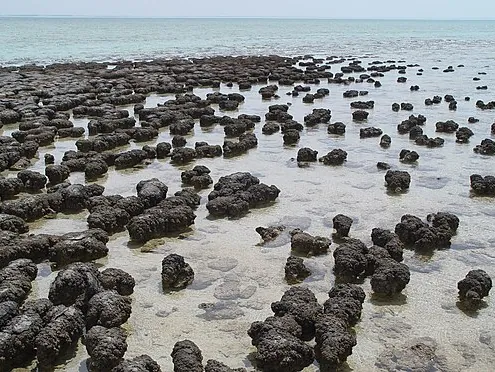
Earth's own record helps: some of the oldest evidence of life on Earth is in 3.5-billion-year-old fossil stromatolites (layered mounds built by microbes) in the Pilbara region of Western Australia. Living stromatolites still grow at Shark Bay. Places like the Pilbara are used to test the instruments and methods used to search for life on Mars.
- Mars. Rovers have shown Mars once had lakes and rivers. In 2024 Perseverance found rock in Jezero Crater with tiny "leopard spot" patterns that, on Earth, are often made by microbes. They aren't proof of life, because chemistry alone might make them, so scientists want the samples brought back to Earth for testing.
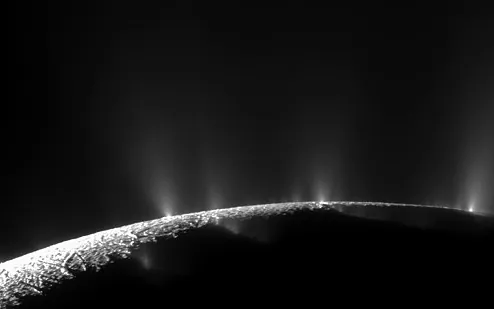
- Europa and Enceladus. These icy moons of Jupiter and Saturn have salty liquid-water oceans under their ice. Cassini flew through jets of water from Enceladus and found salts, organic molecules and phosphorus. NASA's Europa Clipper launched in October 2024 and will reach Jupiter in 2030 to study whether Europa could support life.
- Exoplanet atmospheres. When a planet transits, a little starlight passes through its atmosphere, and the gases absorb certain wavelengths. JWST can read these absorption lines. A biosignature is a gas, such as oxygen with methane, that is hard to explain without life. In 2023 JWST found methane and carbon dioxide on the planet K2-18b, and in 2025 one team claimed a gas that on Earth is only made by life. Other scientists reanalysed the data and found the signal was weak and could be explained in other ways. This is a good example of how science treats an extraordinary claim: it needs extraordinary evidence, checked by independent teams.
- SETI (the Search for Extraterrestrial Intelligence) looks for signals that only technology could make. The Breakthrough Listen project uses Murriyang at Parkes among others. In 2020 it found a candidate signal, BLC1, that seemed to come from the direction of Proxima Centauri. Careful checks showed it was interference from equipment on Earth.
So far there is no confirmed evidence of life beyond Earth. But as the saying goes, absence of evidence is not evidence of absence: we have barely begun to look.
Where we fit in: the cosmic calendar
Imagine squeezing the whole 13.8-billion-year history of the universe into one calendar year, so that each day is about 38 million years and each second is about 440 years.
| Event | Real time ago | Cosmic calendar date |
|---|---|---|
| Big Bang | 13.8 billion years | 1 January, 12:00 am |
| Milky Way begins to form | about 13.5 billion years | early January |
| Sun and Earth form | 4.6 billion years | about 1 September |
| Earliest life on Earth | about 3.8 billion years | about 21 September |
| Dinosaurs die out | 66 million years | 30 December |
| Modern humans appear | about 300 000 years | 31 December, about 11:49 pm |
| Aboriginal people living in Australia | at least 65 000 years | 31 December, about 11:57:30 pm |
| All of written history | about 5000 years | the last 11 seconds |
Modern humans have existed for only about 0.002% of the age of the universe. Yet in that short time, and mostly in the last century, we have worked out how old the universe is, what stars are made of, and where the atoms in our bodies came from.
Test yourself
The depth of a transit dip tells astronomers the planet's
Fraction blocked = (Rp/Rs)².
The radial velocity method detects planets by measuring
The star moves towards and away from us.
The habitable zone around a red dwarf is closer to the star than the Sun's because
A planet must be closer to receive enough energy for liquid water.
Which pair of gases found together in a planet's atmosphere would be the strongest biosignature?
They react with each other, so both must be constantly replaced, which life does on Earth.
A star dims by 0.25% during each transit. The planet's radius compared with the star's is
√0.0025 = 0.05 = 5%.
Label the transit diagram and light curve.
Which method does each statement describe?
Put these events in cosmic calendar order, from earliest to latest.
A planet orbiting another star is called an . In the method, the planet blocks some starlight and the depth of the dip gives the planet's . In the radial velocity method, the star's shifts its spectral lines. The range of distances where liquid could exist on a planet's surface is called the .
In 2025 a research team reported a gas in the atmosphere of exoplanet K2-18b that on Earth is only produced by living things. Evaluate whether this claim is evidence of life, and describe how the scientific community should test it.
When K2-18b passes in front of its star, some starlight passes through the planet's atmosphere, and gases absorb particular wavelengths. JWST measures the spectrum of this light, so the missing wavelengths show which gases are present. A biosignature is a gas that is hard to explain without life, so finding one would be very important. However, a single detection is weak evidence for several reasons. The signal is very small compared with the noise, so the result depends on how the data are processed and on statistics. We know little about the conditions on K2-18b, which is much bigger than Earth and may not even have a surface ocean, so there may be non-living chemical processes that make the gas there. When other teams independently reanalysed the same data, they found the signal was weaker and could be explained by other gases. The claim should therefore be tested by publishing the methods so others can check them, peer review, independent reanalysis, more observations with JWST at different wavelengths, and looking for several gases together that make a stronger case. My judgement is that this is an interesting result but not yet evidence of life: extraordinary claims need extraordinary, repeated evidence.