 Coaching Centre
Displacement and decomposition
The activity series of metals, metal displacement reactions and electron transfer, how reactivity decides how metals are extracted from ores, thermal, electrical and light-driven decomposition, and a summary of reaction types.
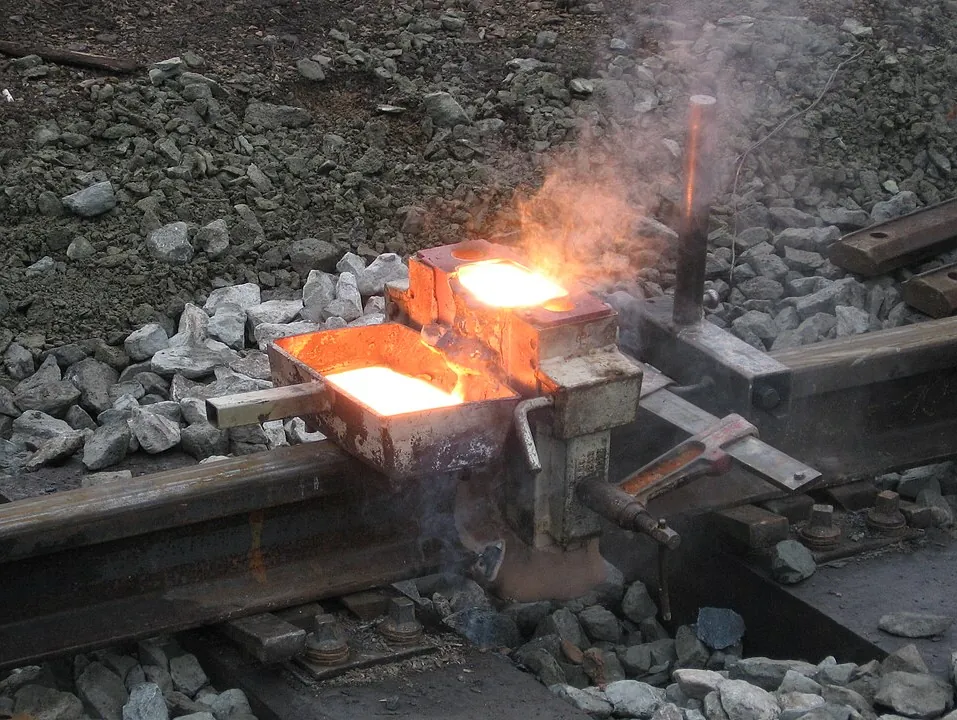
To join two lengths of railway track, workers clamp a mould around the gap, fill a crucible above it with powdered aluminium and iron oxide, and light it. Within seconds the mixture reaches about 2500 °C and white-hot molten iron pours into the gap, welding the rails together. This is the thermite reaction: aluminium is more reactive than iron, so it snatches the oxygen away. 2Al + Fe₂O₃ → Al₂O₃ + 2Fe.
The activity series
In Year 9 you saw that some metals react violently with water while others barely react with acid. Arranging metals in order of how readily they react gives the activity series (or reactivity series). More reactive metals lose their outer electrons more easily to form positive ions.
Hydrogen is included in the series even though it is not a metal. Metals above hydrogen can push hydrogen out of dilute acids, which is why they fizz in acid; metals below it, such as copper, silver and gold, can't.
Displacement reactions
A more reactive metal will displace a less reactive metal from a solution of its compound. Put a strip of zinc into blue copper(II) sulfate solution and it soon turns brown with a coating of copper, while the blue colour fades and the solution warms up:
Zn(s) + CuSO₄(aq) → ZnSO₄(aq) + Cu(s)
The sulfate ions are spectators, so the ionic equation shows what is really happening: each zinc atom gives two electrons to a copper(II) ion.
Zn(s) + Cu²⁺(aq) → Zn²⁺(aq) + Cu(s)
A displacement reaction is a single displacement: one element takes the place of another in a compound (A + BC → AC + B). If the metal is less reactive than the metal in the solution, nothing happens. Copper in zinc sulfate stays shiny forever. That gives a simple way to work out the order of the series: test each metal with solutions of the others and see which reactions go.
The further apart two metals are in the series, the more energy the reaction releases. Thermite works because aluminium is far above iron. Displacement reactions between non-metals follow the same idea: chlorine displaces bromine and iodine from their salts, because chlorine is the most reactive of the three halogens.
- Dip zinc into each of the other solutions. Which metal ions can zinc displace, and which can't it?
- Fill in the whole table. How many of the 20 pairs react? Use your results to put the five metals in order.
- Which pair gives the biggest temperature rise?
- Copper in silver nitrate: describe what forms on the strip and what happens to the colour of the solution.
Getting metals out of their ores
Only the least reactive metals, such as gold and some silver and copper, are found as the pure metal (native). Most metals are found as compounds in ores, usually oxides, sulfides or carbonates, and the metal must be extracted. Reactivity decides how:
- Metals below carbon (zinc, iron, tin, lead, copper) can be extracted by heating the ore with carbon, which takes the oxygen away. Iron is made this way in a blast furnace (3G). Sulfide ores such as copper sulfide are first roasted in air, a reaction with oxygen that releases sulfur dioxide.
- Metals above carbon (aluminium, magnesium, sodium, potassium) hold on to their non-metal too strongly. They are extracted by electrolysis of the molten compound, which uses a great deal of electricity. Australia is one of the world's largest producers of bauxite, the ore of aluminium, and refines it into alumina (aluminium oxide) for smelters.
The most reactive metals were discovered last, because they were the hardest to extract. Copper, gold and iron have been used for thousands of years, but aluminium only became cheap after 1886, once electricity could be generated in bulk.
Decomposition reactions
In a decomposition reaction, one compound breaks down into two or more simpler substances (AB → A + B). It is the reverse of a synthesis (combination) reaction. Decomposition needs energy, which can come from heat, electricity or light.
- Thermal decomposition (heat): green copper carbonate turns into black copper oxide, giving off carbon dioxide. Heating limestone in a kiln makes lime for cement and mortar: CaCO₃ → CaO + CO₂. (4A looks at the energy this takes and the carbon dioxide it releases.)
- Electrolysis (electricity): passing a current through water (with a little dissolved salt to help it conduct) splits it into hydrogen and oxygen. Aluminium oxide is decomposed by electrolysis to make aluminium.
- Photodecomposition (light): hydrogen peroxide slowly breaks down into water and oxygen in light, which is why it is sold in brown bottles. Silver bromide in old photographic film darkens because light decomposes it into silver.
Types of reactions
| Type | Pattern | Example |
|---|---|---|
| Synthesis (combination) | A + B → AB | 2Mg + O₂ → 2MgO |
| Decomposition | AB → A + B | 2H₂O → 2H₂ + O₂ |
| Combustion | fuel + O₂ → oxides | CH₄ + 2O₂ → CO₂ + 2H₂O |
| Single displacement | A + BC → AC + B | Fe + CuSO₄ → FeSO₄ + Cu |
| Precipitation (double displacement) | AB + CD → AD + CB (one product insoluble) | Pb(NO₃)₂ + 2KI → PbI₂ + 2KNO₃ |
| Neutralisation (acid–base) | acid + base → salt + water | HCl + NaOH → NaCl + H₂O |
Some reactions fit more than one type: burning magnesium is both a synthesis and a combustion, and a metal reacting with acid is a single displacement of hydrogen.
Test yourself
Which mixture will react?
Magnesium is above iron, so it displaces it.
In Fe(s) + Cu²⁺(aq) → Fe²⁺(aq) + Cu(s), the iron atoms
Fe becomes Fe²⁺ by losing electrons to Cu²⁺.
Aluminium is extracted by electrolysis rather than by heating with carbon because
Carbon can't take the oxygen from aluminium oxide.
CaCO₃ → CaO + CO₂ is an example of
One compound breaks down when heated.
Electrolysis of water collects 30 mL of hydrogen. How much oxygen collects at the same time?
2H₂O → 2H₂ + O₂: half as much oxygen.
Label the electrolysis of water.
Classify each reaction.
A list of metals in order of reactivity is called the series. A more reactive metal will a less reactive metal from its compounds. Iron is extracted by heating its ore with , but aluminium needs . Breaking one compound into simpler substances is called .
A student places strips of three unknown metals, X, Y and Z, into solutions of each other's nitrates. X reacts with the nitrates of Y and Z. Y reacts with the nitrate of Z only. Z reacts with neither. (a) Put the metals in order of reactivity. (b) Explain what happens at the particle level when X is placed in a solution containing Y²⁺ ions. (c) Predict which metal would be easiest to find as the native metal, and justify your answer.
(a) X is the most reactive because it displaces both other metals, Y is in the middle because it displaces only Z, and Z is the least reactive: X > Y > Z. (b) When X is placed in a solution of Y²⁺ ions, X atoms on the surface of the strip each lose electrons and become X ions that dissolve. The Y²⁺ ions gain those electrons and become Y atoms, which build up as a coating of Y metal on the strip. If X also forms 2+ ions, the ionic equation is X(s) + Y²⁺(aq) → X²⁺(aq) + Y(s). The nitrate ions are spectators. (c) Z is the most likely to be found native, because as the least reactive metal it has the least tendency to lose electrons and combine with other elements, so it is most likely to survive in the ground as the uncombined metal, as gold does.