 Coaching Centre
Structure and scale of the universe
The main structures in the universe, from stars, planets and nebulae to galaxies, clusters, superclusters and the cosmic web; the Milky Way; astronomical units, light years and parsecs; scientific notation; and why looking out into space means looking back in time.
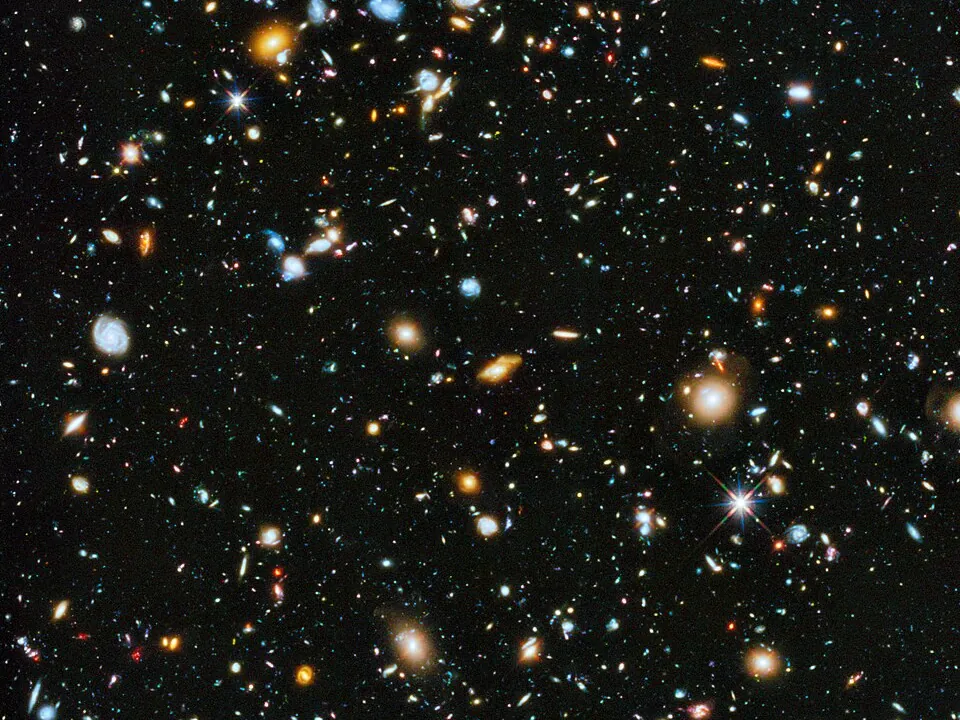
In July 2022 the James Webb Space Telescope released its first deep image. It covers a patch of sky about the size of a grain of sand held at arm's length, and it contains thousands of galaxies, each made of billions of stars. Point the telescope at any other grain-sized patch of dark sky and you'd find the same. The universe is far bigger and more crowded than anyone a century ago imagined.
What is in the universe?
The universe is everything that exists: all matter and energy, and space and time themselves. Gravity organises the matter in it into a hierarchy of structures, each one sitting inside the next.
| Structure | What it is | Typical size |
|---|---|---|
| Planet | An object that orbits a star, is massive enough for its gravity to pull it into a round shape, and has cleared other objects from around its orbit. Objects that fail the last test, such as Pluto and Ceres, are dwarf planets. | Earth: 12 742 km across |
| Star | A huge ball of hot plasma held together by its own gravity, giving out energy from nuclear fusion in its core. Stars are mostly hydrogen and helium. | Sun: 1.39 million km across |
| Planetary system | A star (or several) with the planets, moons, dwarf planets, asteroids, comets and dust that orbit it. Ours is called the Solar System. | Solar System to Neptune: about 9 billion km |
| Nebula | A cloud of gas (mostly hydrogen) and dust. Some are where stars are born; others are the remains of dying stars. | A few to hundreds of light years |
| Star cluster | A group of stars born from the same cloud: loose open clusters of young stars, or ball-shaped globular clusters of very old stars. | Tens to hundreds of light years |
| Galaxy | Millions to trillions of stars, with gas, dust and dark matter, held together by gravity. | Milky Way: about 100 000 light years |
| Group or cluster of galaxies | A few dozen (a group) to thousands (a cluster) of galaxies held together by gravity. | Local Group: about 10 million light years |
| Supercluster | Many groups and clusters. Ours is the Laniakea Supercluster, mapped in 2014 and named from the Hawaiian for "immense heaven". | About 500 million light years |
| Cosmic web | On the largest scales, superclusters form long filaments and sheets around enormous empty voids. | Observable universe: about 93 billion light years |
Pluto was called the ninth planet from its discovery in 1930 until 2006. Astronomers then began finding other icy worlds in the same region, one of them (Eris) about as big as Pluto. Rather than add dozens of new planets, the International Astronomical Union wrote the definition in the table, and Pluto became a dwarf planet. That didn't make Pluto less interesting: when the New Horizons probe flew past in 2015 it found mountains of water ice, a huge heart-shaped glacier of frozen nitrogen and a thin hazy atmosphere.
Nebulae
The word nebula is Latin for "mist". Before telescopes could separate them, astronomers called any fuzzy patch a nebula, including galaxies. Today the word only means clouds of gas and dust inside a galaxy, and there are four main kinds.
- Emission nebulae glow pink-red because ultraviolet light from hot young stars makes their hydrogen gas give out light. The Orion Nebula and the Carina Nebula, both visible without a telescope from Australia, are star nurseries like this.
- Reflection nebulae are dust clouds that scatter the light of nearby stars. They look blue for the same reason the sky does: blue light is scattered more than red.
- Dark nebulae are dense dust clouds that block the light behind them. The Coalsack beside the Southern Cross is one, and it forms the head of the Emu in the Sky.
- Planetary nebulae are glowing shells of gas puffed off by dying stars like the Sun (6E). They have nothing to do with planets: early astronomers just thought their round shapes looked like planets.
Our galaxy, the Milky Way
The Milky Way is a barred spiral galaxy about 100 000 light years across, containing somewhere between 100 and 400 billion stars. Most of its stars, gas and dust lie in a thin disc only about 1000 light years thick, with spiral arms where new stars are forming. In the middle is a bulge of older stars crossed by a bar, and at the very centre is a black hole, Sagittarius A*, with about 4 million times the mass of the Sun. Around it all is a faint halo containing old globular clusters and a lot of invisible dark matter (6H).
The Sun sits in a small arm called the Orion Arm, about 26 000 light years from the centre. It travels at about 230 km/s and takes roughly 230 million years to go once around the galaxy. The last time the Sun was in this part of its orbit, the first dinosaurs were appearing.
Because we are inside the disc, the Milky Way appears as a band of light across the sky. It is brightest in the direction of the centre, in Sagittarius and Scorpius, which is high overhead on winter evenings in Australia. The dark lanes along it are dust clouds.
From the Southern Hemisphere you can also see the Large and Small Magellanic Clouds, two small galaxies that orbit the Milky Way, about 160 000 and 200 000 light years away. The nearest large galaxy, Andromeda, is 2.5 million light years away. Together with the Milky Way and dozens of small galaxies it forms the Local Group.
Units for enormous distances
Kilometres work well on Earth, but in space the numbers get out of hand, so astronomers use bigger units and scientific notation. In scientific notation a number is written as a value from 1 to 10 multiplied by a power of ten: 150 000 000 km = 1.5 × 10⁸ km.
| Unit | Definition | Size | Used for |
|---|---|---|---|
| Astronomical unit (AU) | The average distance from the Earth to the Sun | 1.496 × 10⁸ km | Distances within planetary systems |
| Light year (ly) | The distance light travels in one year, at 300 000 km/s | 9.46 × 10¹² km = 63 000 AU | Distances to stars and galaxies |
| Parsec (pc) | The distance at which a star has a parallax of 1 arcsecond (6B) | 3.26 ly = 3.09 × 10¹³ km | Professional astronomy; also kpc and Mpc (thousand and million parsecs) |
A light year is a distance, not a time, even though it has "year" in its name. It's like saying the shops are "ten minutes away": you're describing a distance by how long it takes to travel.
60 s × 60 min × 24 h × 365.25 days = 3.156 × 10⁷ s
1 ly = 3.00 × 10⁵ km/s × 3.156 × 10⁷ s = 9.46 × 10¹² km
4.24 × 9.46 × 10¹² km = 4.01 × 10¹³ km. When you multiply, multiply the front numbers and add the powers.
The fastest spacecraft launched so far, the Parker Solar Probe, reached about 190 km/s near the Sun. Even at that speed the trip would take 4.01 × 10¹³ ÷ 190 ÷ 3.156 × 10⁷ ≈ 6700 years.
Looking out is looking back in time
Light takes time to reach us, so we always see things as they were when the light left them. You see the Moon as it was 1.3 seconds ago, the Sun as it was 8.3 minutes ago, and Proxima Centauri as it was 4.2 years ago. When you look at the Andromeda Galaxy without a telescope (it's a faint smudge, low in the north in late spring), the light entering your eye left it 2.5 million years ago, before modern humans existed.
This means telescopes are time machines. The most distant galaxies JWST has found are seen as they were less than 300 million years after the universe began. It also explains a strange-sounding number: the universe is 13.8 billion years old, yet the observable universe is about 93 billion light years across. Space has been expanding the whole time the light was travelling, so the galaxies that sent it are now much further away than 13.8 billion light years (6F).
- Start at Earth and zoom out until you can see the Moon's orbit. How long does light take to cross the view?
- Keep zooming to the planets. At about what view width do kilometres become awkward, so that AU make more sense? When do light years become the sensible unit?
- Find Voyager 1 and then Proxima Centauri. How many times further away is the nearest star than our most distant spacecraft?
- Zoom out to a view width of 10²¹ m. How long does light take to cross the Milky Way? Where is the Sun?
- Keep going to the Local Group, Laniakea and the observable universe. At the largest scale, what pattern do the galaxies make?
Test yourself
Which list is in order from smallest to largest?
Planets orbit stars; billions of stars make a galaxy; galaxies form clusters and superclusters.
A light year is
About 9.46 × 10¹² km.
Pluto is classified as a dwarf planet because
Pluto orbits the Sun and is round, but shares its region with many other icy bodies.
The pink glow of an emission nebula such as the Orion Nebula comes from
Reflection nebulae scatter light; emission nebulae make their own light from energised gas.
Light from the Andromeda Galaxy reaching us tonight shows the galaxy as it was
Andromeda is 2.5 million light years away, so its light has travelled for 2.5 million years.
Label the parts of the Milky Way.
Put these in order from nearest to furthest from Earth.
A star makes energy by nuclear . A cloud of gas and dust is called a . Our galaxy, the Way, is a barred spiral about 100 000 light years across. The average distance from the Earth to the Sun is one astronomical , and one equals 3.26 light years.
The star Betelgeuse is about 550 light years away. (a) Convert this distance to kilometres, showing your working in scientific notation. (b) A news headline says "Betelgeuse could explode tonight!" Explain what we would actually see, and when, if Betelgeuse exploded tonight.
(a) 1 light year = 9.46 × 10¹² km, so 550 ly = 550 × 9.46 × 10¹² km = 5.20 × 10¹⁵ km.
(b) Light from Betelgeuse takes 550 years to reach Earth, so we always see it as it was 550 years ago. If it exploded tonight, nothing would change in our sky for about 550 years, and then it would suddenly become as bright as a half Moon for a few weeks. The headline is misleading in another way too: if we did see it explode tonight, the explosion would really have happened about 550 years ago, around the 1470s, and we would only just be finding out.