 Coaching Centre
Genes, chromosomes and genomes
How DNA is packed into chromosomes, what genes and alleles are, chromosome numbers in different species, karyotypes and sex chromosomes, chromosome number errors, and what the Human Genome Project and complete genome sequencing revealed.
A platypus has ten sex chromosomes. A male jack jumper ant has just one chromosome in every cell. A small fern has more than a thousand. You have 46. Chromosome number has nothing to do with how complex an organism is, so what does it tell us?
From DNA to chromosomes
The DNA in one human cell is about 2 metres long but has to fit inside a nucleus about 6 micrometres across. It is packed in levels, like a thread wound onto spools, then coiled, then folded:
- The DNA double helix winds around clusters of proteins called histones, about twice round each cluster. Under an electron microscope this looks like beads on a string.
- The beaded thread coils and loops into a fibre called chromatin. Most of the time chromatin is loosely spread through the nucleus, so the genes can be read.
- Before a cell divides, the chromatin coils up much more tightly into compact, visible chromosomes. Each chromosome has been copied, so it is made of two identical sister chromatids joined at a narrow waist, the centromere.
A gene is a section of DNA that carries the instructions for one product, usually a protein. Each gene sits at a fixed position on a particular chromosome, called its locus. Genes come in different versions called alleles. For example, the gene for the ABO blood group has three common alleles. Different alleles differ by just a few bases.
Chromosome pairs and karyotypes
Body cells contain chromosomes in homologous pairs: one of each pair came from the mother's egg and one from the father's sperm. The two members of a pair are the same length, have the centromere in the same place and carry the same genes in the same order, though they may carry different alleles. A cell with two sets is diploid (written 2n). Eggs and sperm have one set and are haploid (n).
Humans have 46 chromosomes (23 pairs). Pairs 1 to 22 are autosomes, numbered roughly from largest to smallest. The 23rd pair are the sex chromosomes: females usually have two X chromosomes (XX) and males usually have one X and one much smaller Y (XY). A gene on the Y chromosome called SRY switches on development as a male about seven weeks after conception.
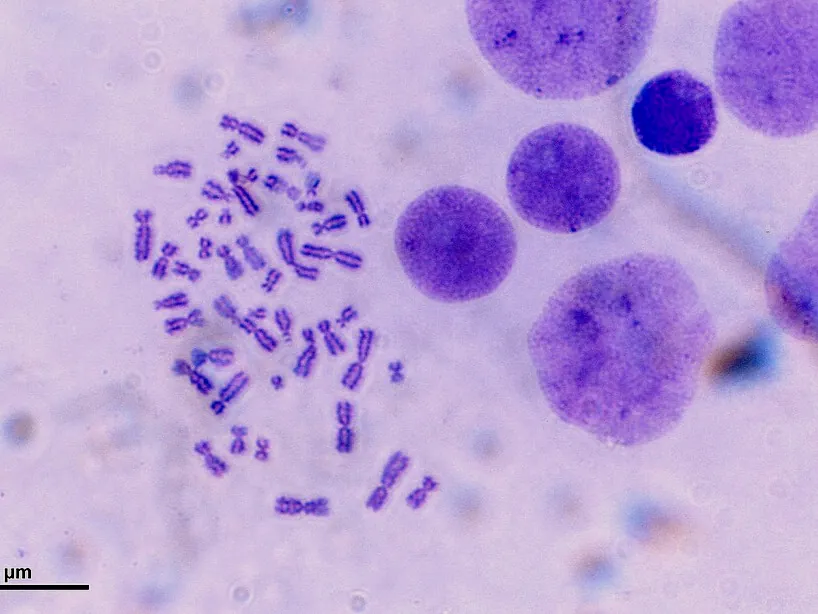
A karyotype is a picture of all the chromosomes in one cell, arranged in their pairs. To make one, cells (often white blood cells) are grown, stopped while dividing, burst open and stained so each chromosome shows a pattern of dark and light bands. Each chromosome has its own band pattern, size and centromere position, which is how they are matched up. Today computers do most of the sorting.
| Organism | Chromosomes in a body cell (2n) |
|---|---|
| Jack jumper ant (Myrmecia croslandi) | 2 (males have just 1) |
| Fruit fly | 8 |
| Garden pea | 14 |
| Koala | 16 |
| Red kangaroo | 20 |
| Rice | 24 |
| Human | 46 |
| Chimpanzee | 48 |
| Platypus | 52 (including 10 sex chromosomes) |
| Dog and dingo | 78 |
| Adder's-tongue fern (Ophioglossum reticulatum) | more than 1200 |
Chimpanzees have one more pair than us because, in our ancestors, two medium-sized chromosomes fused end to end to form human chromosome 2. You can still see the remains of the extra centromere and of chromosome ends (telomeres) in the middle of it.
When the number is wrong
Occasionally a pair of chromosomes fails to separate when eggs or sperm are made (1C). An egg or sperm then has an extra or a missing chromosome, and so does the baby. Most such embryos do not survive, but a few combinations do:
- Trisomy 21 (Down syndrome): three copies of chromosome 21, written 47,XX,+21 or 47,XY,+21. It occurs in about 1 in 700 to 1 in 1000 births, and the chance rises with the mother's age.
- Klinefelter syndrome (47,XXY): about 1 in 600 males. Often not noticed until adulthood, when it may cause reduced fertility.
- Turner syndrome (45,X): one X and no second sex chromosome, about 1 in 2500 females. Usually short stature and ovaries that do not develop fully.
- For Patient A, click a chromosome, then click its partner. What three features do you use to match them?
- Find the sex chromosomes for Patient C. Why do X and Y count as a pair even though they look different?
- Arrange the karyotype for each patient. Which one has 47 chromosomes with an extra autosome, and which has an extra sex chromosome?
- Count the chromosomes in Patient B's arranged karyotype. Which number is unusual?
The human genome
An organism's genome is one complete set of its DNA. The human genome is about 3.1 billion base pairs long; each body cell holds two copies, one from each parent. Typed out at one letter per millimetre, one copy would stretch about 3100 km, almost from Sydney to Perth.
The Human Genome Project, an international collaboration, set out in 1990 to read the order of all those bases. A draft was published in 2001 and a version declared complete in 2003, at a cost of about US$2.7 billion. In fact about 8% was still missing: long stretches of repeated sequence that the technology of the time could not piece together. The first truly complete, gap-free human sequence, from the Telomere-to-Telomere consortium, was published only in 2022.
The project held some surprises:
- Humans have only about 20 000 protein-coding genes, about the same as a mouse and fewer than many plants. Early guesses were 100 000.
- Only about 1–2% of the genome codes for proteins. The rest includes switches that control when genes turn on, genes for RNA molecules, repeated sequences, and the remains of ancient viruses (about 8%).
- Any two people share about 99.9% of their DNA sequence. The 0.1% that differs, about 3 million bases, accounts for much of our inherited variation.
Not all of your DNA is in the nucleus. Your mitochondria have their own small circle of DNA, 16 569 base pairs long with 37 genes. You inherit mitochondria only from your mother, through the egg. This makes mitochondrial DNA useful for tracing maternal ancestry back thousands of years.
Test yourself
Homologous chromosomes are
Homologues carry the same genes in the same order, though perhaps different alleles.
How many autosomes are in a human sperm cell?
A sperm has 23 chromosomes: 22 autosomes plus one sex chromosome (X or Y).
A karyotype shows 47 chromosomes including XXY. This person has
An extra X in a male is Klinefelter syndrome, 47,XXY.
What proportion of the human genome codes for proteins?
The rest includes control switches, RNA genes, repeats and ancient viral DNA.
Mitochondrial DNA is useful for tracing ancestry along the mother's line because
Sperm mitochondria are not passed on, so mitochondrial DNA follows the maternal line.
Label how DNA is packed into a chromosome.
Order these from largest to smallest.
DNA winds around proteins called . A copied chromosome is made of two sister joined at the . Different versions of a gene are called . A picture of a cell's chromosomes arranged in pairs is a . One complete set of an organism's DNA is its .
A karyotype from a baby shows three copies of chromosome 21. Describe how the karyotype was made and interpreted, and explain what the result means.
A sample of the baby's cells, usually white blood cells, is grown in the lab and stopped part way through cell division, when the chromosomes are most condensed. The cells are burst open on a slide and stained, giving each chromosome a pattern of light and dark bands. The chromosomes are photographed and arranged in pairs from largest to smallest, matching each pair by length, centromere position and band pattern. This baby's karyotype has 47 chromosomes because there are three copies of chromosome 21 instead of two: trisomy 21, which causes Down syndrome. It usually happens because chromosome 21 failed to separate when the egg (or sometimes the sperm) was made, so that cell carried two copies instead of one.