 Coaching Centre
Energy and chemical bonds
Why reactions release or absorb energy: breaking bonds takes energy in and making bonds gives energy out, calculating enthalpy change (ΔH) from bond energies, reading energy profiles, making fire by friction, measuring the energy of neutralisation, thermal decomposition of limestone, and how heating changes yellow ochre into red.
Light a gas stove and its blue flame can boil a litre of water in a few minutes. Yet before methane can burn, every molecule has to be torn apart, and pulling atoms apart always costs energy. So where does all that heat come from? Not from the fuel's bonds breaking, but from the new, stronger bonds that form as the flame makes carbon dioxide and water.
Breaking and making bonds
In Year 8 you learned that exothermic reactions give out energy and endothermic reactions take it in. Now you can explain why, using the bonds that hold atoms together.
- Breaking a bond always takes energy in. Atoms are held together by the attraction between their nuclei and shared or transferred electrons. Pulling them apart is work, like pulling two magnets apart.
- Making a bond always gives energy out. When atoms snap together, the same amount of energy is released, usually as heat.
Every reaction does both: bonds in the reactants break, then new bonds form in the products. Whether the reaction is exothermic or endothermic depends on which is bigger.
| Exothermic | Endothermic | |
|---|---|---|
| Bonds made compared with bonds broken | More energy released making bonds than taken in breaking them | More energy taken in breaking bonds than released making them |
| Energy stored in chemicals | Products store less than reactants | Products store more than reactants |
| Surroundings | Get hotter | Get colder (or energy must be supplied) |
| Sign of ΔH | Negative (energy lost by the chemicals) | Positive (energy gained by the chemicals) |
| Examples | Combustion, respiration, neutralisation, rusting | Photosynthesis, thermal decomposition, electrolysis, cooking an egg |
The energy change of a reaction is called the enthalpy change, written ΔH ("delta H"; Δ means "change in"). It is measured in kilojoules (kJ), usually for a fixed amount of reactant called a mole. A mole is just a chemist's counting unit, like a dozen but much bigger: 6.02 × 10²³ particles. You'll use moles properly in Stage 6; for now, read "per mole" as "for the amounts shown in the equation".
Calculating ΔH from bond energies
A bond energy is the energy needed to break one mole of a particular bond. The same amount is released when that bond forms. These values are averages measured across many compounds.
| Bond | Energy (kJ/mol) | Bond | Energy (kJ/mol) |
|---|---|---|---|
| H–H | 436 | C–H | 413 |
| O=O | 498 | C=O (in CO₂) | 805 |
| O–H | 463 | C–C | 346 |
| Cl–Cl | 242 | C–O | 358 |
| H–Cl | 431 | N≡N | 945 |
| H–I | 299 | N–H | 391 |
| I–I | 151 | N=O (in NO) | 630 |
The rule is:
ΔH = energy taken in to break bonds − energy given out making bonds
H₂ + Cl₂ → 2HCl. Draw the bonds: H–H + Cl–Cl → H–Cl + H–Cl.
One H–H (436) and one Cl–Cl (242): 436 + 242 = 678 kJ.
Two H–Cl: 2 × 431 = 862 kJ.
ΔH = 678 − 862 = −184 kJ. More energy comes out than goes in, so the reaction is exothermic. The measured value is −185 kJ, very close.
For methane, the natural gas in a gas stove: CH₄ + 2O₂ → CO₂ + 2H₂O. Breaking 4 C–H and 2 O=O takes in 4 × 413 + 2 × 498 = 2648 kJ. Making 2 C=O and 4 O–H gives out 2 × 805 + 4 × 463 = 3462 kJ. So ΔH = 2648 − 3462 = −814 kJ per mole of methane. (The measured value with the water as steam is −802 kJ. The small difference is because bond energies are averages.)
Notice that energy is not stored "in" the fuel's bonds waiting to escape. Breaking bonds costs energy. The energy is released because the bonds in carbon dioxide and water are stronger than the bonds in methane and oxygen. A good fuel is one whose products have much stronger bonds than the fuel and oxygen did.
Reading energy profiles
An energy profile (energy level diagram) plots the energy stored in the chemicals as the reaction goes from reactants to products.
- The activation energy (Eₐ) is the energy needed to start breaking bonds so the reaction can get going. It is measured from the reactants up to the top of the hump. Even very exothermic reactions, like the hydrogen balloon, need it, which is why fuels don't burst into flame on their own.
- The enthalpy change (ΔH) is measured from the reactant level to the product level. Downwards is negative (exothermic); upwards is positive (endothermic).
- A catalyst provides a different pathway with a lower hump. It changes Eₐ but never ΔH, because the reactants and products are the same.
- Choose H₂ + Cl₂. Break the bonds, then make the new ones. Check that ΔH is −184 kJ, as in the worked example.
- Try every reaction. Which three are endothermic? What do they have in common?
- Compare "Water split" with "H₂ + O₂". What do you notice about the two values of ΔH?
- Methane releases 814 kJ per mole and ethanol 1272 kJ. Now look at the energy per gram shown for each. Which is the better fuel for the same mass, and why is it different from the per-mole answer?
- N₂ + O₂ → 2NO is endothermic. Use the bond energies to explain why this reaction only happens at the very high temperatures inside a car engine or a lightning bolt.
Endothermic reactions at work
Thermal decomposition breaks a compound into simpler substances using heat. It is always endothermic, because bonds are broken and the products are less stable on their own.
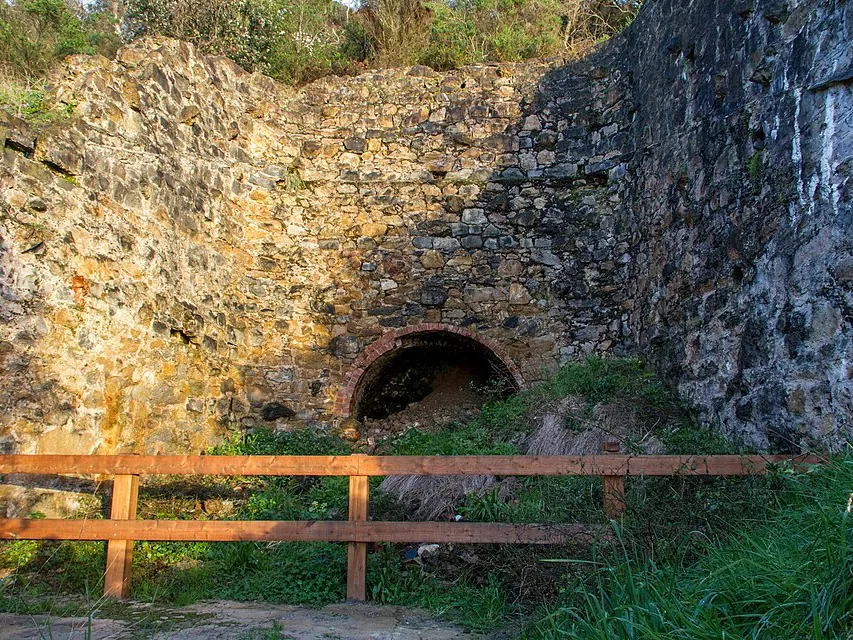
The most important example is turning limestone into quicklime (calcium oxide) in a lime kiln at about 900 °C:
CaCO₃ → CaO + CO₂ ΔH = +178 kJ
Quicklime is used to make cement and steel, to treat drinking water and to neutralise acidic soils and mine waste. Adding water to quicklime is strongly exothermic (it makes slaked lime, Ca(OH)₂, and can boil the water). Cement making releases carbon dioxide twice over: from the fuel burned to heat the kiln, and from the limestone itself. Together these make cement responsible for about 8% of the world's carbon dioxide emissions, so chemists are developing lower-carbon cements and ways to capture the CO₂.
Ochre: chemistry on Country
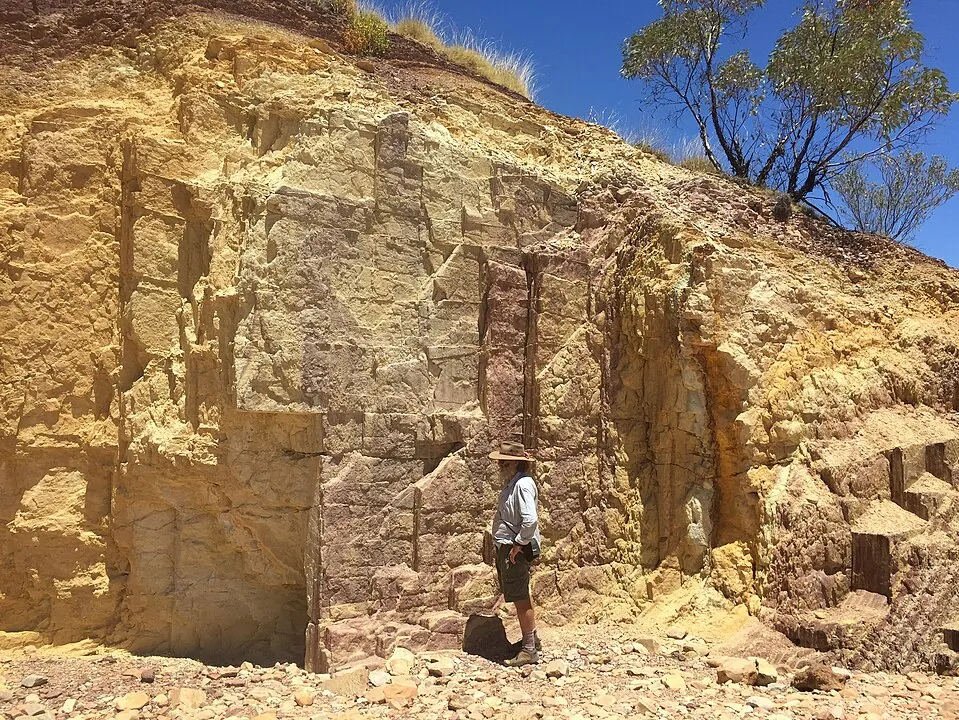
Aboriginal and Torres Strait Islander peoples have used ochre for tens of thousands of years, for painting on rock, bark and bodies, in ceremony, as medicine, to protect skin and to tan hides. Ochres are natural earths coloured by iron compounds. Yellow ochre contains the mineral goethite, FeO(OH); red ochre contains hematite, Fe₂O₃.
Heating yellow ochre in a fire turns it red. The heat supplies the energy to break bonds and drive water out of the goethite, an endothermic decomposition: 2FeO(OH) → Fe₂O₃ + H₂O. Making red pigment this way is a practice known from many cultures, and archaeologists can sometimes tell whether ancient ochre was heated by looking at its crystals.
Good ochre was valuable and was traded across the continent. Red ochre from Pukardu (near Parachilna) in Adnyamathanha Country in the Flinders Ranges, and from Wilgie Mia on Wajarri Yamaji Country in Western Australia, one of the oldest mines in the world, was carried hundreds of kilometres. Many ochre sources are sacred sites, and who may collect and use ochre is governed by cultural law.
Test yourself
When a chemical bond forms, energy is
Making bonds releases energy; breaking bonds absorbs it.
A reaction takes in 1200 kJ breaking bonds and gives out 1500 kJ making bonds. ΔH is
ΔH = 1200 − 1500 = −300 kJ. More energy out than in.
On an energy profile, the activation energy is measured from
Eₐ is the energy the reactants need to get over the barrier.
Adding a catalyst to a reaction
The catalyst gives a lower-energy pathway between the same reactants and products.
Which reaction is endothermic?
Thermal decomposition only continues while energy is supplied.
Label the energy profiles.
Is each change exothermic or endothermic?
Breaking chemical bonds energy. The energy change of a reaction is called the enthalpy change, symbol . For an exothermic reaction ΔH is . The minimum energy needed to start a reaction is the energy. Heating a compound to break it down is called thermal .
Hydrogen burns in oxygen: 2H₂ + O₂ → 2H₂O. Using bond energies H–H 436 kJ/mol, O=O 498 kJ/mol and O–H 463 kJ/mol, calculate ΔH for this reaction. State whether it is exothermic or endothermic and explain your answer in terms of bonds.
Bonds broken: two H–H bonds and one O=O bond, 2 × 436 + 498 = 1370 kJ absorbed. Bonds made: each water molecule has two O–H bonds, so four O–H bonds form, 4 × 463 = 1852 kJ released. ΔH = 1370 − 1852 = −482 kJ. The reaction is exothermic because more energy is released forming the strong O–H bonds in water than is absorbed breaking the bonds in hydrogen and oxygen, so the extra energy is given out to the surroundings as heat (and light and sound).