 Coaching Centre
Beyond simple dominance
Inheritance patterns that go beyond Mendel's dominant and recessive alleles: incomplete dominance, codominance, multiple alleles and the ABO blood groups, polygenic traits, and how the environment and epigenetics affect phenotype.
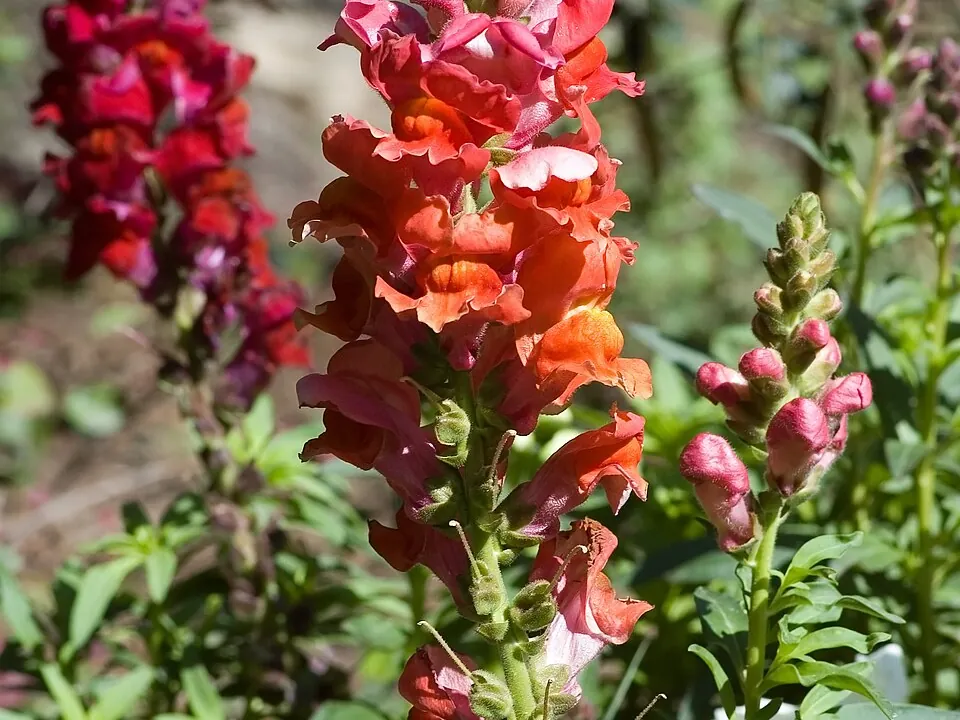
Cross a red snapdragon with a white one and you get pink flowers. Incubate a central bearded dragon egg above about 32 °C and a lizard with male chromosomes can hatch as a fully working female. Mendel's peas were the simple case. Most of biology is messier and more interesting.
Incomplete dominance
In incomplete dominance, neither allele is fully dominant, and a heterozygote has an intermediate phenotype. In snapdragons, one allele (Cᴿ) makes red pigment and the other (Cᵂ) makes none. CᴿCᴿ plants are red, CᵂCᵂ plants are white, and CᴿCᵂ plants have only one working copy, make half as much pigment, and are pink. Because each genotype has its own phenotype, a cross of two pinks gives a 1 red : 2 pink : 1 white ratio that you can see directly. Note the notation: both alleles get a capital letter with a superscript, because neither is recessive.
Codominance
In codominance, both alleles are fully expressed in a heterozygote, side by side. In Shorthorn cattle, a red bull crossed with a white cow gives roan calves: their coat has red hairs and white hairs mixed together. No hair is pink. The difference from incomplete dominance is blend versus both.
Multiple alleles: the ABO blood groups
Many genes have more than two alleles in a population, though any one person carries only two. The ABO blood group gene has three common alleles. Each codes for a version of an enzyme that adds sugar molecules to the surface of red blood cells:
- Iᴬ adds A antigens
- Iᴮ adds B antigens
- i codes for a non-working enzyme that adds neither.
Iᴬ and Iᴮ are codominant with each other, and both are dominant to i. That gives six genotypes but only four blood groups:
| Genotype | Blood group | Antigens on red cells | Antibodies in plasma |
|---|---|---|---|
| IᴬIᴬ or Iᴬi | A | A | anti-B |
| IᴮIᴮ or Iᴮi | B | B | anti-A |
| IᴬIᴮ | AB | A and B | neither |
| ii | O | neither | anti-A and anti-B |
Blood groups matter for transfusions. If group A blood is given to a group B person, their anti-A antibodies attack the donated cells, making them clump. Group O red cells have no A or B antigens, so they can be given to anyone in an emergency. In Australia, O is the most common group and AB the rarest. A separate gene decides the Rhesus (Rh) factor, the + or − in "O positive".
A mother is group A and the father is group AB. Could they have a group O child?
Group O is ii, so the child would need an i allele from each parent.
A group AB father is IᴬIᴮ. He has no i allele to pass on.
No. Their children could be A, B or AB (B only if the mother is Iᴬi), but never O.
- Cross Mum Iᴬi with Dad Iᴮi. How many different blood groups can their children have? What is the chance of each?
- Find two parents who can only have group AB children.
- Which pairs of parents can have a group O child? What must both parents carry?
- Solve three paternity puzzles. Can a blood group ever prove who a child's father is?
Polygenic traits
Mendel's traits came in two clear forms. Most human traits, such as height, skin colour, eye colour and the risk of type 2 diabetes, show a smooth range instead. They are polygenic: controlled by many genes, each adding a small effect. Height is influenced by thousands of DNA variants. With many genes each pushing a little up or down, most people end up near the middle and few at the extremes, giving a bell-shaped curve. This is continuous variation, as opposed to the discontinuous variation of blood groups, where everyone fits one category.
Genes and environment
Phenotype = genotype + environment. A plant with genes for tallness will still be short in poor soil, and a child's height depends on nutrition as well as genes. Some striking examples:
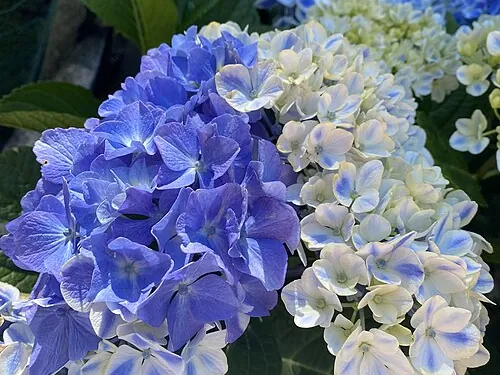
- Hydrangeas with the same genes have blue flowers in acidic soil and pink flowers in alkaline soil, because acidic soil releases aluminium ions that change the pigment's colour.
- Temperature decides sex in many reptiles. Saltwater crocodile eggs incubated at around 32 °C mostly hatch as males; cooler or hotter nests produce mostly females. In the central bearded dragon (Pogona vitticeps), sex is set by chromosomes, but Australian researchers found that eggs with male (ZZ) chromosomes incubated above about 32 °C develop into females that can lay eggs.
- Identical twins have the same DNA but can differ in height, weight, health and personality, and the differences grow with age. Comparing identical and non-identical twins lets scientists estimate how much of the variation in a trait is due to genes.
Epigenetics is part of the reason. Chemical tags, such as methyl groups attached to DNA or to histones, switch genes on or off without changing the base sequence. Diet, stress, smoking and other factors can change these tags, and some are copied when cells divide. In honeybees, female larvae fed royal jelly develop into queens, while larvae fed mostly pollen and nectar develop into workers. Their DNA is the same; the diet changes which genes are switched on.
Test yourself
A pink snapdragon is crossed with a white snapdragon. The expected offspring are
CᴿCᵂ × CᵂCᵂ gives CᴿCᵂ and CᵂCᵂ in equal numbers.
A person with blood group AB has the genotype
Both codominant alleles are present and both are expressed.
Parents Iᴬi and Iᴮi have a child. The chance the child is group O is
i from each parent: ½ × ½ = ¼.
Human height shows a smooth range of values because it is
Many genes plus nutrition and health give continuous variation.
Epigenetic changes
Chemical tags on DNA or histones control whether genes are read.
Name each inheritance pattern.
Which pattern is shown?
When both alleles are fully expressed in a heterozygote, they are . A gene with more than two versions in a population has multiple . Group O blood has neither A nor B . Traits controlled by many genes are and show variation.
A baby is group O. The mother is group A. A man who is group AB claims to be the father. Use genotypes to explain whether he could be.
Group O is recessive, so the baby must be ii and must have received one i allele from each parent. The mother is group A, so she must be Iᴬi to have passed on an i. A group AB man has the genotype IᴬIᴮ. He has no i allele, so every child of his would receive either Iᴬ or Iᴮ and could not be group O. He cannot be the baby's father. Blood groups can rule a man out like this, but they cannot prove who the father is, because many men share any blood group; DNA profiling would be needed.