 Coaching Centre
Colour and brightness of stars
Why star colour reveals surface temperature, the spectral classes O, B, A, F, G, K and M, how luminosity depends on both temperature and size, what colour can and can't tell us about a star's age and distance, and how spectra showed that stars are mostly hydrogen and helium.
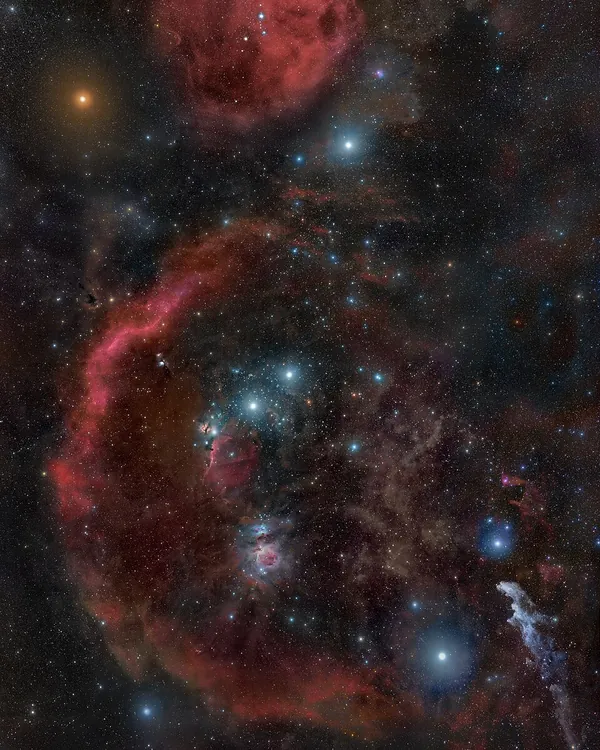
Find Orion on a summer evening (in Australia it looks like a saucepan, upside down from the way it's drawn in northern books). At one corner is Betelgeuse, glowing orange-red. At the opposite corner is Rigel, a sharp blue-white. Those colours aren't decoration: they are thermometer readings, taken from hundreds of light years away.
Colour shows temperature
Turn on an electric stove element and watch it: first it glows dull red, then orange as it gets hotter. A light-globe filament is hotter still and glows yellow-white. Every object gives out electromagnetic radiation because of its temperature, called thermal radiation. As the temperature rises, the object gives out more energy at every wavelength, and the wavelength where it gives out the most, its peak, moves to shorter wavelengths.
Stars behave almost exactly like this. A cool star at 3500 K peaks in the infrared and gives out much more red light than blue, so it looks orange-red. The Sun, at about 5800 K, peaks near 500 nm in the middle of the visible spectrum and gives out a fairly even mix of colours, so it looks white with a hint of yellow. A star at 10 000 K or more peaks in the ultraviolet and gives out more blue than red, so it looks blue-white. The peak wavelength is inversely proportional to temperature (Wien's law):
peak wavelength (nm) ≈ 2 900 000 ÷ temperature (K)
For the Sun: 2 900 000 ÷ 5800 = 500 nm. Notice there are no green stars. A star that peaks in the green also gives out plenty of red and blue light on either side, and the mixture looks white.
Spectral classes
About a century ago astronomers at Harvard, led by Annie Jump Cannon, sorted the spectra of hundreds of thousands of stars into classes. Cannon personally classified about 350 000 stars. Her scheme, which is still used, turned out to be a temperature sequence: O, B, A, F, G, K, M, from hottest to coolest. (A classic way to remember it: "Oh Be A Fine Girl or Guy, Kiss Me".)
| Class | Surface temperature (K) | Colour | Examples |
|---|---|---|---|
| O | above 30 000 | blue | stars in the Carina Nebula |
| B | 10 000–30 000 | blue-white | Rigel, Acrux, Achernar |
| A | 7500–10 000 | white | Sirius, Vega |
| F | 6000–7500 | yellow-white | Canopus, Procyon |
| G | 5200–6000 | yellow-white | the Sun, Alpha Centauri A |
| K | 3700–5200 | orange | Arcturus, Aldebaran |
| M | below 3700 | orange-red | Betelgeuse, Antares, Proxima Centauri |
In 1925 Cecilia Payne used these spectra, and new physics about how atoms absorb light, to show something astonishing: the differences between classes are mostly caused by temperature, not composition, and stars are made almost entirely of hydrogen and helium. At the time most astronomers assumed stars had about the same make-up as the Earth. She was right, and it's now one of the foundations of astrophysics.
Luminosity depends on size and temperature
A star's luminosity is the total energy it gives out each second, usually compared with the Sun's. Two things control it:
- Temperature. Each square metre of a hotter surface gives out far more energy. Doubling the temperature makes each square metre 2⁴ = 16 times as bright.
- Size. A bigger star has more surface. Doubling the radius gives 2² = 4 times the surface area, and 4 times the luminosity.
luminosity ∝ radius² × temperature⁴
This explains some stars that seem odd at first. Betelgeuse has a cool surface (about 3600 K), but it is so enormous, roughly 750 times the Sun's radius, that it gives out around 100 000 times as much energy as the Sun. Sirius B, a white dwarf, has a scorching surface of about 25 000 K, but it is only about the size of Earth, so it is very dim.
Star A has the same radius as the Sun but a surface twice as hot. Star B has the same temperature as the Sun but 10 times its radius. Which gives out more energy?
Same size, so only temperature changes: luminosity = 1² × 2⁴ = 16 times the Sun.
Same temperature, so only size changes: luminosity = 10² × 1⁴ = 100 times the Sun.
Star B is about 6 times more luminous, even though Star A is hotter and bluer. Colour alone doesn't tell you how powerful a star is.
- Start with the Sun seen from 10 parsecs. Where is its peak, and what magnitude does it have from that distance?
- Choose Proxima Centauri, the nearest star. Where does its output peak? What fraction of its energy is visible light, and why can't you see it without a telescope?
- Compare Betelgeuse and Rigel. Which is hotter? Which is more luminous? Explain how a cool star can be so powerful.
- Set the radius to 1 and drag the temperature from about 3000 K to about 30 000 K. By roughly what factor does the luminosity change? Does it match radius² × temperature⁴?
- Keep a star the same and change only its distance. Which readouts change and which stay the same?
The magnitude in the simulation counts all the energy the star gives out, including infrared and ultraviolet. Our eyes only see the visible part, so cool red stars look fainter to us than their total output suggests. Proxima Centauri, the nearest star of all, gives out most of its energy as infrared and is far too faint to see without a telescope.
What can colour tell us about age and distance?
Age. Hot blue stars are massive and burn their fuel so quickly that they last only a few million years (6E). If you see blue stars, you know they must be young, and a group of stars still containing blue stars must have formed recently. The Jewel Box cluster near the Southern Cross, with its bright blue-white stars and one orange supergiant, is only about 10 to 20 million years old. A group with no blue stars left, such as the globular cluster 47 Tucanae near the Small Magellanic Cloud, must be very old: about 12 billion years.
A single red star could be old or young, though. Red dwarfs live for trillions of years, and red giants and supergiants are stars near the end of their lives.
Distance. Colour on its own tells you nothing about distance, because a star's colour doesn't change as its light travels. There are two small exceptions. Dust between the stars scatters blue light, so very distant stars in dusty parts of the galaxy look slightly redder than they should. And for whole galaxies billions of light years away, the expansion of the universe stretches their light to longer wavelengths (6F).
Test yourself
Which star has the hottest surface?
Blue-white stars peak at the shortest wavelengths, so they are hottest.
A star's thermal radiation peaks at 290 nm. Its surface temperature is about
2 900 000 ÷ 290 = 10 000 K.
Betelgeuse is cooler than the Sun but much more luminous because it
Its huge surface area more than makes up for its lower temperature.
A star has the same radius as the Sun and three times its surface temperature. Its luminosity is
3⁴ = 81.
Cecilia Payne showed in 1925 that stars are mostly
Differences between spectra are mostly due to temperature, not composition.
Label the thermal radiation graph.
Put the spectral classes in order from hottest to coolest.
What can a star's colour alone tell you?
A hotter star gives out most of its light at wavelengths, so it looks blue-white. A star's total power output is its , which depends on its radius squared and its to the fourth power. Stars are sorted into spectral classes O, B, A, F, G, K and M; the Sun is a class star. Cecilia Payne showed from their that stars are mostly made of and helium.
Rigel (about 12 000 K) and Betelgeuse (about 3600 K) are the two brightest stars in Orion. Explain why they are different colours, and use the relationship between luminosity, radius and temperature to explain how both can be among the most luminous stars in our part of the galaxy.
Every star gives out thermal radiation whose peak wavelength gets shorter as the temperature rises (peak ≈ 2 900 000 ÷ T nm). Rigel, at about 12 000 K, peaks at about 240 nm in the ultraviolet, so in visible light it gives out more blue than red and looks blue-white. Betelgeuse, at about 3600 K, peaks at about 800 nm in the infrared, so it gives out more red than blue and looks orange-red.
Luminosity is proportional to radius² × temperature⁴. Each square metre of Rigel's surface gives out about (12 000 ÷ 3600)⁴ ≈ 120 times more energy than a square metre of Betelgeuse, and Rigel is also about 80 times the Sun's radius, so it is extremely luminous. Betelgeuse makes up for its low temperature by being enormous, roughly 750 times the Sun's radius, so its surface area is huge. Both end up tens of thousands to over a hundred thousand times as luminous as the Sun, by different routes: one by being very hot, the other by being very big.