 Coaching Centre
Phosphorus, oxygen and water cycles
How phosphorus cycles slowly through rock, soil, living things and the ocean; why Australia's ancient soils are so phosphorus-poor and how native plants cope; peak phosphorus and recycling; the oxygen cycle and ozone formation; and measuring transpiration in the water cycle.
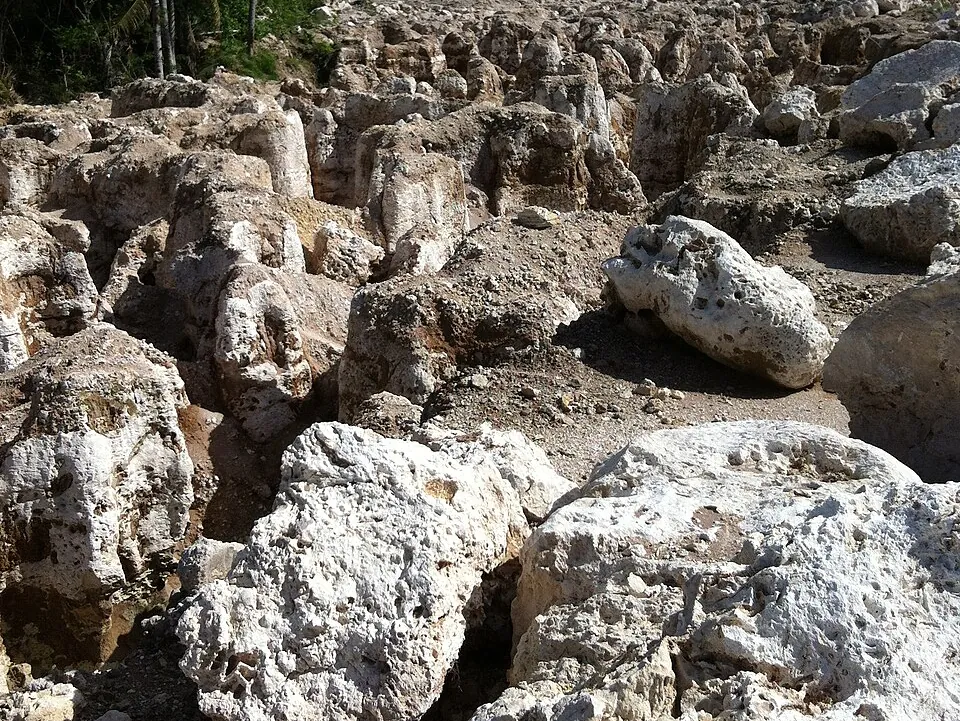
For 90 years, ships left the tiny Pacific island of Nauru loaded with phosphate rock, made from ancient seabird droppings and marine sediments, bound for farms in Australia and New Zealand. By the 1980s about 80% of the island had been strip-mined, leaving a moonscape of jagged limestone pinnacles where nothing can be farmed. Nauru's people had briefly become some of the richest in the world, and then the phosphate ran out. A good share of the phosphorus in Australian wheat, and in your bones, came from places like Nauru.
In Year 7 you studied the water cycle, and in Year 9 the carbon and nitrogen cycles. Phosphorus behaves very differently from both, and it may be the cycle that matters most for feeding the world.
The phosphorus cycle
Every living cell needs phosphorus. It is part of DNA and RNA, of the energy-carrying molecule ATP, and of the phospholipids that make cell membranes. Your bones and teeth are mostly calcium phosphate. Unlike carbon and nitrogen, phosphorus has no common gas form, so it cannot travel through the atmosphere. It moves only through rock, soil, water and living things, and most of its cycle is extremely slow.
- Weathering of rocks slowly releases phosphate ions into soil and water.
- Plants absorb phosphate through their roots; animals get it by eating plants or other animals.
- Wastes and dead organisms are broken down by decomposers, returning phosphate to the soil.
- Some phosphate washes into rivers and the sea, where it eventually settles into sediments. Only when tectonic forces lift those sediments into new land, over millions of years, does it return.
- Seabirds provide a shortcut: they eat fish at sea and drop phosphorus-rich guano on islands and coasts.
Australia: the phosphorus-poor continent
Australia's soils are among the oldest and most weathered in the world. Most of the continent has not been scraped by glaciers or covered by fresh volcanic ash for millions of years, so rain has slowly washed the phosphorus out. When Europeans first tried growing wheat on these soils, crops often failed, until farmers began spreading superphosphate, made by treating phosphate rock with sulfuric acid. Much of that rock came from Nauru and Banaba (Ocean Island), mined by a commission run by Australia, New Zealand and Britain. On Banaba, mining damaged the island so badly that most Banaban people were moved to Rabi Island in Fiji in 1945.
Native plants evolved to cope. Banksias, hakeas, grevilleas and waratahs (the Proteaceae family) grow cluster roots: dense bottlebrushes of short rootlets that release organic acids such as citrate. The acids dissolve phosphate locked onto iron and aluminium minerals in the soil so the plant can absorb it. Many of these plants are so well adapted to low phosphorus that ordinary garden fertiliser poisons them, which is why nurseries sell special "native" fertiliser.
Peak phosphorus
Modern farming depends on mined phosphate rock: without it, the world could feed only a fraction of today's population. But phosphate rock is a non-renewable resource, and about 70% of the known reserves are in Morocco and Western Sahara. In 2008 the price of phosphate rock rose about eightfold in a year, causing problems for farmers worldwide. Some scientists warned of "peak phosphorus", when production would start to fall. Newer estimates of the reserves are much larger, and most experts now expect them to last a few hundred years, but the supply is fragile and much of what we mine is wasted.
- Most fertiliser phosphorus is never taken up by crops. Some binds tightly to soil; some washes into rivers, where it helps cause algal blooms (Year 8).
- Almost all the phosphorus in our food ends up in sewage, manure and food waste. Treatment plants can recover it as a mineral called struvite, which makes good slow-release fertiliser.
- With the starting settings, how much phosphorus must be mined each year, and how long do the reserves last?
- Which helps more: doubling the recycling, or raising the crop uptake from 40% to 60%? Why?
- Set demand growth to 3% a year. What happens to the lifetime of the reserves?
- Find settings that make the reserves last more than 600 years. What would farmers and cities need to do in real life?
The oxygen cycle
Oxygen cycles alongside carbon. Photosynthesis releases oxygen, and respiration, decay and burning use it (Year 9). About half of all photosynthesis on Earth is done by microscopic phytoplankton in the ocean, so the sea supplies about half the oxygen production of the planet.
- Rocks are by far the largest store of oxygen, locked in silicates, carbonates and iron oxides. Weathering of iron minerals (rusting) removes oxygen from the air.
- In the stratosphere, ultraviolet light splits oxygen molecules into single atoms (photolysis). These atoms join other O₂ molecules to form ozone (O₃), which absorbs UV. You studied how CFCs destroyed ozone, and how the Montreal Protocol is fixing it, in 4E.
- Oxygen dissolves in water, which is how fish breathe. Cold water holds more dissolved oxygen than warm water, which is one reason warmer rivers suffer fish kills.
Plants in the water cycle
Plants move a huge amount of water from the soil to the atmosphere by transpiration: water evaporates from leaves through tiny pores called stomata. Over land, transpiration returns more water to the air than evaporation from soil, lakes and rivers combined. Clearing forests therefore changes rainfall, river flow and even the salinity of soils: in parts of WA and Victoria, replacing deep-rooted native trees with shallow-rooted crops let the water table rise, bringing salt to the surface and creating dryland salinity.
Two similar leaves are hung up for two days. Leaf A is untreated. Leaf B has its underside coated in petroleum jelly to block its stomata. Leaf A goes from 2.40 g to 1.68 g; leaf B goes from 2.45 g to 2.30 g. Compare the percentage mass lost.
Test yourself
Phosphorus is different from carbon and nitrogen because it
So it cannot move through the atmosphere.
Banksias grow cluster roots to
An adaptation to very phosphorus-poor soils.
Ozone in the stratosphere forms when
This process is called photolysis.
A leaf's mass falls from 3.0 g to 2.4 g. The percentage mass lost is
0.6 ÷ 3.0 × 100% = 20%.
Label the phosphorus cycle.
Sort the farming and city practices.
Bird droppings rich in phosphate are called . Phosphorus returns from ocean sediments to land through over millions of years. Splitting molecules with light is called . Water evaporating from leaves is called . A phosphate mineral recovered from sewage is .
Explain why phosphorus could limit world food production in the future, and evaluate two ways of making phosphorus use more sustainable.
Every crop needs phosphorus for DNA, ATP and cell membranes, and nothing can replace it. Phosphorus has no gas form, so once it washes into the sea it takes millions of years to return to land. Modern farms therefore rely on fertiliser made from mined phosphate rock, which is non-renewable, and about 70% of the known reserves are in Morocco and Western Sahara, so supply and prices could be disrupted, as in 2008 when the price rose about eightfold. One solution is to recover phosphorus from sewage as struvite. This turns a pollutant into fertiliser and protects rivers from algal blooms, but it needs new equipment at treatment plants and could only supply part of the need. A second solution is to apply fertiliser more precisely, using soil tests and placing it where roots can reach it. This is cheap and also saves farmers money, but it doesn't close the loop, because phosphorus in food still ends up in sewage. Combining both, along with composting food waste, would make phosphorus use far more sustainable than relying on mining alone.