 Coaching Centre
PCR and DNA profiling
How the polymerase chain reaction copies DNA, how restriction enzymes cut DNA, how gel electrophoresis separates fragments by size, and how DNA profiles based on short tandem repeats are used in forensic science, paternity testing, identifying remains and conservation.
A single hair root, a smear of saliva on a cup or a few skin cells left on a door handle contain only a few trillionths of a gram of DNA. In a few hours a machine can copy that DNA a billion times, enough to produce a profile that matches only one person on Earth, unless they have an identical twin.
PCR: copying DNA
The polymerase chain reaction (PCR) makes millions or billions of copies of a chosen stretch of DNA. It was invented by American chemist Kary Mullis in 1983, an idea he said came to him while driving at night, and won him the 1993 Nobel Prize in Chemistry. PCR is one of the most used techniques in biology: it is how COVID-19 PCR tests detected the virus's genetic material.
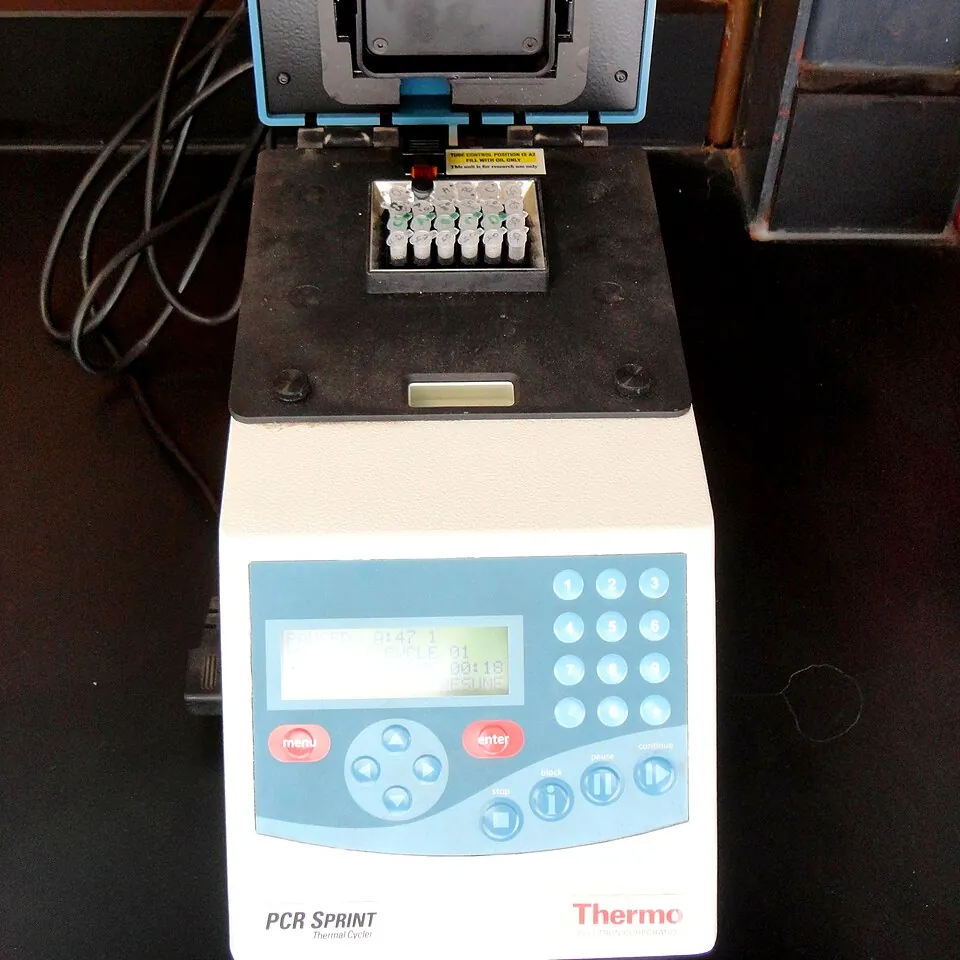
A PCR tube contains the sample DNA, a supply of free nucleotides, a DNA polymerase enzyme, and two primers: short single strands of DNA, about 20 bases long, made to match the two ends of the section to be copied. A machine called a thermocycler then repeats three steps, each taking a minute or less:
- Denature (about 95 °C): the heat breaks the hydrogen bonds and separates the two strands.
- Anneal (about 50–65 °C): the mixture cools and the primers pair with their matching sequences on each single strand.
- Extend (72 °C): DNA polymerase starts at each primer and adds nucleotides to build a new complementary strand.
Each cycle doubles the number of copies of the target section. After n cycles there are 2n copies of each starting molecule: 210 ≈ 1000 after 10 cycles and 230 ≈ 1 billion after 30. Most enzymes would be destroyed by the 95 °C step. The trick that made PCR practical is Taq polymerase, from a bacterium, Thermus aquaticus, discovered in a hot spring in Yellowstone National Park. Its enzymes survive near-boiling temperatures.
Cutting DNA with restriction enzymes
Restriction enzymes are made by bacteria to chop up the DNA of invading viruses. Each one recognises a particular short sequence, usually 4 to 8 bases, and cuts the DNA there. For example, the enzyme EcoRI, from E. coli, finds the sequence GAATTC and cuts between the G and the A. Because the sequence reads the same on the opposite strand (in the opposite direction), the cuts are staggered, leaving single-stranded overhangs called sticky ends that can pair with any other DNA cut by the same enzyme. Hundreds of restriction enzymes are known, and they are basic tools for cutting DNA in gene technology (1J).
Gel electrophoresis
Gel electrophoresis separates pieces of DNA by size.
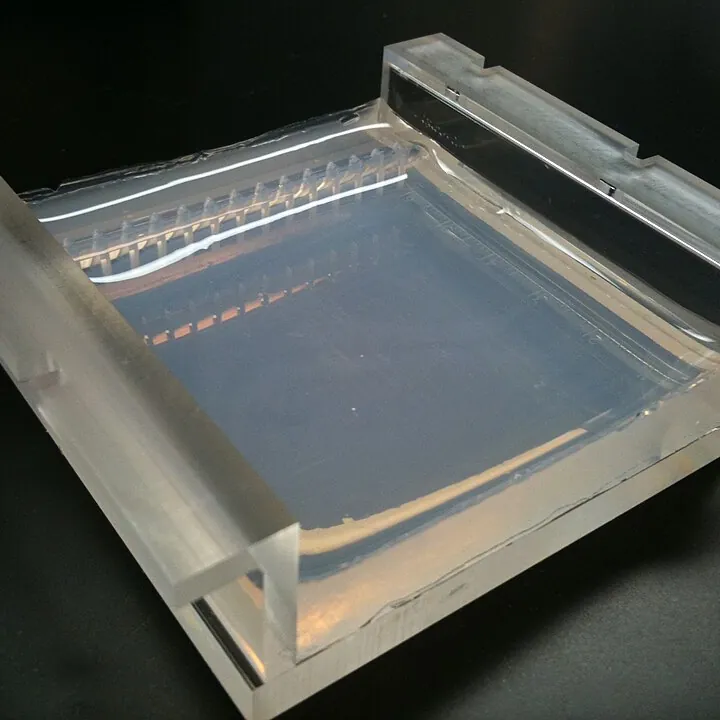
- A slab of agarose gel, a jelly made from seaweed, is set with a row of small wells at one end and covered in a salt buffer solution.
- DNA samples are loaded into the wells, with a ladder of fragments of known sizes in one lane for comparison.
- An electric current is passed through the gel. DNA is negatively charged, because of its phosphate groups, so all the fragments move towards the positive electrode.
- The gel is a mesh of fibres. Short fragments slip through faster and travel further; long fragments are held back.
- The gel is stained with a dye that glows under UV or blue light, showing each group of same-sized fragments as a band.
Fragment sizes are measured in base pairs (bp). The distance a fragment travels is roughly proportional to the logarithm of its size, so the bands of a ladder get closer together near the top of the gel.
DNA profiling
Since 99.9% of human DNA is the same in everyone, profiles focus on places where people differ a lot. Short tandem repeats (STRs) are short sequences, such as GATA, repeated over and over: one person might have 8 repeats at a particular place on chromosome 5, another 13. Each person has two alleles at each STR site, one from each parent. PCR copies about 20 STR sites at once, and the lengths are measured, today usually by a machine that pushes them through a thin gel-filled tube (capillary electrophoresis) and reads them with a laser. The result is a list of numbers: the person's DNA profile.
British geneticist Alec Jeffreys invented DNA fingerprinting in 1984. It was first used in a criminal case in England in 1986–87, where it cleared an innocent suspect who had confessed, and then identified the real killer. Uses now include:
- forensic science: matching crime scene samples to suspects, and freeing people who were wrongly convicted
- paternity and family testing: a child's alleles must each come from one parent
- identifying human remains after disasters, or of soldiers from past wars, by comparison with relatives
- conservation and wildlife crime: identifying poached ivory or illegally traded animals, and checking how related individuals in breeding programs are, such as Tasmanian devils kept free of facial tumour disease.
At one STR site a child has alleles of 11 and 14 repeats. The mother has 11 and 16. Man A has 9 and 12. Man B has 14 and 15. Who could be the father?
The mother has 11 but not 14, so the child's 11 came from her.
The child's 14 must have come from the father.
Man A has no 14 and is excluded. Man B has a 14 and could be the father. Testing about 20 sites would make the conclusion almost certain.
- Run the crime scene gel at 100 V. Which way do the bands move, and which fragments travel furthest?
- Reset and run at 150 V. What changes, and what is the risk of running too long?
- Use the ladder to estimate the size of each crime scene band. Which suspect matches?
- Swap the electrodes and run the gel. What happens to the DNA, and why?
- Switch to the paternity case. Which of the child's bands came from the mother? Which man could be the father?
Limits and safeguards
- A match shows that DNA came from a person, not how or when it got there. Skin cells and hair can be transferred by touch or carried on clothing, so innocent people's DNA can turn up at crime scenes.
- Tiny samples can be contaminated, so forensic labs use strict procedures, protective clothing and "elimination" profiles of their own staff.
- Close relatives share many alleles, and identical twins share all of them.
- DNA databases raise privacy questions: who is stored, for how long, and who can search them. In Australia, laws in each state and territory control when police can take samples and how long profiles are kept.
Test yourself
During PCR, the DNA strands separate at about
The high temperature breaks the hydrogen bonds between the strands.
Starting from one DNA molecule, how many copies of the target are there after 5 PCR cycles?
25 = 32.
Why was Taq polymerase important for PCR?
It comes from a bacterium that lives in hot springs.
In gel electrophoresis, the band that travels furthest from the wells contains
Short fragments move through the gel mesh most easily.
A child's STR alleles are 8 and 12; the mother's are 8 and 10. The father must have
The 8 came from the mother, so the 12 must have come from the father.
Label the gel.
Put the steps for making a DNA profile from a crime scene in order.
PCR stands for chain reaction. Short pieces of DNA that start copying at each end of the target are called . Bacterial enzymes that cut DNA at specific sequences are enzymes. DNA moves through a gel because it is charged. DNA profiles compare short tandem .
A blood stain is found at a crime scene. Describe how a DNA profile is made from it and compared with suspects, and evaluate how strong DNA evidence is.
DNA is extracted from white blood cells in the stain. PCR then copies about 20 short tandem repeat regions: the DNA is heated to 95 °C to separate the strands, cooled so primers attach either side of each STR, then held at 72 °C while Taq polymerase builds new strands; around 30 cycles make about a billion copies. The copies are separated by electrophoresis: DNA is negatively charged, so it moves through the gel towards the positive electrode, with shorter fragments travelling further. Comparing the positions of the bands, or the measured repeat numbers, with profiles from suspects shows whether they match at every site. A full match across 20 sites is extremely strong evidence that the blood came from that person, since the chance of a random match is about one in a billion or less. But it cannot show when or how the blood got there, samples can be contaminated or transferred, and an identical twin would have the same profile, so DNA evidence should be weighed with other evidence.