 Coaching Centre
Ocean currents and the global conveyor
Wind-driven surface currents around Australia, including the East Australian and Leeuwin currents; the deep thermohaline circulation driven by temperature and salinity; upwelling and marine food webs; how currents move heat; and why a warming, freshening ocean could slow the conveyor.
In January 1992 a container ship in a storm in the North Pacific lost about 29 000 plastic bath toys: yellow ducks, red beavers, green frogs and blue turtles. Over the next 15 years they washed up in Alaska, Hawaii, South America and Australia, and some were frozen into Arctic sea ice and carried towards the Atlantic. By recording where and when each toy was found, oceanographers built one of the best maps ever made of the Pacific's surface currents.
Surface currents: driven by the wind
The top few hundred metres of the ocean are pushed along by the prevailing winds: the trade winds near the tropics and the westerlies further south. Because Earth spins, moving water is deflected by the Coriolis effect, to the left in the Southern Hemisphere and to the right in the Northern. The result is a set of huge circling currents called gyres. In the Southern Hemisphere they turn anticlockwise.
- The East Australian Current (EAC) carries warm tropical water south along the east coast, at up to 2 metres per second in places. It brings tropical fish larvae to Sydney each summer, and near Sydney most of it swings east across the Tasman Sea.
- The Leeuwin Current is unusual. Most currents along the west coasts of continents flow towards the equator and are cold. The Leeuwin flows south, carrying warm water from Indonesia down the WA coast and around Cape Leeuwin. It is why corals grow at the Houtman Abrolhos Islands, far further south than you would expect.
- The Antarctic Circumpolar Current, driven by the westerly winds, is the largest current on Earth. It is the only current that flows all the way around the planet, and it helps keep Antarctica cold by cutting it off from warmer water.
For thousands of years Torres Strait Islanders have navigated by the winds and currents that change with the seasons. In many island languages the south-east trade wind season is called Sager and the north-west monsoon season Kuki, and knowing when each arrives decides when it is safe to travel, fish and plant.
The deep ocean conveyor
Below a few hundred metres, the wind has little effect. Deep water moves because of differences in density, which depends on two things:
- Temperature: colder water is denser.
- Salinity: saltier water is denser.
This density-driven flow is called the thermohaline circulation ("thermo" = heat, "haline" = salt). Dense water forms in only a few places. In the North Atlantic, winter winds chill the salty water carried north by the Gulf Stream until it sinks. Around Antarctica, when sea water freezes into sea ice, the salt is squeezed out as brine, making the water below it extremely cold and salty. This Antarctic Bottom Water is the densest in the world. It slides down the continental slope and spreads along the sea floor into every ocean, including the deep basins off Australia.
Sinking water has to be replaced, and deep water eventually rises again, mainly in the Southern Ocean and the Pacific. Altogether, a parcel of water takes roughly 1000 years to complete the loop. The conveyor carries heat, oxygen, nutrients and dissolved carbon dioxide around the planet, linking the hydrosphere, atmosphere and biosphere.
- Drop the tropical surface water. Where does it end up, and why?
- Try the North Atlantic winter water and the Antarctic sea ice water. Which sinks further? What makes it so dense?
- Choose North Atlantic winter water and mix in meltwater from Greenland. How much meltwater stops it reaching the deep ocean?
- Use Own mix to make water that settles at about 1000 m. Is there more than one way to do it?
Upwelling: bringing up the food
Sunlit surface water often runs short of nutrients, because plankton use them up and their remains sink. In some places, winds blowing along the coast push the surface water offshore, and cold, nutrient-rich deep water rises to replace it. This is upwelling. The nutrients feed huge blooms of phytoplankton, which feed krill and fish, which feed seabirds, seals and whales.
Every summer, south-easterly winds cause the Bonney Upwelling along the coast of south-east South Australia and western Victoria. Swarms of krill gather, and pygmy blue whales come to feed on them. Upwelling zones cover a tiny fraction of the ocean but support a large share of the world's fish catch.
Currents, heat and a changing ocean
Together with the winds, ocean currents carry heat from the tropics towards the poles. The Gulf Stream and its extension are a big part of why London, at 51°N, has much milder winters than places at the same latitude in Canada. The ocean has also absorbed about 90% of the extra heat trapped by greenhouse gases since the 1970s, which is why it is central to climate change (7F).
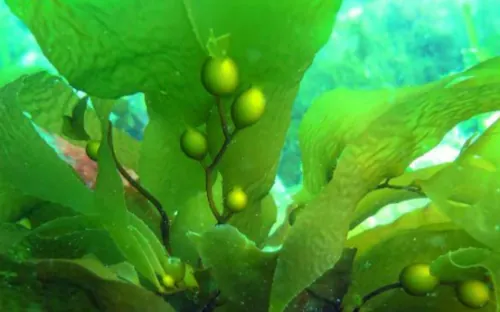
- The EAC is strengthening and pushing further south. The sea off eastern Tasmania is warming at several times the global average. Warm-water species such as the long-spined sea urchin have moved in and grazed away kelp, and Tasmania has lost more than 95% of its giant kelp forests since the mid-1900s. Scientists are now trialling heat-tolerant kelp.
- Meltwater is freshening the polar seas. Fresher water is less dense, so it sinks less readily. The IPCC's latest report (AR6) says the Atlantic part of the conveyor is very likely to weaken this century, though a sudden collapse before 2100 is thought unlikely (the film The Day After Tomorrow exaggerates wildly). In 2023, Australian-led modelling suggested that the sinking of deep water around Antarctica could slow by about 40% by 2050 if emissions stay high.
We know much of this from about 4000 Argo floats drifting through the world's oceans. Every ten days each one sinks to 2000 m, then rises, measuring temperature and salinity, and sends its data by satellite. Australia, through CSIRO and the Integrated Marine Observing System, is one of the biggest contributors.
Test yourself
The thermohaline circulation is driven mainly by differences in
Temperature and salt decide the density of sea water.
The Leeuwin Current is unusual because it
Most west-coast currents are cold and flow towards the equator.
Upwelling zones are rich in marine life because
Nutrients plus sunlight allow phytoplankton to bloom.
Adding meltwater to the North Atlantic could slow the conveyor because the water becomes
Less dense water doesn't sink as easily.
Name the currents around Australia.
Put the formation of Antarctic Bottom Water in order.
Water that is cold and salty has a high . Earth's spin deflects currents by the effect. Deep water rising to the surface near a coast is called . The warm current flowing south along the east coast of Australia is the East Australian . Robotic floats that measure the ocean down to 2000 m are called floats.
Explain how the formation of sea ice around Antarctica helps drive the global ocean conveyor, and predict how increased melting of Antarctic ice could affect it.
When sea water near Antarctica freezes, the ice that forms is mostly fresh, so the salt is left behind as brine in the water below. That water is already near freezing, and now it is also extra salty, so it is the densest water in the ocean. It sinks down the continental slope to the sea floor as Antarctic Bottom Water and spreads north into the Atlantic, Indian and Pacific oceans. Because water is sinking here, water must flow in to replace it and deep water elsewhere must eventually rise, so this sinking is one of the engines of the global conveyor. If more Antarctic ice melts, fresh meltwater mixes into the surface water, lowering its salinity and density. Less water would then be dense enough to sink, so the formation of bottom water and the conveyor would slow. This would carry less oxygen into the deep ocean and change how heat and carbon dioxide are stored, affecting climate and marine life.