 Coaching Centre
Technology for exploring the universe
How telescopes are designed to collect more light and see finer detail, why some telescopes must go into space, the James Webb Space Telescope and the next giant telescopes, Australian radio astronomy and fast radio bursts, imaging black holes with the Event Horizon Telescope, spacecraft and human exploration, and First Nations observations of the sky.
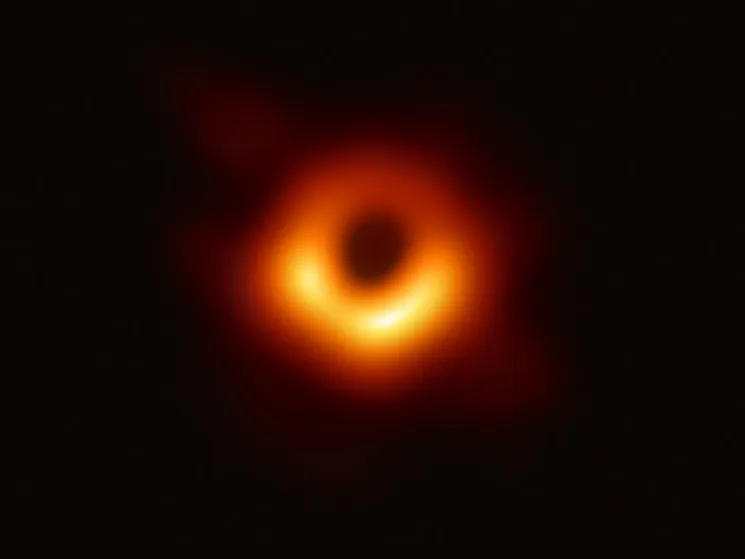
On 10 April 2019 astronomers showed the world the first image of a black hole: a ring of glowing gas around the dark shadow of M87*, a black hole 6.5 billion times the mass of the Sun, 55 million light years away. Seeing it was like reading a newspaper in New York from a café in Paris. No single telescope could do it. Eight radio observatories on four continents, timed by atomic clocks, combined their data to act like one telescope the size of the Earth.
What a telescope has to do
Almost everything we know about the universe beyond the Solar System comes from light and other radiation, so astronomy is limited by how well we can collect it. A telescope has two main jobs.
- Collect light. The bigger the main mirror or dish (the aperture), the more light it gathers, so the fainter the objects it can see. Light collected depends on area, so a mirror twice as wide collects four times as much light.
- Resolve detail. Waves spread out slightly as they pass through any opening, which blurs fine detail. The smallest angle a telescope can separate is about
smallest angle (radians) ≈ 1.22 × wavelength ÷ aperture diameter
So a bigger aperture, or a shorter wavelength, sees finer detail. Radio waves are about a million times longer than visible light, which is why radio telescopes must be enormous, or must be linked together across large distances in arrays (an approach called interferometry).
Hubble's mirror is 2.4 m across. What is the smallest angle it can resolve with green light of wavelength 550 nm?
angle = 1.22 × 550 × 10⁻⁹ ÷ 2.4 = 2.8 × 10⁻⁷ radians
1 radian = 206 265″, so angle ≈ 2.8 × 10⁻⁷ × 206 265 ≈ 0.058″. That is the width of a 10-cent coin seen from about 80 km away. Your eye manages about 20″ at best.
- Choose the human eye and target Acrux A and B, the brightest star of the Southern Cross. Can the eye split them? Now try Galileo's telescope and a backyard 20 cm telescope.
- Try to separate Pluto from its moon Charon. Which is the smallest telescope that can do it in theory? (In practice the moving air blurs detail to about 1″ for ground telescopes, which is one reason Charon wasn't discovered until 1978.)
- Compare Hubble and JWST on the 0.07″ pair. JWST has a much bigger mirror, so why is its smallest detail larger? (Check the wavelength each one uses.)
- Murriyang, at Parkes, is a 64 m dish. Why does it resolve less detail than a 20 cm backyard telescope?
- Target M87*'s ring. Which telescope is the only one that can see it? Use the formula to explain why an Earth-sized array is needed.
Making better telescopes
A single solid glass mirror much bigger than about 8 m sags under its own weight and is almost impossible to make and move. Modern telescopes get around this in several ways.
- Segmented mirrors. The two 10 m Keck telescopes in Hawaii each have 36 hexagonal segments, kept aligned by computer-controlled supports to within a fraction of the wavelength of light.
- Adaptive optics. Turbulence in the air makes stars twinkle and blurs images. A laser makes an artificial "guide star" high in the atmosphere, and a flexible mirror changes shape hundreds of times a second to undo the blurring.
- Digital detectors. Charge-coupled devices (CCDs) record about 90% of the light that hits them, compared with about 1% for photographic plates. Their inventors, Willard Boyle and George Smith, shared the 2009 Nobel Prize in Physics.
- Many objects at once. The 2dF system on the Anglo-Australian Telescope at Siding Spring uses robots to place up to 400 optical fibres, each collecting light from a different galaxy at the same time. Its survey measured the redshifts of about 220 000 galaxies (1997–2002) and mapped the cosmic web.
The next generation is enormous. The Vera C. Rubin Observatory in Chile, with an 8.4 m mirror and the largest digital camera ever built (3200 megapixels), released its first images in June 2025. It will photograph the whole southern sky every few nights for ten years, making a time-lapse of the universe that catches supernovae, asteroids and variable stars. Two giant telescopes are under construction in Chile: Europe's Extremely Large Telescope, with a 39 m mirror made of 798 segments, and the Giant Magellan Telescope, with seven 8.4 m mirrors, in which Australia is a founding partner.
Why go to space?
The atmosphere blocks most of the electromagnetic spectrum. Only visible light, some infrared and most radio waves reach the ground. Gamma rays, X-rays, most ultraviolet and much of the infrared can only be studied from above the atmosphere. Space telescopes also avoid twinkling, weather, daylight and light pollution.
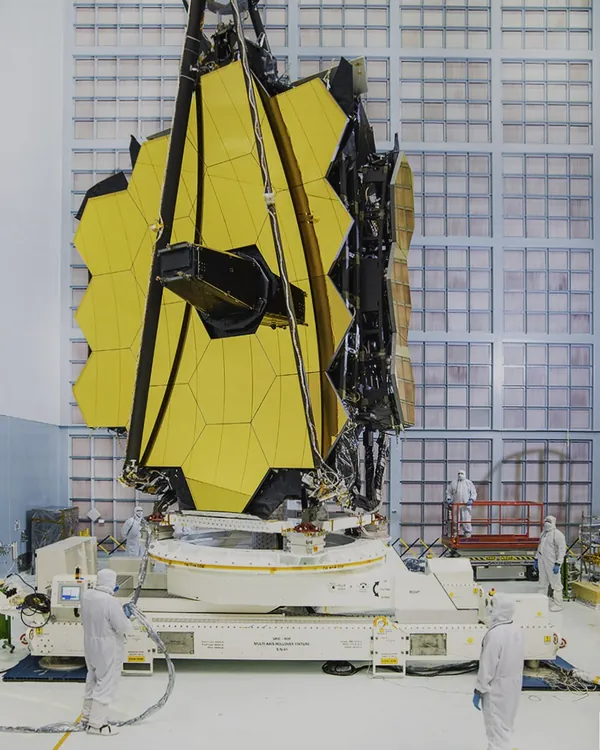
The James Webb Space Telescope (JWST), launched on 25 December 2021, is the largest telescope ever sent into space. Its 6.5 m mirror is made of 18 gold-coated beryllium segments that unfolded in space. It observes infrared light, which is ideal for three things: seeing through dust into star-forming clouds, studying the atmospheres of exoplanets, and seeing the most distant galaxies, whose light has been redshifted from visible into infrared by the expansion of the universe. To detect faint infrared, the telescope must be colder than −220 °C, so it shelters behind a five-layer sunshield the size of a tennis court. It orbits the Sun at a point called L2, 1.5 million km beyond the Earth, where the Sun, Earth and Moon all stay on the same side of the shield. Since 2022 JWST has found galaxies from less than 300 million years after the Big Bang, more numerous and brighter than many astronomers expected.
Radio astronomy in Australia
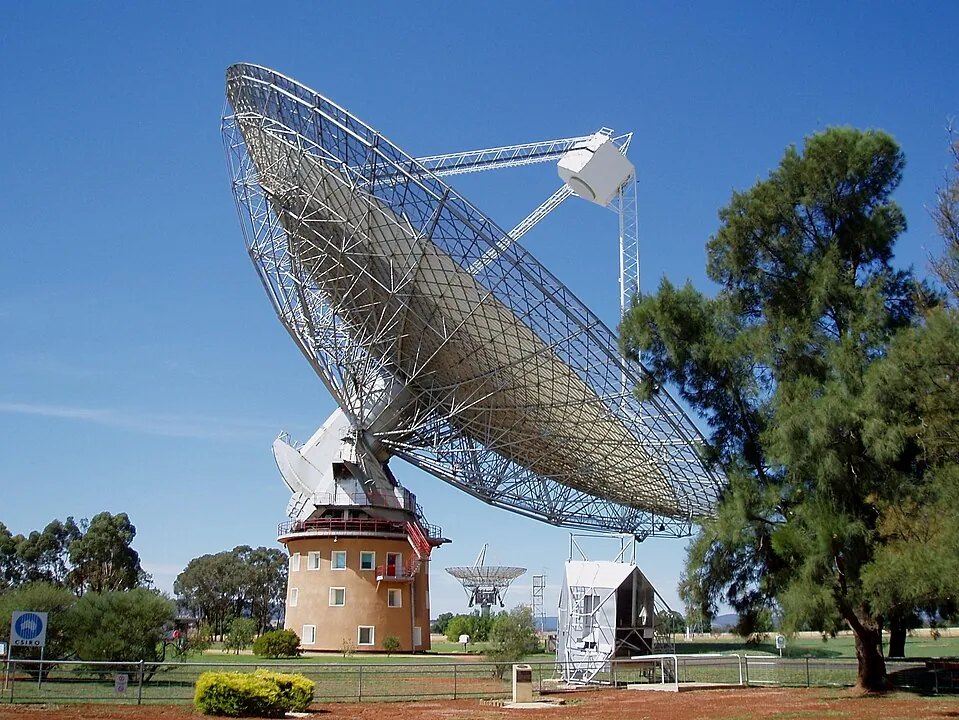
Australia has been a world leader in radio astronomy since the 1940s. Ruby Payne-Scott, the first woman radio astronomer, helped show that the Sun gives out bursts of radio waves, using an antenna on the cliffs at Dover Heights in Sydney that used reflections off the sea to see fine detail. The Parkes radio telescope, Murriyang, has discovered a large share of all the pulsars known (6E).
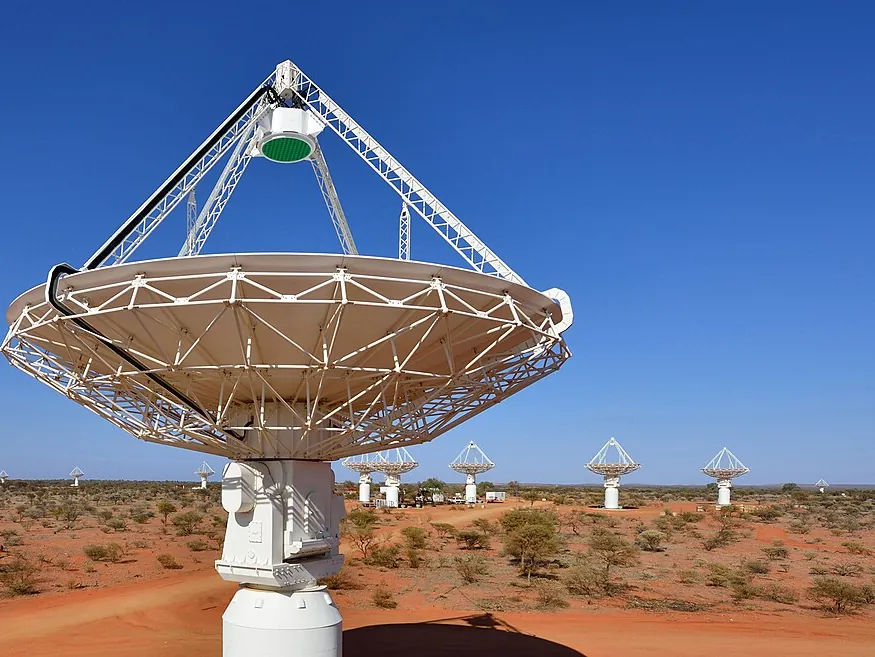
In 2007 Duncan Lorimer and his student found a single, extremely bright radio flash lasting less than five thousandths of a second in old Parkes data: the first fast radio burst (FRB). Thousands have been detected since. Most come from other galaxies, and many seem to be linked to highly magnetic neutron stars. CSIRO's ASKAP array at Inyarrimanha Ilgari Bundara, the Murchison Radio-astronomy Observatory on Wajarri Yamaji Country in Western Australia, can pinpoint which galaxy each burst comes from. In 2020 the late Jean-Pierre Macquart and his team used the way the gas between galaxies delays each burst to weigh it, finding the ordinary matter that had been "missing" from the universe.
Imaging black holes
The Event Horizon Telescope (EHT) links radio dishes across the world and observes at a wavelength of 1.3 mm. Because the dishes are up to about 12 700 km apart, the array resolves detail as fine as the formula allows for an Earth-sized aperture: about 25 microarcseconds, more than 2000 times finer than Hubble. The EHT's image of M87* was released in 2019, and its image of Sagittarius A*, the black hole at the centre of the Milky Way, in 2022. Both show a bright ring around a dark shadow, about the size predicted by Einstein's theory of gravity.
Going there
Telescopes look from afar; spacecraft go and visit.
| Mission | Launched | What it has done |
|---|---|---|
| Voyager 1 and 2 | 1977 | Flew past the giant planets, then left the heliosphere (2012 and 2018). Voyager 1 is now almost one light-day from Earth, the most distant human-made object. |
| New Horizons | 2006 | First flyby of Pluto (July 2015), revealing nitrogen-ice glaciers and mountains of water ice; then flew past Arrokoth, a small Kuiper Belt object, in 2019. |
| Perseverance rover and Ingenuity helicopter | 2020 | Exploring Jezero Crater on Mars, an ancient lake bed, and collecting rock samples that could show signs of past life. Ingenuity made the first powered flight on another planet (2021). |
| Parker Solar Probe | 2018 | Flew through the Sun's outer atmosphere; on 24 December 2024 it passed 6.1 million km from the surface at about 690 000 km/h, the fastest human-made object. |
| Artemis II | 2026 | On 1 April 2026 four astronauts launched on a ten-day trip around the Moon, the first crew to leave Earth orbit since Apollo 17 in 1972. |
Plans for longer stays on the Moon are being shaped by a discovery made after your textbook was printed. Water ice has been confirmed in permanently shadowed craters near the lunar poles, by NASA's LCROSS impact (2009) and by measurements from India's Chandrayaan-1 (published 2018). Ice could be mined for drinking water, oxygen and rocket fuel. An earlier plan to send astronauts to an asteroid by 2025 was cancelled in 2017.
First Nations observation of the sky
Careful observation is a technology too. Aboriginal and Torres Strait Islander peoples have observed the sky for many thousands of years, connecting what they saw to seasons, weather, food, law and navigation. Meriam people of Mer (Murray Island) in the Torres Strait watch how strongly the stars twinkle. Twinkling is caused by turbulence in the air above, so strong twinkling can signal changing winds, rising humidity and approaching weather. Meriam elder Alo Tapim and researchers including Duane Hamacher described this knowledge in a 2019 paper, showing that the same atmospheric effect that adaptive optics corrects for has long been used to read the weather.
Aboriginal and Torres Strait Islander scientists are also leading in modern astronomy, including Karlie Noon, a Gamilaraay astronomer, and Kirsten Banks, a Wiradjuri astrophysicist and science communicator, both of whom share First Nations sky knowledge alongside astrophysics.
Test yourself
A new telescope has a mirror 3 times as wide as an older one. How much more light does it collect?
Light collected depends on area, which goes as diameter squared: 3² = 9.
X-ray telescopes must be placed in space because
Only visible, some infrared and radio waves reach the ground.
JWST observes in the infrared mainly because
Infrared also passes through dust, and suits exoplanet atmospheres.
The Event Horizon Telescope could image M87* because
Resolution improves as aperture increases.
Fast radio bursts were first discovered in data from
The Lorimer burst, reported in 2007.
Label the James Webb Space Telescope and its orbit.
Where should each telescope go?
A telescope with a larger collects more light and resolves finer detail. Detail also improves at wavelengths, so radio telescopes are linked into . Twinkling caused by the air is corrected using . JWST studies light from a point called , 1.5 million km from Earth.
Explain why astronomers build both very large ground-based telescopes and telescopes in space. Refer to at least two examples.
Ground-based telescopes can be made far larger than anything that can be launched, and they can be repaired and upgraded. A larger aperture collects more light, so fainter objects can be seen, and it resolves finer detail. The Extremely Large Telescope in Chile will have a 39 m segmented mirror, and adaptive optics will remove much of the blurring caused by turbulence in the air. Radio waves pass easily through the atmosphere, so radio telescopes such as Murriyang and the ASKAP array in Western Australia work well on the ground. However, the atmosphere absorbs gamma rays, X-rays, most ultraviolet and much infrared, and it causes twinkling. To study these wavelengths telescopes must be above it. JWST is in space at L2 because it observes infrared light, which is absorbed by water vapour in the air and swamped by the warmth of the Earth; its cold, shaded location lets it detect very faint, redshifted light from the earliest galaxies. So the two types complement each other: the ground gives size, space gives access to all wavelengths and perfectly steady images.