 Coaching Centre
Evidence from fossils
How the fossil record supports evolution, the modern geological time scale, transitional fossils such as Tiktaalik, Archaeopteryx and early whales, Australian fossils from Lightning Ridge and Riversleigh, the megafauna, living fossils, and why the record has gaps.
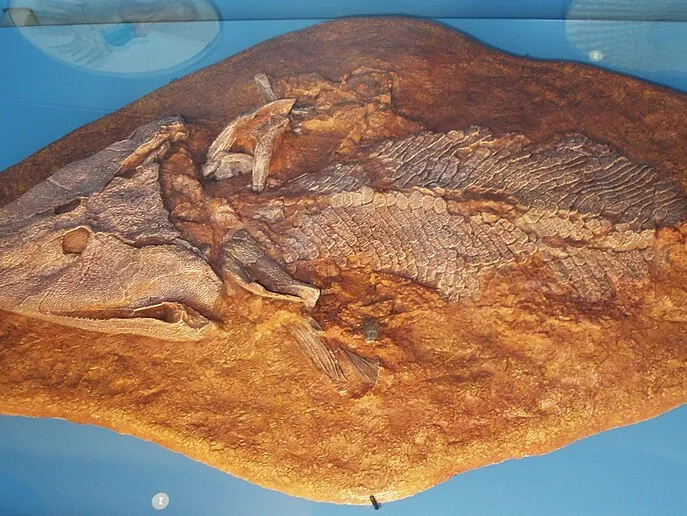
In 1999 the palaeontologist Neil Shubin and his team made a prediction. If fish evolved into four-legged animals, then rocks about 375 million years old, laid down by ancient rivers, should hold something in between. They found rocks of the right age and type on Ellesmere Island in the Canadian Arctic, and after four summers of searching, in 2004 they found a flat-headed fish with a neck and a wrist: Tiktaalik. Its name comes from the Inuktitut word for a large freshwater fish, chosen by Inuit elders of Nunavut.
What the fossil record shows
In Year 8 you learnt how fossils form and how rocks are dated using superposition, index fossils and radioactive decay. Put together, millions of dated fossils from every continent give the fossil record: a history of life written in rock. It provides several kinds of evidence for evolution:
- Life has changed over time. The oldest rocks with signs of life contain only microbes. Animals appear much later, and groups appear in a consistent order: fish before amphibians, amphibians before reptiles, reptiles before mammals and birds, and flowering plants late. Fossils are never found out of this order, anywhere in the world.
- Most species that ever lived are extinct. Five mass extinctions, and many smaller ones, cleared the way for new groups to radiate.
- Transitional fossils show features of an older group and a newer one, exactly where evolution predicts they should be.
- Fossils match living species in the same region. Fossil marsupials are found in Australia, fossil armadillo relatives in South America, just as Darwin noticed.
When the biologist J.B.S. Haldane was asked what evidence would disprove evolution, he reportedly answered: "fossil rabbits in the Precambrian." In more than 150 years of searching, no fossil has ever been found in a rock layer that contradicts the order of evolution.
The geological time scale today
Some textbooks still use the names Tertiary and Quaternary for the last 66 million years, with the Quaternary starting 1.8 million years ago. The International Commission on Stratigraphy has updated the time scale: the old Tertiary is now split into the Paleogene (66–23 million years ago) and the Neogene (23–2.58 million years ago), and the Quaternary, the period of ice ages that we live in, begins 2.58 million years ago. The start of the Cambrian, when animals with shells appear, is now dated to about 539 million years ago, and the asteroid impact that ended the age of non-bird dinosaurs to 66 million years ago. Dates like these are refined as dating methods improve; it is the order of events that the fossil record fixes so firmly.
| Time (million years ago) | What appears in the fossil record |
|---|---|
| 3500 | Stromatolites built by microbes (Pilbara, WA) |
| about 1800 | Cells with a nucleus (eukaryotes) |
| about 560 | Soft-bodied Ediacaran animals (Flinders Ranges, SA) |
| 539 | Animals with shells and skeletons: the Cambrian "explosion" |
| about 470 | Plants on land |
| about 375 | Fish with neck and wrist (Tiktaalik); four-limbed animals soon after |
| about 320 | Reptiles and the ancestors of mammals |
| about 230 | Dinosaurs; the first mammals soon after |
| about 150 | Archaeopteryx and other feathered dinosaurs |
| about 130 | Flowering plants |
| 66 | Asteroid impact; non-bird dinosaurs extinct; mammals and birds radiate |
| about 7 | The human and chimpanzee lineages separate |
| about 0.3 | Our species, Homo sapiens |
Transitional fossils
A transitional fossil has a mix of features of an ancestral group and a descendant group. It is not usually the direct ancestor itself, but a close relative of it, showing what the in-between stages looked like.
From water to land
Tiktaalik (about 375 million years ago) had scales, fins with fin rays and gills, like a fish. But it also had lungs, a flat head with eyes on top like a crocodile, a neck that let it turn its head without moving its body, strong ribs, and fins containing a shoulder, elbow and wrist. It could probably prop itself up in shallow water. Slightly younger animals such as Acanthostega had true limbs with digits but still had gills.
From dinosaurs to birds
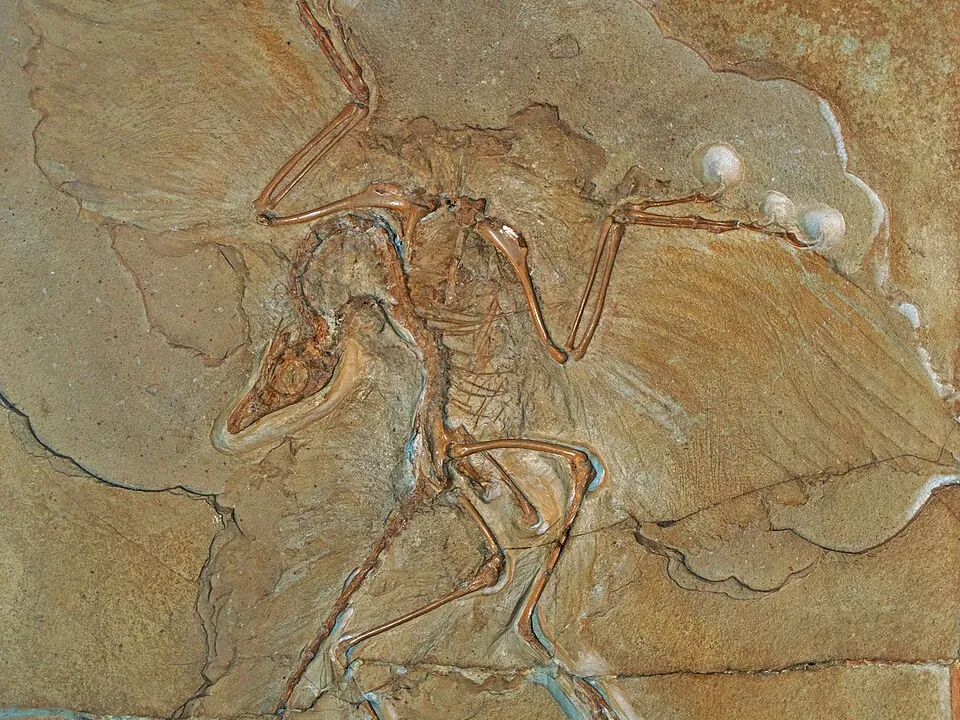
Archaeopteryx, found in Germany in 1861 just two years after Darwin's book, lived about 150 million years ago. It had feathers and wings like a bird, but also teeth, clawed fingers and a long bony tail like a small meat-eating dinosaur. Since 1996, fossil beds in China have revealed dozens of feathered dinosaurs, showing that feathers evolved in dinosaurs long before flight. Birds are living dinosaurs.
From land to sea
Whales are mammals: they breathe air, feed their young milk and have hair as embryos. Since the 1980s, fossils from Pakistan, India and Egypt have shown how they evolved from land mammals related to hippos. The early forms are recognised as whales by a thickened ear bone found only in whales.
- Before you dig, decide which layer you would search for an animal between fish and four-limbed animals, and why. Then turn on Show the prediction to compare.
- Dig the 385 Ma and 365 Ma layers. List what the animals in each have and lack.
- Dig the 375 Ma layer. Which features of the fossil are fish-like and which are like four-limbed animals?
- Why would digging the 370 Ma marine limestone be unlikely to help, even though it is the right age?
- Dig the 395 Ma layer. What does this find tell you about whether Tiktaalik was our direct ancestor?
Evidence from Australian fossils
Australia's long isolation makes its fossils especially revealing:
- Lightning Ridge, NSW, on Yuwaalaraay and Gamilaraay Country, has fossils turned to opal. In 1985 an opalised jaw about 100 million years old was described as Steropodon, an early monotreme: evidence that the ancestors of platypuses and echidnas were already here when dinosaurs were alive.
- Riversleigh, Queensland, on Waanyi Country, preserves about 25 million years of mammal evolution in limestone, including toothed platypuses, ancient koalas, marsupial lions and early thylacines. The sequence shows Australian rainforest animals changing as the continent dried.
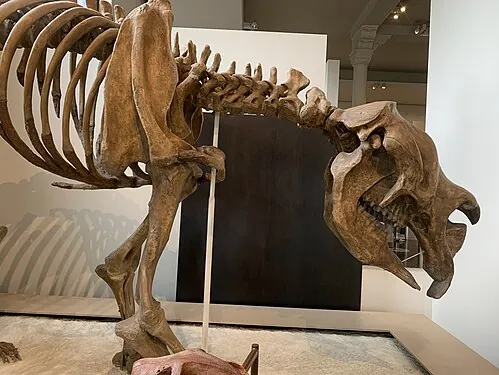
- Megafauna. Until about 40 000 years ago Australia had giant animals, including Diprotodon (a wombat relative weighing up to about 2.7 tonnes), the marsupial lion Thylacoleo, the giant bird Genyornis and short-faced kangaroos. Why they died out is still debated: a drying climate, hunting and changed fire patterns after people arrived, or a combination. First Nations people lived alongside megafauna for thousands of years.
- Rock art as evidence. Paintings in Arnhem Land show thylacines, which disappeared from mainland Australia about 3200 years ago. The art records animals that the fossil record also shows were once widespread.
Living fossils, and why there are gaps
Some living species look very like their fossil relatives. The coelacanth, a lobe-finned fish known only from fossils, was found alive off South Africa in 1938. The Queensland lungfish looks almost the same as fossils about 100 million years old, and the Wollemi pine (Year 7) belongs to a family known from fossils over 90 million years old. These are sometimes called living fossils, but the name is misleading: their DNA has kept changing, and they have simply kept a successful body plan in a stable environment, as stabilising selection predicts.
Why is the record incomplete? Fossilisation is rare, soft-bodied animals rarely fossilise, most rock containing fossils has been eroded, melted or is buried out of reach, and only a tiny fraction of fossil sites have been searched. Gaps are expected. What matters is that every new fossil found fits into the pattern instead of contradicting it, and that predictions like Shubin's succeed.
Test yourself
- A transitional fossil is best described as
It is usually a close relative of the actual ancestor.
- Which feature of Tiktaalik is shared with four-limbed animals rather than fish?
Fish have no neck; their head is joined directly to the shoulder bones.
- Why did Shubin's team search rocks about 375 million years old?
It was a prediction based on evolution, and it succeeded.
- On the current geological time scale, the Quaternary period began about
The older value of 1.8 million years was changed in 2009.
- Archaeopteryx is evidence that
It had feathers and wings, but also teeth, clawed fingers and a bony tail.
- Steropodon, an opalised jaw from Lightning Ridge, shows that
It is one of the oldest known mammal fossils from Australia.
Name each animal in the whale sequence.
Put these in the order they first appear in the fossil record, oldest first.
A fossil with features of two groups is a fossil. The period we live in is the . Giant Australian animals that died out about 40 000 years ago are called . Fossils at Lightning Ridge have been turned to . Fossil whales are recognised by a thickened bone.
A student says: "There are gaps in the fossil record, so fossils can't be good evidence for evolution." Evaluate this claim, using at least two examples.
The claim is not justified. Gaps are expected because fossilisation needs rapid burial and hard parts, so most organisms never fossilise, and many fossil-bearing rocks have since been eroded, melted or buried too deep to reach. Only a small fraction of the Earth's rocks have been searched. Despite the gaps, the fossils we do have strongly support evolution. First, they always appear in the same order: microbes, then simple animals, fish, amphibians, reptiles, then mammals and birds, and no fossil has been found in a layer that contradicts this. Second, there are many transitional fossils. Evolution predicted that a fish with limb-like fins should exist in river rocks about 375 million years old, and Tiktaalik was found in exactly such rocks in 2004. Fossil whales such as Pakicetus, Ambulocetus and Dorudon show hind legs shrinking and nostrils moving back as whales adapted to the sea. So, although the record is incomplete, the evidence it provides is consistent and has passed real tests.