 Coaching Centre
How new species form
What a species is, gene flow and reproductive isolation, isolating mechanisms such as timing, behaviour and hybrid sterility, allopatric and sympatric speciation, adaptive radiation, and examples from rock-wallabies, cicadas and Darwin's finches.
In 1981 a single large male cactus finch from another island landed on tiny Daphne Major in the Galápagos and bred with the local medium ground finches. His descendants had an unusual song and beak, and females of the local species ignored them. By their third generation they were breeding only with each other. The scientists watching called them the "Big Bird" lineage: a new population that, in a few decades, began behaving like a separate species.
What is a species?
A species is a group of organisms that can interbreed in nature to produce fertile offspring. Horses and donkeys can mate, but their offspring, mules, are almost always sterile, so horses and donkeys are separate species. A horse has 64 chromosomes and a donkey 62, so a mule has 63, and its chromosomes cannot pair up properly during meiosis to make sperm or eggs. Zebras crossed with horses (zorses) are sterile for the same reason.
This definition works well for animals that reproduce sexually, but it has limits. It cannot be tested on fossils, it doesn't apply to bacteria that reproduce asexually, and some separate species, especially plants, occasionally form fertile hybrids. Biologists therefore also use body features and DNA comparisons to decide where one species ends and another begins.
Gene flow and reproductive isolation
As long as individuals move between groups and interbreed, gene flow keeps mixing their gene pools, so the groups stay one species. A new species forms when one population becomes reproductively isolated: something stops gene flow between it and the rest of the species. Isolating mechanisms include:
| Mechanism | How it stops interbreeding | Example |
|---|---|---|
| Geographical | A physical barrier separates populations | Rock-wallaby colonies on separate rocky ranges; populations on different islands |
| Temporal (timing) | They breed at different times | Periodical cicadas that emerge every 13 or 17 years |
| Behavioural | Courtship signals don't match | Frog species with different calls; lyrebird and bowerbird displays |
| Mechanical | Body parts or flowers don't fit together | Flowers shaped so that only one kind of pollinator can reach the pollen |
| Gametic | Sperm cannot fertilise the egg | Corals and sea urchins releasing gametes into the same water |
| Hybrid problems | Hybrids die young or are sterile | Mules, zorses |
Speciation by separation
The most common way new species form is allopatric speciation ("other homeland"):
- A population is split by a geographical barrier, such as a rising sea, a river changing course, a mountain range, or a few individuals rafting to a new island.
- With no gene flow between the groups, each gene pool changes independently: different mutations arise, genetic drift acts differently, and natural selection favours different features if the environments differ.
- Over many generations the groups become so different that, even if the barrier disappears, they can no longer interbreed successfully. They are now separate species.
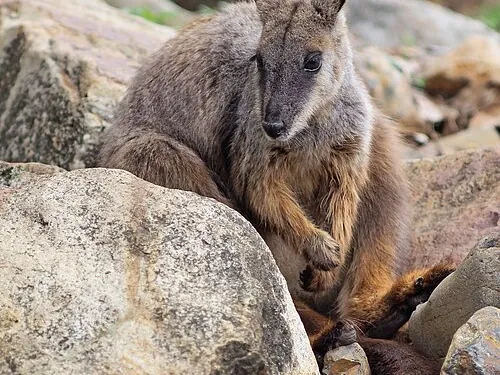
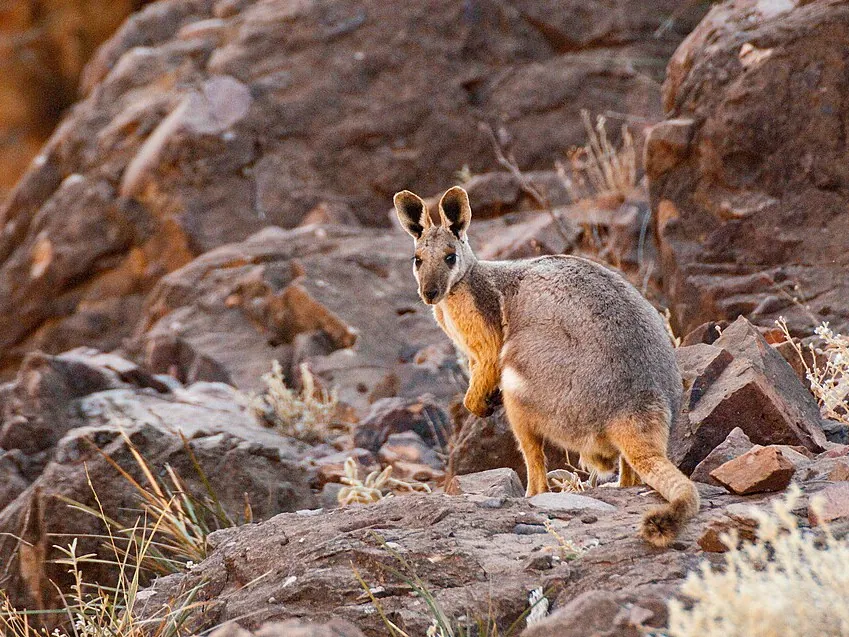
Australia has a striking example. Rock-wallabies (Petrogale) live on rocky outcrops and cliffs, and rarely cross the open country between them. There are about 17 species, many found only on one set of ranges, and neighbouring species often differ in their chromosomes. Some neighbouring populations can still produce hybrids where they meet, which shows speciation caught part-way through.
Islands are natural laboratories for allopatric speciation. In 1995 a group of green iguanas survived a hurricane by rafting about 250 km on a mat of uprooted trees to the Caribbean island of Anguilla, where they founded a new population. Darwin's finches probably began the same way: a small flock arrived from South America, spread to different islands and diverged.
- With a Wide sea and the same habitat on both sides, run until a new species forms. About how many generations does it take?
- Start again with Different habitats on each side turned on. How much faster do the two groups become separate species? Why does natural selection speed things up?
- Choose Narrow channel, where only about 2 lizards in every 10 000 cross each generation. Run 20 000 generations. Do they ever become separate species? What does this tell you about gene flow?
- Look at the colours of the lizards on each side when habitats differ. Which side's lizards would be better camouflaged if moved to the other side?
New species without separation
Occasionally new species form in the same place as the parent population, called sympatric speciation. It is most common in plants. A mistake in meiosis can produce offspring with double the normal number of chromosomes (polyploidy). These plants can breed with each other but not with the parent species, so they are instantly isolated. Bread wheat, cotton and many ferns arose this way. In animals, sympatric speciation is rarer and harder to prove, but cichlid fish in small crater lakes in Africa and Central America appear to have split into species that feed in different parts of the lake and choose mates of their own type.
Adaptive radiation
When a few individuals reach a new place with many unused resources, their descendants can spread into different niches and split into many species. This is adaptive radiation. Darwin's finches radiated into about 18 species that eat seeds, insects, cactus, leaves, and even the blood of seabirds. On a much bigger scale, the marsupials that rode Australia north from Gondwana radiated into kangaroos, possums, wombats, koalas, bandicoots, dunnarts and the extinct marsupial lion, filling roles that placental mammals fill on other continents. Eucalypts radiated into more than 800 species as Australia dried out.
Test yourself
- Horses and donkeys are different species because
A species must produce fertile offspring.
- Two frog species live in the same pond, but one calls in early spring and the other in late summer. This is
Breeding at different times prevents interbreeding.
- In allopatric speciation, what happens immediately after the population is separated?
Without gene flow, the gene pools then change independently.
- Why does even a small amount of gene flow tend to prevent speciation?
Shared alleles keep the gene pools similar.
- A plant with double its parent's number of chromosomes can breed only with similar plants. This is an example of
It is reproductively isolated in the same place as its parents.
- The many marsupials of Australia, filling roles that placental mammals fill elsewhere, are an example of
One ancestral group diversified into many niches.
Name each stage of allopatric speciation.
Does each mechanism stop interbreeding before or after mating?
A group that can interbreed to produce fertile offspring is a . Movement of alleles between populations is gene . Speciation after a barrier separates a population is called speciation. Speciation in the same place is speciation. One ancestor diversifying into many species is adaptive .
Thousands of years ago, rising seas after the last ice age cut Kangaroo Island off from mainland South Australia. Explain how a population of small lizards on the island could eventually become a new species, and describe how scientists could test whether speciation has happened.
When the sea separated the island, the island lizards were cut off from the mainland population, so gene flow between them stopped. From then on, the two gene pools changed independently. New mutations arose by chance in each population and were not shared. Because the island population was small, genetic drift could change its allele frequencies quickly. The island's climate, vegetation and predators were also different, so natural selection favoured different features, for example a different body colour or size. Over thousands of generations the allele frequencies of the two populations moved further apart. Eventually the differences, in DNA, chromosomes, courtship behaviour or body shape, could become great enough that the two groups could no longer produce fertile offspring together: the island lizards would then be a new species. To test this, scientists could compare the DNA of the two populations, and could bring island and mainland lizards together in suitable enclosures to see whether they recognise each other as mates, and whether any offspring survive and are themselves fertile. Pairs from the same population would be used as a comparison.