 Coaching Centre
Human evolution and the first Australians
How humans are related to other apes, features of hominins such as walking upright, the hominin family tree from Sahelanthropus to Homo sapiens, recent discoveries including Homo naledi, Homo floresiensis, Homo luzonensis and Denisovans, interbreeding, and the arrival of First Nations people in Australia at least 65 000 years ago.
In 2013 two cavers squeezed through an 18 cm wide crack deep in the Rising Star cave system in South Africa and found a chamber littered with bones. The team needed scientists slim enough to get through, and six women were chosen as "underground astronauts". They brought out more than 1500 pieces of at least 15 individuals of a species no one had seen before: Homo naledi.
Our place among the apes
Humans are primates, and our closest living relatives are chimpanzees and bonobos, then gorillas, then orangutans. Humans did not evolve from chimpanzees. Instead, humans and chimpanzees share a common ancestor that lived in Africa about 6 to 7 million years ago. Since then each lineage has evolved separately. The group that includes humans and all our extinct relatives since that split is called the hominins.
The key features that distinguish hominins evolved at different times:
- Walking upright on two legs (bipedalism) came first. Bipedal hominins have a skull opening for the spinal cord (foramen magnum) underneath, an S-shaped spine, a short bowl-shaped pelvis, thigh bones angled in towards the knees, and an arched foot with a big toe in line with the others. Footprints at Laetoli in Tanzania show hominins walking upright 3.66 million years ago.
- Smaller canine teeth and a flatter face.
- Larger brains came much later, mainly in the last 2 million years, along with stone tools, use of fire and complex culture.
A bush, not a ladder
Old pictures show a single line of ape-like ancestors marching towards a modern human. The fossils show something very different: a branching bush, with several hominin species often alive at the same time, and most branches ending in extinction.
- Early hominins such as Sahelanthropus (about 7 million years ago, Chad) and Ardipithecus (Ethiopia) show the first signs of upright walking.
- Australopithecines walked upright but had small, ape-sized brains. The "Taung child", found in South Africa in 1924 and described by Raymond Dart in 1925, was the first australopithecine discovered. "Lucy", a 3.2-million-year-old Australopithecus afarensis skeleton about 1.1 m tall, was found in Ethiopia in 1974.
- Early Homo, such as Homo habilis, appeared about 2.4 million years ago with larger brains and stone tools. Homo erectus was the first hominin to leave Africa, reaching Georgia by 1.8 million years ago and later Java and China, and survived in Java until about 110 000 years ago.
- Neanderthals lived in Europe and western Asia from about 400 000 to 40 000 years ago, with brains as large as ours. They made complex tools, used fire, cared for the sick and buried their dead.
- Our own species, Homo sapiens, appears in Africa about 300 000 years ago: the oldest fossils, from Jebel Irhoud in Morocco, were dated in 2017.
Discoveries that changed the story
Some of the biggest discoveries in human evolution have come since 2003, and several were made in our own region:
| Species | Found | What it showed |
|---|---|---|
| Homo floresiensis | Liang Bua cave, Flores, Indonesia, 2003 | Adults about 1.1 m tall with brains about 420 mL, living until at least 60 000 years ago (their stone tools until about 50 000). Fossils 700 000 years old from elsewhere on Flores suggest they descended from an early Homo population that shrank on the island. Early claims that they were modern humans with a disease are now rejected by most researchers. |
| Homo naledi | Rising Star cave, South Africa, described 2015 | A small brain (about 465–610 mL) with a mix of ancient and modern features, yet only 335 000 to 236 000 years old, alive at the same time as early Homo sapiens. Brain size did not simply increase in every lineage. Whether they deliberately buried their dead is still debated. |
| Homo luzonensis | Callao Cave, Luzon, Philippines, described 2019 | Teeth and hand and foot bones at least 50 000 years old, with curved finger and toe bones like much older hominins: another island species. |
| Denisovans | Denisova Cave, Siberia, 2010 | First identified from DNA in a single finger bone, not from a skeleton. A jaw from the Tibetan Plateau (identified 2019), a tooth from Laos (2022) and, in 2025, a skull from Harbin in China identified from its proteins and DNA show they lived across much of Asia. |
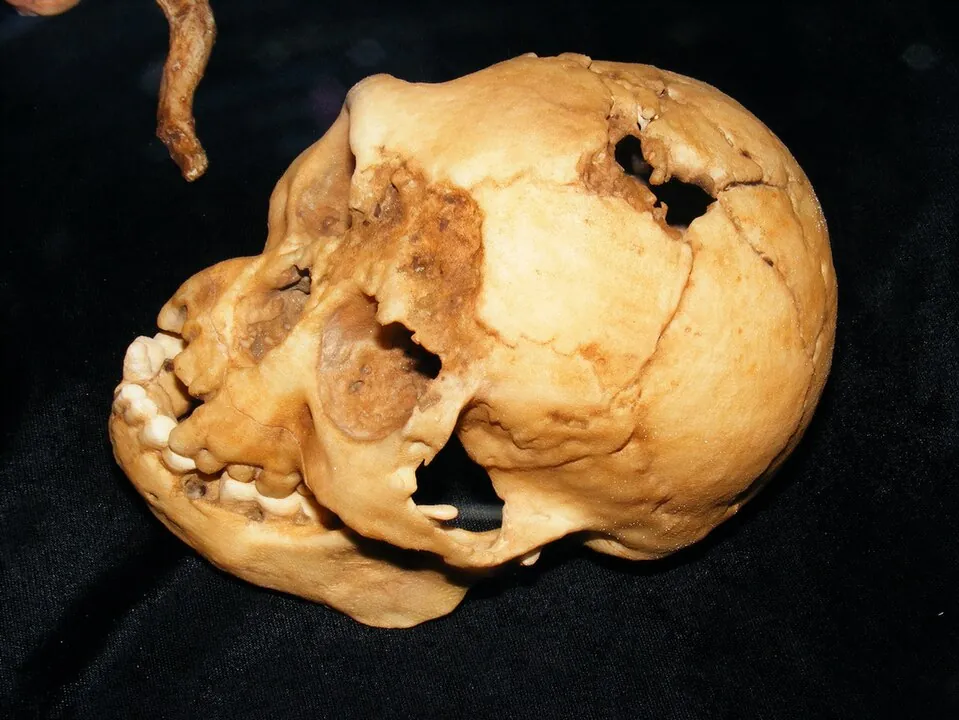
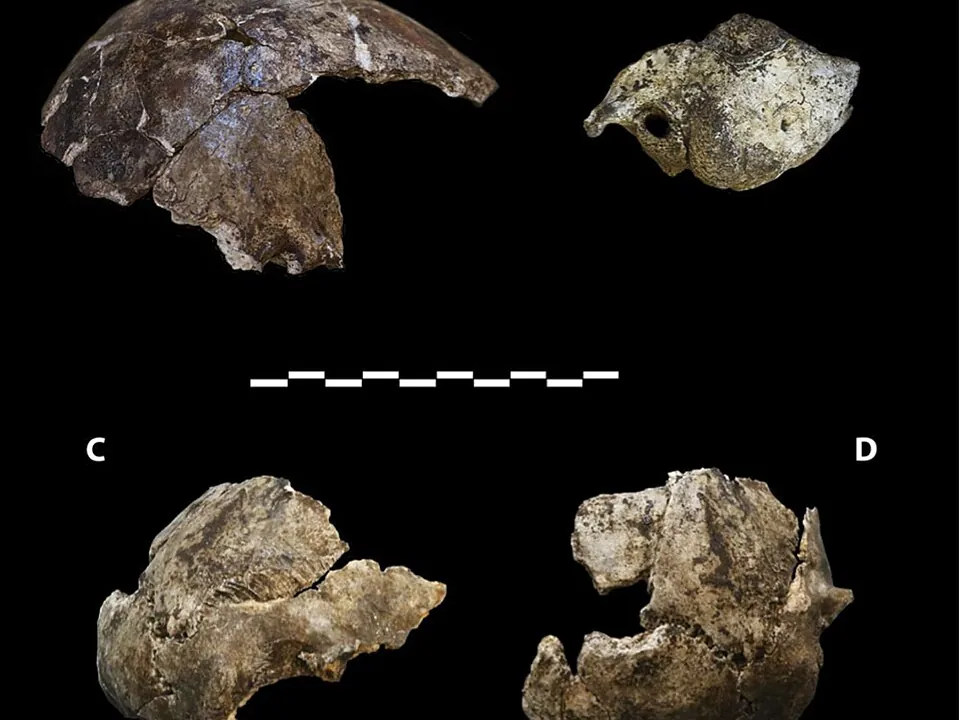
Ancient DNA has also shown that our species interbred with other hominins. People with ancestry from outside Africa carry about 1–2% Neanderthal DNA. People in Papua New Guinea and many Aboriginal Australians carry a few per cent of Denisovan DNA. Some of these inherited alleles were favoured by natural selection: a version of a gene called EPAS1, inherited from Denisovans, helps many Tibetan people live at high altitude with little oxygen.
- Drag the time to about 60 000 years ago. How many kinds of hominin were alive? Which were living in our region of the world?
- Drag to about 2 million years ago. Were Homo and Paranthropus alive at the same time?
- Turn on the Brain size graph. Find two species that do not fit the idea that brains always got bigger over time.
- Why is it wrong to draw human evolution as a single line?
The first Australians
During the ice ages, sea levels were up to about 120 m lower than today. Australia, New Guinea and Tasmania were joined in one continent called Sahul, and much of South-East Asia formed a continent called Sunda. But deep water always separated the two, along Wallace's Line. Even when sea levels were lowest, people reaching Sahul had to cross open sea between islands, in places tens of kilometres wide. These were among the earliest deliberate sea voyages known anywhere in the world.
At Madjedbebe, a rock shelter on Mirarr Country in western Arnhem Land, archaeologists working in partnership with the Mirarr Traditional Owners excavated stone tools, grinding stones and ground ochre. In 2017 they reported that the oldest layers are at least 65 000 years old. Some researchers argue for a younger date of about 50 000 to 55 000 years, but either way, First Nations peoples have lived in Australia for many tens of thousands of years, through ice ages, the loss of the megafauna and huge changes in sea level and climate: the oldest continuing cultures on Earth. Many First Nations people express this as having been on Country since the beginning, and the scientific dates are consistent with that deep connection.
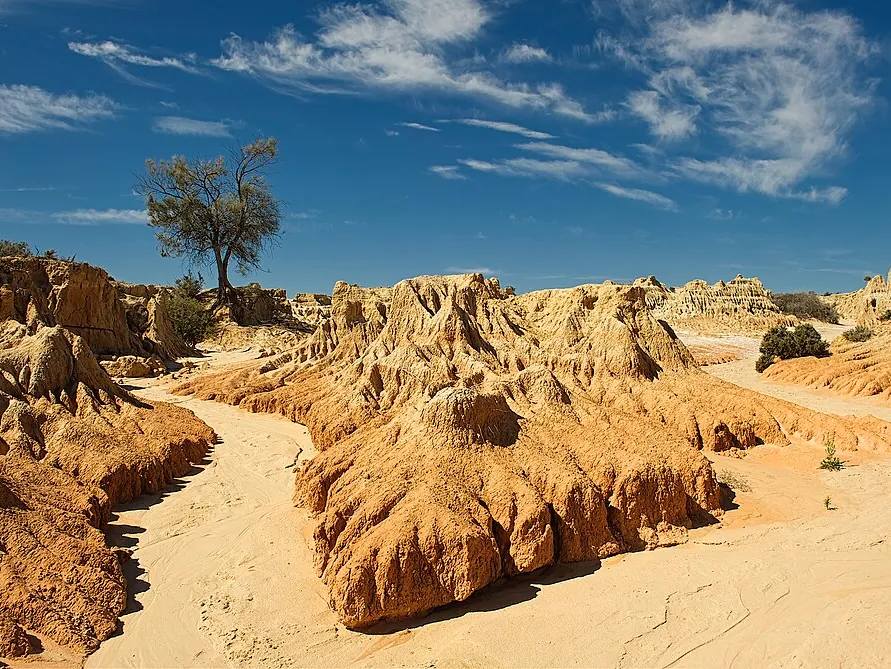
At Lake Mungo in the Willandra Lakes, on the Country of the Paakantyi (Barkindji), Mutthi Mutthi and Ngiyampaa peoples, the remains known as Mungo Lady and Mungo Man are about 42 000 years old. Mungo Lady was cremated and Mungo Man was buried with red ochre: among the oldest known ceremonial burials in the world. After decades in university collections, both were returned to Country at the request of their descendants. Nearby, hundreds of human footprints about 20 000 years old record adults and children walking across wet clay.
DNA studies published in 2016, carried out with the consent and involvement of Aboriginal communities, found that Aboriginal Australians and Papuans descend from one of the earliest groups of modern humans to leave Africa, and that Aboriginal populations in different regions have been separate for tens of thousands of years, matching the great diversity of languages and nations across the continent.
Are humans still evolving?
Yes. In the last 10 000 years, alleles that let adults digest the milk sugar lactose became common in populations that farmed cattle, goats or camels. Alleles that protect against malaria, such as the sickle cell allele, are common where malaria is widespread. The Bajau people of South-East Asia, who have dived for food for over 1000 years, have larger spleens that help them stay underwater longer. Natural selection continues wherever some inherited variation affects survival and reproduction.
Test yourself
- Which statement about humans and chimpanzees is correct?
Both lineages have been evolving separately since the split.
- A skull with the foramen magnum underneath, rather than towards the back, suggests the animal
The head balances on top of a vertical spine.
- What did the discovery of Homo naledi show?
It is only 335 000 to 236 000 years old despite its small brain.
- Denisovans were first identified from
A whole hominin group was recognised from its genome before its skulls were known.
- Why must the first people to reach Sahul have travelled by sea?
Australia and New Guinea were joined, but separated from Sunda by deep water.
- Madjedbebe, on Mirarr Country in Arnhem Land, is important because
It was excavated in partnership with the Mirarr Traditional Owners.
Label the features that distinguish the two skulls.
Put these hominins in order of when they first appear, oldest first.
Is each discovery mainly from fossils or from DNA?
Humans and their extinct relatives since the split from chimpanzees are called . Walking on two legs is called . When sea levels were low, Australia and New Guinea formed one continent called . The skull opening for the spinal cord is the foramen . Mungo Man was buried with red .
Old textbooks often showed human evolution as a straight line, with each species turning into the next. Use evidence from at least three discoveries made since 2003 to explain why scientists now describe human evolution as a branching bush.
A straight line implies one species at a time, each replaced by a more advanced, bigger-brained successor. Recent discoveries contradict this. Homo floresiensis, found on Flores in 2003, was about 1.1 m tall with a brain of about 420 mL, yet it lived until at least 60 000 years ago, when Homo sapiens and Neanderthals were also alive. Homo naledi, described in 2015, had a brain of about 465–610 mL but lived 335 000 to 236 000 years ago, at the same time as early Homo sapiens in Africa, so brain size did not increase steadily in every lineage. Homo luzonensis, described in 2019, was another separate island species in the Philippines at least 50 000 years ago. Ancient DNA revealed the Denisovans in 2010 and showed that modern humans interbred with both Denisovans and Neanderthals, so branches also exchanged genes. Together these show that many hominin species existed side by side, adapted to different places, and that most branches went extinct, leaving only Homo sapiens today. That pattern is a branching bush, not a ladder.