 Coaching Centre
Genetic testing and ethics
Newborn, carrier and predictive genetic testing, stem cells and cloning, the debate over GM foods, germline editing, and Indigenous genomics and data sovereignty, with a framework for weighing benefits, risks and values.
For about $500 you can now have your whole genome read. It might tell you that you are a carrier for a disease you have never heard of, that you have a raised risk of a cancer, or that you have relatives you didn't know about. Would you want to know? Who else should be allowed to know?
Kinds of genetic testing
| Test | Who and when | Example |
|---|---|---|
| Newborn screening | Almost every baby in Australia, a few days after birth, from a heel-prick blood spot | Phenylketonuria (PKU), cystic fibrosis and over 25 other conditions where early treatment makes a big difference |
| Carrier screening | Adults, ideally before pregnancy | Tests both partners for recessive alleles such as CF, spinal muscular atrophy and fragile X syndrome |
| Prenatal testing | During pregnancy | A blood test from the mother detects fragments of the baby's DNA to screen for trisomies |
| Diagnostic testing | People with symptoms | Sequencing a sick baby's genome to find the cause of a rare disease |
| Predictive testing | Healthy adults with a family history | Huntington's disease; BRCA1 and BRCA2 alleles that raise breast and ovarian cancer risk |
PKU shows why newborn screening matters. Babies with two recessive alleles can't break down the amino acid phenylalanine, which builds up and damages the developing brain. A diet low in phenylalanine, started in the first weeks, lets them develop normally. Screening for PKU began in the 1960s and is a big reason the heel-prick test exists.
Carrier screening in Australia
About 1 in 25 Australians of European ancestry carries a CF allele, and most have no family history of it. Between 2019 and 2023, Mackenzie's Mission, an Australian study named after a girl who died of spinal muscular atrophy, offered free screening for more than 1000 serious recessive conditions to about 10 000 couples. Around 1 in 50 couples were found to be at increased risk of having an affected child, and most of them had no idea. Since November 2023, Medicare has funded carrier screening for CF, spinal muscular atrophy and fragile X syndrome for anyone planning or in early pregnancy. Couples who are both carriers can choose among options including IVF with embryo testing, prenatal testing, using donor eggs or sperm, or going ahead with knowledge and preparation. Screening gives information and choices; it doesn't tell people what to do.
- With carriers at 1 in 25, how many of the 2500 couples are both carriers? Compare with the expected 1 in 625.
- Turn on babies. How many have CF? Press New group several times. Why does the number jump around?
- Change carriers to 1 in 50. Why does the number of affected babies fall by about four times, not two?
- Turn screening off. Why can't carriers be identified without a test?
Stem cells and cloning
In Year 8 you met stem cells: unspecialised cells that can divide and turn into specialised cells. Embryonic stem cells can become any cell type, but obtaining them destroys an early embryo, which some people believe is wrong. In 2006 Japanese scientist Shinya Yamanaka found that switching on just four genes turns ordinary adult skin cells back into stem-like cells, called induced pluripotent stem (iPS) cells, avoiding the use of embryos. He shared the 2012 Nobel Prize. Australian researchers have used iPS cells to grow "mini-kidneys" in the lab for testing drugs.
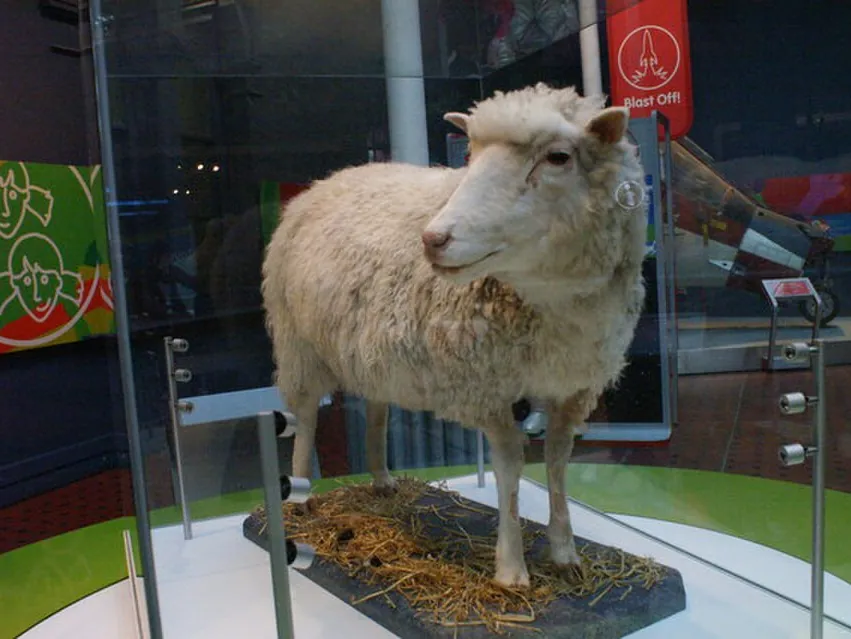
Cloning makes a genetically identical copy of an organism. Plants are cloned naturally and by cuttings (Year 8, 2C). Cloning an adult mammal was thought impossible until Dolly the sheep, born in July 1996 at the Roslin Institute in Scotland and announced in February 1997. She was made by somatic cell nuclear transfer: the nucleus of an udder cell from one sheep was put into an egg cell whose own nucleus had been removed; the egg was stimulated to divide and placed in a surrogate mother. It took 277 attempts. Dolly lived for six and a half years and had six lambs. Cloning is now used for some livestock and racehorses, and Australian scientists are storing frozen cells and tissue from endangered native animals in case cloning or other technologies can one day help save them. Cloning humans is illegal in Australia.
The GM food debate
Many people worry about eating genetically modified food. What does the evidence say? Major scientific bodies, including the World Health Organization, the US National Academies of Sciences and Australia's food regulator, have reviewed hundreds of studies and concluded that approved GM foods are as safe to eat as their non-GM equivalents. No health harm has been shown from eating them in the 30 years since the first, the Flavr Savr tomato, went on sale in the USA in 1994. Older textbooks said there was "no clear evidence either way"; that is no longer an accurate summary.
That doesn't settle every question, because many arguments are about values, economics and the environment rather than safety:
- Environment: Bt crops reduce insecticide spraying, but pests and weeds can evolve resistance; genes may spread to wild relatives.
- Economics: seed companies patent GM crops, and farmers must buy new seed each season. Critics worry about a few large companies controlling the food supply.
- Choice: some people want to avoid GM food for personal, cultural or religious reasons, which is why labelling matters.
- Benefits: crops that resist drought, pests or disease, or that are more nutritious, could help feed a growing population in a changing climate.
Editing future generations
Editing somatic cells affects only the patient. Editing an embryo, egg or sperm (germline editing) would change every cell of the person and be passed to their descendants. In 2018 Chinese scientist He Jiankui announced the birth of twin girls whose embryos he had edited with CRISPR to try to make them resistant to HIV. Scientists worldwide condemned it: the edits were not medically needed, were not done safely, and the parents had not been properly informed. He was jailed for three years. Germline editing for reproduction is illegal in Australia and many other countries. Many scientists say it should stay that way until it is proven safe and society agrees on whether it should ever be used, and for what.
Indigenous genomics and data sovereignty
Genetic research has a troubled history with Indigenous peoples. Blood samples were taken from Aboriginal and Torres Strait Islander communities for decades, often without people understanding how they would be used, and some were used for purposes the donors never agreed to. Around the world, there are cases of samples given for one study being used for others without permission.
Things are changing, led by Indigenous people. The National Centre for Indigenous Genomics at the Australian National University, governed by a board with an Indigenous majority, looks after a collection of about 7000 blood samples taken from Aboriginal and Torres Strait Islander people from the 1960s to the 1990s. It works with communities to decide whether each sample is returned, destroyed or used in research, and on what terms. Research done in genuine partnership has produced important results: a 2016 study, designed with Aboriginal communities, found that Aboriginal Australians descend from one of the first groups of people to leave Africa, and that they have lived continuously in Australia for around 50 000 years, among the oldest continuous cultures on Earth. Research is also working to make genomic medicine work for Indigenous people, whose DNA has been under-represented in the reference databases used to diagnose disease.
Two sets of principles guide this work:
- Indigenous data sovereignty, promoted in Australia by the Maiam nayri Wingara collective, is the right of Indigenous peoples to govern the collection, ownership and use of data about their communities, lands and resources. Genomic data is shared by whole families and communities, not just the individual who gave a sample.
- The CARE principles (Collective benefit, Authority to control, Responsibility, Ethics) set out how research data about Indigenous peoples should be handled so it benefits them.
These ideas apply beyond Indigenous research: your DNA also reveals information about your parents, siblings and children, who never consented to your test.
Weighing up a genetic technology
When you evaluate a technology, separate the questions:
- Science: what can it do, how well does it work, and what is the evidence on risks?
- Benefits and harms: to whom, now and in future? To individuals, communities and the environment?
- Rights and values: consent, privacy, fairness and access, cultural values, and who decides.
- Regulation: what controls exist, such as Australia's Gene Technology Regulator, food labelling laws and research ethics committees?
A balanced argument presents evidence for more than one position and reaches a justified conclusion.
Test yourself
Why are newborn babies screened for PKU?
Early treatment with a low-phenylalanine diet allows normal development.
Dolly the sheep was genetically identical to
Her nuclear DNA came from the udder cell.
Germline gene editing is controversial mainly because
Edits to embryos, eggs or sperm pass to descendants.
Indigenous data sovereignty means that
It is about authority and control over data, including genomic data.
If 1 in 25 people are carriers of CF, the chance that two random partners are both carriers is about
1/25 × 1/25 = 1/625. Their baby's chance of CF is then a further 1 in 4: 1 in 2500.
Which kind of question is it?
Order the steps used to clone Dolly.
Testing healthy adults for recessive alleles before pregnancy is screening. Adult cells reprogrammed to behave like embryonic stem cells are called pluripotent stem cells. Dolly was made by somatic cell nuclear . Editing embryos so the change is inherited is editing. The CARE principles guide how data is used.
A research team wants to study the genomes of people in a remote Aboriginal community to find genes linked to kidney disease, which is common there. Evaluate the benefits and the ethical issues, and recommend how the research should be done.
The research could bring real benefits. Finding genetic factors in kidney disease could improve diagnosis and treatment for a community that carries a heavy burden of the disease, and adding Indigenous genomes to reference databases would make genetic medicine more accurate for Aboriginal people, who are currently under-represented. However, there are serious ethical issues. In the past, samples were taken from Aboriginal communities without proper understanding or consent and used for other purposes, which damaged trust. Genomic data is collective: it reveals information about relatives and the whole community, not only the person tested, so individual consent alone is not enough. Results could also be misused to stigmatise the community or to suggest disease is "only genetic", ignoring factors such as access to healthy food and health care. I recommend the research go ahead only as a genuine partnership guided by Indigenous data sovereignty and the CARE principles: the community, through its own organisations, should help design the questions and have authority over how samples and data are stored, shared and used; consent should be informed and ongoing, with the right to withdraw samples; Aboriginal researchers and health workers should be involved; and results and benefits, such as better kidney care, should be returned to the community.