 Coaching Centre
The Big Bang theory
What the Big Bang theory says and doesn't say, the history of the universe from the first second to today, the main evidence (expansion, the cosmic microwave background, the abundance of light elements and the evolution of galaxies), the Steady State theory and how the scientific community decided between them, matter from energy, and the open questions of dark matter and dark energy.
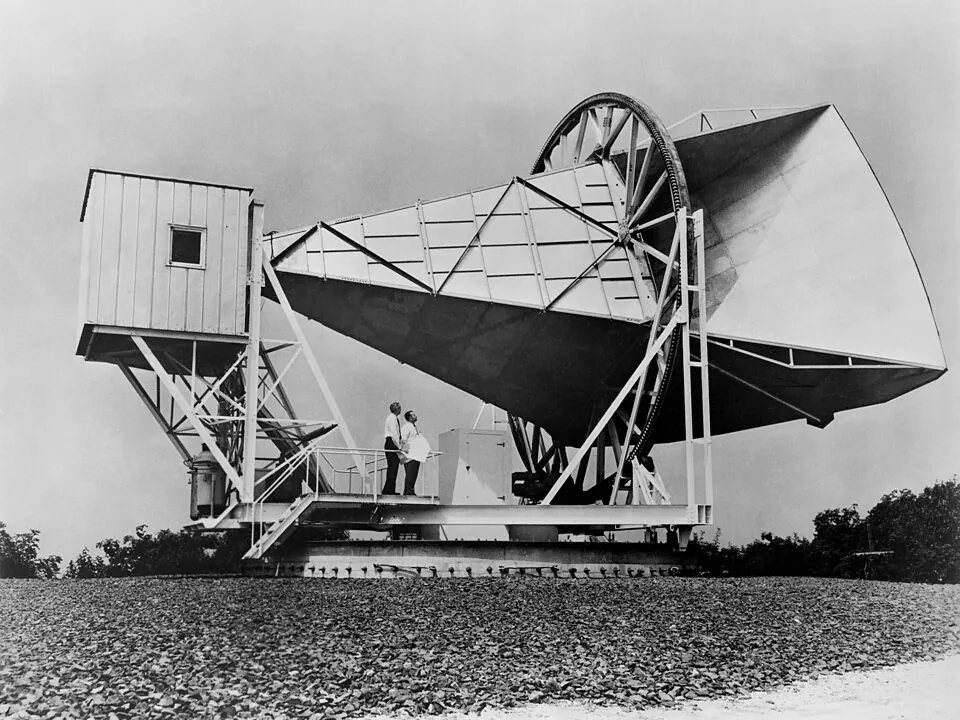
In 1964 two radio engineers at Bell Labs in New Jersey, Arno Penzias and Robert Wilson, had a problem. Their large horn-shaped antenna picked up a faint, steady hiss of microwaves that came from every direction, day and night. They checked the electronics, pointed it away from cities, and even evicted a pair of pigeons and cleaned out what they politely called "white dielectric material". The hiss stayed. It turned out to be the afterglow of the birth of the universe, and it earned them a Nobel Prize.
What the theory says
The Big Bang theory says that the universe began about 13.8 billion years ago in an extremely hot, dense state, and has been expanding and cooling ever since. As it cooled, energy became particles, particles became atoms, and gravity gathered atoms into stars and galaxies.
The name is misleading in two ways. It wasn't an explosion of matter flying out into empty space from one point: space itself has been expanding everywhere at once, so there is no centre and no edge that the universe is expanding into. And the theory describes what happened after the beginning; it doesn't explain what, if anything, came before or caused it. The name itself was coined in 1949 by Fred Hoyle, who didn't believe the theory, on a BBC radio program.
| Time after the Big Bang | Temperature | What happened |
|---|---|---|
| Less than 10⁻³² s | unknown | Inflation: a tiny region expands enormously in a fraction of a second (a hypothesis with good support, proposed in 1980). |
| Up to about 1 s | trillions to 10 billion K | Energy turns into particles. Quarks join to make protons and neutrons. |
| 3 to 20 minutes | about 1 billion K | Nucleosynthesis: protons and neutrons fuse into helium nuclei, with traces of deuterium and lithium. |
| 380 000 years | about 3000 K | Electrons join nuclei to make atoms. Light can travel freely: the cosmic microwave background is released. |
| To about 100 million years | falling | The "dark ages": no stars yet. |
| About 100 to 200 million years | The first stars form. JWST has seen galaxies from less than 300 million years after the Big Bang. | |
| About 1 billion years onwards | Galaxies grow and merge; stars make heavier elements. | |
| 9.2 billion years (4.6 billion years ago) | The Sun and Earth form. | |
| 13.8 billion years (today) | 2.7 K (the CMB) | The expansion is speeding up. |
- Start at 1 second. What is the temperature? What particles exist?
- Move to 3 minutes. What is forming, and why couldn't it form earlier?
- Go to 380 000 years. What is the temperature, and how big was any region compared with today? Where is the light's peak wavelength?
- Jump to Today. How has the light released at 380 000 years changed? Why do we now detect it as microwaves?
- Drag slowly from 380 000 years to 1 billion years. What changes in the box, and why does this period get called the dark ages?
The evidence
A scientific theory is only as good as its evidence. The Big Bang is accepted because it predicted things that were later observed, and no other idea explains them all.
1. The universe is expanding. Hubble's law (6F) shows galaxies receding faster the further away they are, as expected if space is expanding. Run the expansion backwards and everything was once together in a hot, dense state.
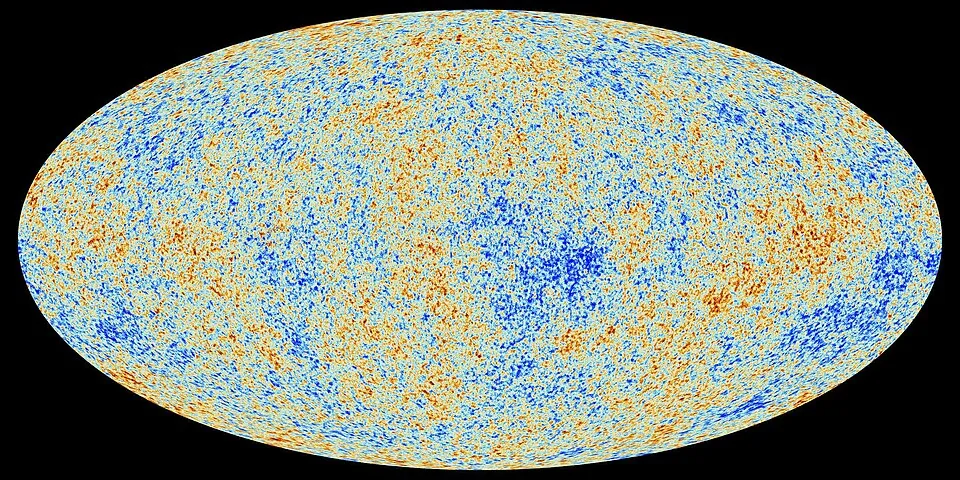
2. The cosmic microwave background (CMB). Until 380 000 years, the universe was a glowing fog: light kept bouncing off free electrons. When atoms formed, the fog cleared and that light set off across space. In 1948 Ralph Alpher and Robert Herman predicted that, stretched by billions of years of expansion, it should still fill the sky as microwaves at a few degrees above absolute zero. Penzias and Wilson found it by accident in 1964–65. The COBE satellite (1989–1993) showed it has exactly the spectrum expected from a hot glowing object, now at 2.725 K, and also detected tiny temperature ripples of about 1 part in 100 000. The WMAP and Planck satellites later mapped these ripples in detail. They are the seeds of galaxies: slightly denser regions that gravity later pulled together.
3. The amounts of light elements. The theory predicts that in the first 20 minutes, about 25% of the ordinary matter (by mass) became helium and almost all the rest stayed as hydrogen, with small, precise amounts of deuterium and lithium. That is what astronomers measure in the oldest stars and in gas clouds that have never been inside a star. Stars could never have made that much helium in the time available.
4. Galaxies change over time. Looking far away means looking back in time (6A). Distant galaxies are smaller, bluer and more irregular than nearby ones, and violent quasars were far more common billions of years ago. The universe hasn't always looked the same, as it would if it had no beginning.
Big Bang or Steady State?
The Big Bang wasn't accepted straight away. In 1948 Fred Hoyle, Hermann Bondi and Thomas Gold proposed the Steady State theory. It accepted that the universe is expanding, but said that new matter is created continuously in the gaps, so the universe looks the same at all times and has no beginning and no end. It was a serious, testable theory, and for about 15 years many astronomers preferred it.
| Observation | Big Bang predicts | Steady State predicts | What we find |
|---|---|---|---|
| Galaxies are moving apart | Yes | Yes | Both fit |
| The distant (past) universe | Looks different from today | Looks the same as today | Different: more radio galaxies and quasars long ago |
| Cosmic microwave background | Yes, at a few kelvin | No natural explanation | Found in 1965 |
| About 25% helium everywhere | Yes | No | Yes |
Through the 1950s and 1960s, counts of distant radio sources, the discovery of quasars and finally the CMB tipped the balance. This is how the scientific community reviews ideas: theories make predictions, other scientists test them, results are published and checked by peers, and the theory that best fits all the evidence is accepted, while staying open to change. The Big Bang theory itself has been refined many times since, with inflation, dark matter and dark energy.
Matter from energy
How can energy turn into matter? Einstein's equation E = mc² says mass and energy are equivalent; c is the speed of light, 3 × 10⁸ m/s. In the early universe, energy was so concentrated that particle pairs were created constantly. Today, the Large Hadron Collider at CERN smashes protons together at 99.999999% of the speed of light, and the energy of the collisions creates new, heavier particles that weren't there before.
How much energy is released if 0.0005 kg (half a gram) of matter is completely converted into energy?
E = 0.0005 × (3 × 10⁸)² = 0.0005 × 9 × 10¹⁶ = 4.5 × 10¹³ J
That is about the energy released by 10 000 tonnes of TNT, from half a gram of matter. Going the other way, it takes an enormous amount of energy to make even a tiny amount of matter.
What we still don't know
The Big Bang theory is very successful, but it has revealed new mysteries.
- Dark matter. Galaxies and clusters contain about five times more matter than we can see (6H). Nobody yet knows what it is.
- Dark energy. In 1998 two teams, one led by Brian Schmidt at the Australian National University's Mount Stromlo Observatory with Adam Riess, and the other by Saul Perlmutter, used type Ia supernovae to find that the expansion of the universe is speeding up. They shared the 2011 Nobel Prize in Physics. Whatever causes it is called dark energy. Together, ordinary matter makes up only about 5% of the universe, dark matter about 27% and dark energy about 68%. Recent results from the DESI galaxy survey (2024–25) hint that dark energy might be changing over time; more data will tell.
- The beginning. Our physics breaks down at the very start, so we can't yet say what happened at time zero, or whether "before" even has a meaning.
- The future. If dark energy stays the same, the universe will expand forever, getting colder and darker as stars burn out.
Test yourself
The best current estimate of the age of the universe is
4.6 billion years is the age of the Solar System.
The cosmic microwave background is
It was released at about 380 000 years.
Which observation could the Steady State theory NOT explain?
Both theories accept expansion, but only the Big Bang predicts the CMB.
About what fraction of the ordinary matter made in the first 20 minutes became helium?
About 25% helium and 75% hydrogen by mass, as observed.
Using E = mc², converting 1 × 10⁻⁷ kg of hydrogen entirely into energy releases
1 × 10⁻⁷ × 9 × 10¹⁶ = 9 × 10⁹ J.
Label the timeline of the universe.
Put these events in order, from earliest to latest.
Which of these support the Big Bang theory?
The Big Bang theory says the universe began about billion years ago in a hot, dense state and has been and cooling ever since. About 380 000 years later formed and light could travel freely; this light is now detected as the cosmic background, at a temperature of about 2.7 K. The theory also explains why about 25% of ordinary matter is .
Evaluate the evidence for the Big Bang theory, and explain how the scientific community came to accept it over the Steady State theory.
The Big Bang theory says the universe began 13.8 billion years ago in a hot, dense state and has been expanding and cooling ever since. Several independent lines of evidence support it. First, galaxies are redshifted, and Hubble's law shows that more distant galaxies recede faster, as expected if space is expanding; running this backwards implies a hot, dense beginning. Second, the cosmic microwave background: in 1948 Alpher and Herman predicted that light released when atoms formed would now be stretched into microwaves a few degrees above absolute zero. Penzias and Wilson detected it in 1965, and COBE showed it has the exact spectrum of a 2.725 K glowing body, with tiny ripples that match the seeds of galaxies. Third, the theory predicts that about 25% of ordinary matter became helium in the first 20 minutes, which matches measurements in the oldest stars and gas, and is far more than stars could have produced. Fourth, distant galaxies, seen as they were long ago, look different from nearby ones, so the universe has changed over time.
The Steady State theory of Hoyle, Bondi and Gold accepted expansion but proposed continuous creation of matter, so the universe would always look the same. It made clear predictions, which is why it could be tested: it predicted no CMB, no universal 25% helium and no change in the distant universe. Radio source counts and quasars in the 1950s and 60s showed the universe had changed, and the discovery of the CMB in 1965 was decisive, because the Steady State theory had no natural explanation for it. Through prediction, independent testing and peer-reviewed publication, the community moved to the Big Bang. In my judgement the CMB is the strongest single piece of evidence because it was predicted in advance and measured precisely. The theory is still being refined, for example by adding dark matter and dark energy and investigating the Hubble tension, which shows that science stays open to new evidence.