 Coaching Centre
Galaxies and the expanding universe
Types of galaxies and Hubble's classification, the discovery that galaxies lie far beyond the Milky Way, redshift and the Doppler effect, Hubble's law and the Hubble constant, why space itself is expanding, estimating the age of the universe, and the current Hubble tension.
In April 1920 two astronomers debated a simple question in front of the US National Academy of Sciences: is the Milky Way the whole universe? Harlow Shapley argued that the fuzzy "spiral nebulae" were clouds inside our galaxy. Heber Curtis argued that they were separate galaxies, "island universes", far away. Neither could prove it. Less than five years later the answer came from a single variable star, and the known universe grew by a factor of millions.
Kinds of galaxies
Galaxies come in a few main shapes. Edwin Hubble arranged them in a "tuning fork" diagram in 1926, and his labels are still used.
- Elliptical galaxies (E0 to E7, from round to flattened) are smooth balls of mostly old, yellow-red stars with little gas, so few new stars form. The biggest galaxies known are giant ellipticals, often at the centres of galaxy clusters.
- Spiral galaxies (Sa to Sc) have a central bulge and a flat disc with spiral arms, where gas and dust form new, blue stars. Barred spirals (SBa to SBc), like the Milky Way, have a bar of stars across the middle. The "a" types have big bulges and tightly wound arms; the "c" types small bulges and loose arms.
- Lenticular galaxies (S0) have a disc but no arms and little gas.
- Irregular galaxies have no clear shape, often because of the gravity of a neighbour. The Magellanic Clouds are irregular galaxies.
There are far too many galaxies for astronomers to classify by eye. Since 2007, the Galaxy Zoo project has asked members of the public to classify galaxies online; hundreds of thousands of volunteers have made tens of millions of classifications, and each galaxy is checked by many people to reduce errors. Volunteers have even discovered new kinds of objects.
Galaxies beyond the Milky Way
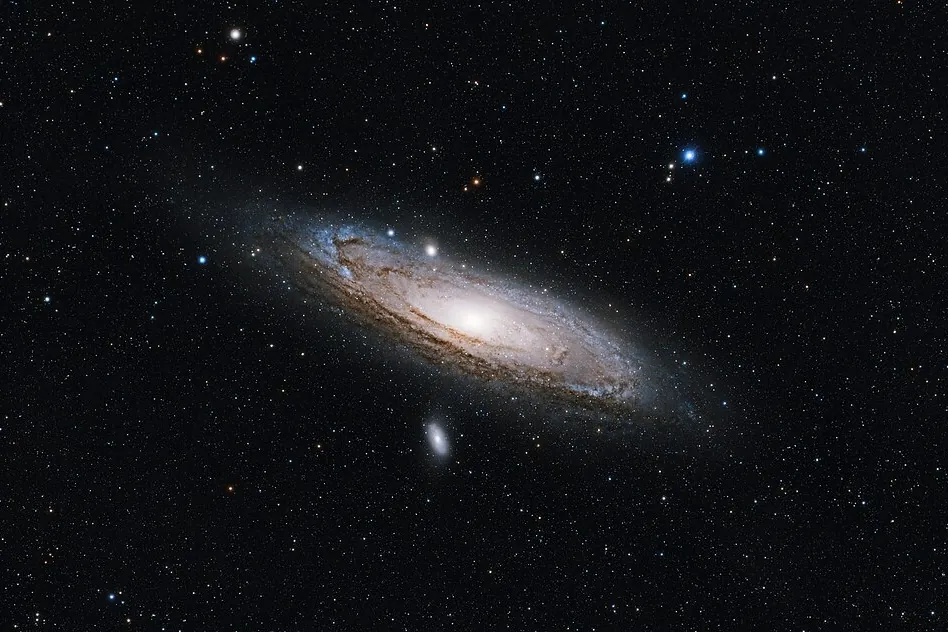
The debate was settled using Henrietta Leavitt's Cepheid variables (6B). In 1923 Edwin Hubble found a Cepheid in the Andromeda "nebula" using the 2.5 m Hooker telescope in California. Timing its pulses gave its true brightness, and comparing that with how bright it looked showed that Andromeda was far outside the Milky Way. Hubble's figure was about 900 000 light years; the modern value is 2.5 million (the Cepheid scale was later corrected). Andromeda was a galaxy as big as our own, and the countless other spiral nebulae were galaxies too.
Redshift
When an ambulance races past, the pitch of its siren drops. As it approaches, its sound waves are squashed together to a shorter wavelength (higher pitch); as it moves away, they are stretched out to a longer wavelength (lower pitch). This is the Doppler effect, and it happens to light too. Light from an object moving away from us is shifted towards longer, redder wavelengths, a redshift. Light from an object approaching is shifted towards the blue, a blueshift.
A rainbow-like spectrum alone doesn't show a shift, but the dark absorption lines of elements do (Year 7 showed how they identify elements). Each element's lines are always at the same wavelengths in a laboratory, so if a galaxy's lines are all shifted by the same proportion, the galaxy is moving.
The redshift z is the fractional change in wavelength. For speeds much less than the speed of light, the speed v is c × z:
z = (observed wavelength − laboratory wavelength) ÷ laboratory wavelength v = c × z
The hydrogen-alpha line is at 656.3 nm in a laboratory. In a galaxy's spectrum it appears at 669.4 nm. How fast is the galaxy moving, and in which direction?
z = (669.4 − 656.3) ÷ 656.3 = 13.1 ÷ 656.3 = 0.0200
v = c × z = 300 000 km/s × 0.0200 = 6000 km/s
The wavelength got longer (a redshift), so the galaxy is moving away from us.
Hubble's law
From 1912 the American astronomer Vesto Slipher measured the spectra of spiral nebulae and found that most were redshifted, some moving away at over 1000 km/s, much faster than any star. In 1927 the Belgian physicist and priest Georges Lemaître combined Slipher's speeds with distances and argued that the universe is expanding. In 1929 Hubble, using his own distances, published the relationship clearly: the further away a galaxy is, the faster it is moving away. This is Hubble's law (since 2018 the International Astronomical Union has recommended calling it the Hubble–Lemaître law):
v = H₀ × d
v is the speed of recession (km/s), d is the distance (in megaparsecs, Mpc; 1 Mpc = 3.26 million ly), and H₀, the Hubble constant, is the gradient of the graph. Its value is about 70 km/s per Mpc: for every extra megaparsec of distance, galaxies are moving away about 70 km/s faster.
Hubble's own estimate in 1929 was about 500 km/s per Mpc, seven times too big, because the Cepheids he used were brighter than he thought, which made his distances too small. As distance measurements improved, the value came down. It is a good example of science correcting itself as evidence improves.
- Choose Galaxy A and measure its redshift. Check the calculation: what are z and v?
- Measure all eight galaxies. Describe the pattern on the graph.
- Fit the line. You should find H₀ is about 70 km/s per Mpc. What does the gradient mean in words?
- Read the age estimate, 1 ÷ H₀. How close is it to the accepted age of 13.8 billion years?
- Clear the graph and fit only the four nearest galaxies. How much does H₀ change? Why do astronomers try to measure galaxies at many distances?
It's space that's expanding
Hubble's law doesn't mean we are at the centre of an explosion. A better picture is a loaf of raisin bread rising in the oven. Every raisin moves away from every other raisin, and raisins that start further apart separate faster, because there is more dough between them to stretch. A raisin can't tell whether it is in the middle of the loaf: every raisin sees the same pattern. In the same way, observers in any galaxy would see the others moving away according to Hubble's law. The universe has no centre.
The galaxies aren't really flying through space; space between them is stretching. As light crosses expanding space, its wavelength is stretched too: that is what the redshift of distant galaxies really is. Gravity holds smaller things together against the expansion. Galaxies, our Local Group, and of course the Solar System and you, are not expanding. Andromeda, held by gravity in the Local Group, is actually approaching us at about 110 km/s and shows a blueshift. It may collide with the Milky Way in a few billion years.
How old is the universe?
If galaxies are all moving apart, then in the past they were closer together. Run the expansion backwards and everything was together at one time. If the expansion had always been at the same rate, the time since then would be 1 ÷ H₀:
1 Mpc = 3.26 × 10⁶ ly × 9.46 × 10¹² km = 3.09 × 10¹⁹ km
H₀ = 70 km/s per Mpc, so 1 ÷ H₀ = 3.09 × 10¹⁹ km ÷ 70 km/s = 4.41 × 10¹⁷ s
4.41 × 10¹⁷ s ÷ 3.156 × 10⁷ s per year = 1.4 × 10¹⁰ years, about 14 billion years
The best modern value, which allows for the expansion first slowing and then speeding up, is 13.8 billion years. The simple estimate is remarkably close.
Test yourself
A galaxy's spectral lines are shifted to longer wavelengths. This shows the galaxy is
A redshift shows motion away from the observer.
Using H₀ = 70 km/s per Mpc, a galaxy 200 Mpc away is moving away at about
v = 70 × 200 = 14 000 km/s.
A galaxy's spectrum has a redshift z = 0.05. Its speed is about
v = cz = 300 000 × 0.05 = 15 000 km/s.
Andromeda shows a blueshift because
Locally, gravity is stronger than the expansion.
A smaller value of the Hubble constant would mean the universe is
Age ≈ 1 ÷ H₀, so a smaller H₀ gives a larger age.
Label the types of galaxy.
Put these discoveries in the order they were made.
Light from galaxies moving away is shifted to longer wavelengths, a . Hubble's law says that a galaxy's speed is proportional to its . The gradient of the graph is the Hubble . The redshift happens because itself is expanding. One divided by H₀ gives an estimate of the of the universe.
Explain how measurements of galaxy spectra and distances led scientists to conclude that the universe is expanding, and how the same measurements can be used to estimate its age. Refer to the work of at least two scientists.
Elements absorb light at fixed wavelengths, producing dark lines in a galaxy's spectrum. From 1912 Vesto Slipher found that in most spiral nebulae these lines were shifted towards the red. By the Doppler effect, a redshift means the source is moving away, with speed v = c × z, where z is the fractional change in wavelength. Using Henrietta Leavitt's Cepheid variables as standard candles, Edwin Hubble measured the distances to these galaxies and in 1929 showed that the further away a galaxy is, the faster it recedes: v = H₀d, a straight line through the origin. Georges Lemaître had already argued in 1927 that this is what an expanding universe would produce.
The pattern is explained by space itself stretching: like raisins in rising bread, galaxies that are further apart separate faster, and every galaxy sees the same thing, so there is no centre. If everything is moving apart now, it must have been closer together in the past. Running the expansion backwards at a constant rate gives an age of 1 ÷ H₀; with H₀ ≈ 70 km/s per Mpc this is about 14 billion years, close to the accepted 13.8 billion years. Hubble's first value of H₀ was about 500, because his Cepheid distances were too small, and later, better measurements corrected it, which shows how the scientific community refines its conclusions.