 Coaching Centre
Writing and presenting your report
The sections of a scientific report and what goes in each, writing an abstract and a method someone could repeat, scientific writing style, figures and captions, academic honesty and AI, and presenting your research as a poster or talk.
On 25 April 1953 the journal Nature published a paper by James Watson and Francis Crick proposing the double-helix structure of DNA. It was about one page long, with a single diagram. Its most famous sentence is an understatement: "It has not escaped our notice that the specific pairing we have postulated immediately suggests a possible copying mechanism for the genetic material." Good scientific writing is not long or fancy. It is clear, exact and honest about what the evidence shows.
The structure of a report
You met the basic sections in Year 7 (1H). At Stage 5 each section does more:
| Section | What it does at Year 10 level |
|---|---|
| Title | Names the independent and dependent variables: "The effect of mulch type on water loss from potted soil" |
| Abstract | 100–150 words summarising the aim, method, key result (with a number) and conclusion. Written last, placed first. |
| Introduction | Background research with citations (a mini literature review, 8B), the gap your study fills, the aim, and the hypothesis with its reason |
| Method | Materials with sizes and amounts; variables (independent, dependent, controlled, control group); risk assessment; numbered or paragraph steps; labelled diagram or photo of the set-up |
| Results | Numbered tables and graphs with captions, and a short written summary of the main findings. No explanations yet. |
| Discussion | Explains the results with science, compares them with research, deals with anomalies, evaluates validity, reliability and accuracy, suggests further research (8H) |
| Conclusion | Answers the aim with data and states whether the hypothesis was supported |
| References | Every source cited, in one consistent style (8B) |
| Appendices | Raw data, extra photos, the risk assessment form, and your logbook |
Writing an abstract
Busy scientists read the abstract to decide whether to read the rest, so it must stand alone. Aim for one or two sentences each on why, how, what you found and what it means.
An abstract for the mulch investigation (118 words).
Writing a method someone could repeat
The test of a method is simple: could another student repeat your experiment exactly, using only what you wrote? Include amounts, sizes, times, temperatures and how each measurement was taken. Reports are written in the past tense, because you are reporting what was done, while your logbook can use instructions or notes.
| Logbook note | Report method |
|---|---|
| fill pots w/ soil + water | Sixteen 15 cm plastic pots were each filled with 1.50 kg of the same potting mix and watered with 500 mL of tap water. |
| mulch on, 5 cm | Four pots each were covered with 5 cm of sugarcane mulch, pine bark or 10 mm gravel; four were left uncovered as the control. |
| weigh every arvo | Each pot was weighed at 4 pm daily for 7 days on an electronic balance (± 0.1 g). Pot positions were changed daily using a random number generator. |
Traditionally, reports were written in the passive voice ("the pots were weighed"). Many journals now accept "we weighed the pots", which is often clearer. Follow your teacher's preference and be consistent.
Scientific writing style
- Be exact. Not "a lot hotter" but "6.5 °C hotter". Not "a while" but "after 10 minutes".
- Be concise. Cut words that add nothing: "In order to" becomes "To".
- Use scientific terms correctly: valid, reliable, accurate, precise, correlation, hypothesis supported.
- Number and caption every table and figure ("Figure 2: Mean mass of water lost…"), and refer to them in the text.
- Keep personal reflection for the logbook. "I had lots of fun" doesn't belong in a report.
- For each section, pick the strongest version. Read the feedback on the ones you didn't pick too.
- Choose a weak version for Results. What would a marker say is missing?
- Look at the finished report on the right. Which section would you most want to improve in your own past work?
Academic honesty and AI
Your report must be your own work. Copying sentences, even with small changes, without quotation marks and a citation is plagiarism, and so is submitting text written by someone else or generated by AI as if it were yours. Follow your school's rules on AI tools: some allow them for brainstorming or checking spelling if you declare it, others don't. Above all, never invent or "tidy up" data. Fabricating results is the most serious offence in science, and it always comes out eventually, because other people try to repeat your work.
Presenting your research
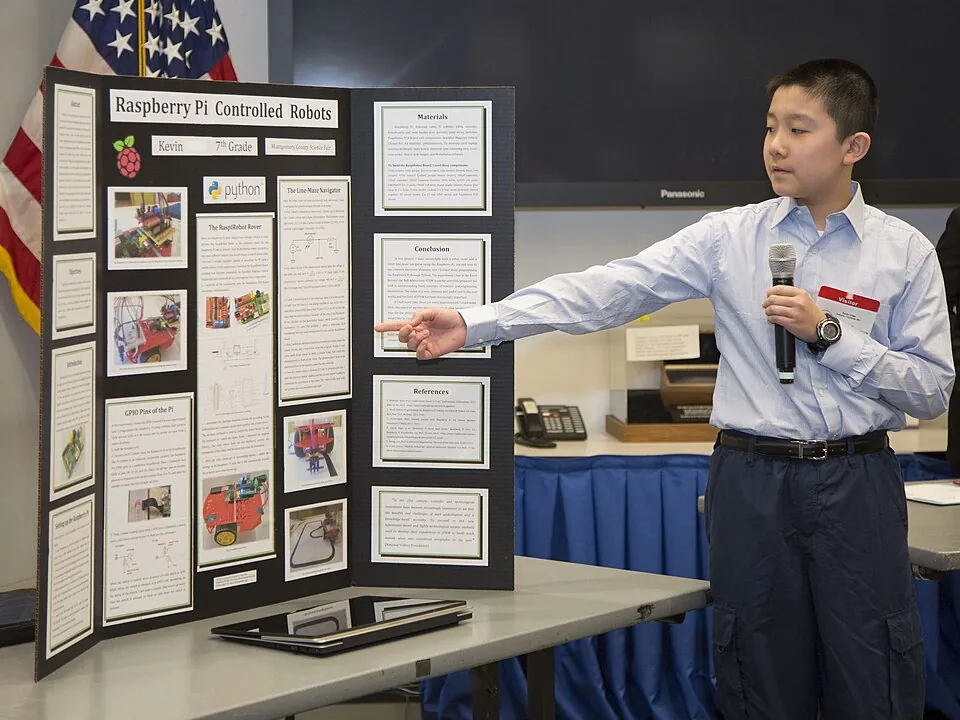
Scientists share results at conferences as talks and posters, and you may present your project the same way. A poster is not your report shrunk down: it should be readable in two minutes from a couple of metres away.
For a talk, practise a two-minute version: the question, why it matters, what you did (with a photo), the key graph, and your conclusion. Expect questions about your method and its limitations; a good answer often begins "That's a limitation; next time I would…". If your project is strong, consider entering a competition such as the STANSW Young Scientist Awards in NSW.
Test yourself
Which sentence belongs in the results section?
Results report data without explanation or evaluation.
The abstract of a report
It is a stand-alone summary of the whole report.
Which is the best method step?
It gives amounts, conditions and how the measurement was taken, in the past tense.
Which is the most serious breach of research integrity?
Fabricating or falsifying data destroys trust in all of a scientist's work.
Label the parts of the research poster.
Put the sections of a report in order.
A stand-alone summary at the start of a report is the . Methods are written in the tense. Raw data and extra material go in the . Copying someone's words without credit is . Every table and figure needs a number and a .
Rewrite this student's method step so that another student could repeat it exactly, and explain two improvements you made: "Get a cup of water and put some salt in it. Stir it till it dissolves and then put in the egg and see if it floats."
"200 mL of tap water at room temperature (22 °C) was measured with a measuring cylinder and poured into a 250 mL beaker. 10.0 g of table salt, weighed on an electronic balance, was added and stirred with a glass rod until no crystals could be seen. A fresh egg was lowered gently onto the surface with a spoon, and whether it floated or sank was recorded after 30 seconds." First, I replaced "some salt" and "a cup of water" with exact amounts and equipment, so another student would use the same concentration and could compare results. Second, I made the observation specific (floats or sinks, recorded at a set time) so that the result is recorded the same way every time. I also wrote it in the past tense, as a report records what was done.