 Coaching Centre
Life cycles of stars
How stars are born in nebulae, the balance between gravity and pressure, fusion and E = mc², the different fates of low-mass and massive stars (red giants, planetary nebulae, white dwarfs, supergiants, supernovae, neutron stars and black holes), where the elements come from, and observations of changing stars including Aboriginal records of variable stars and Eta Carinae.
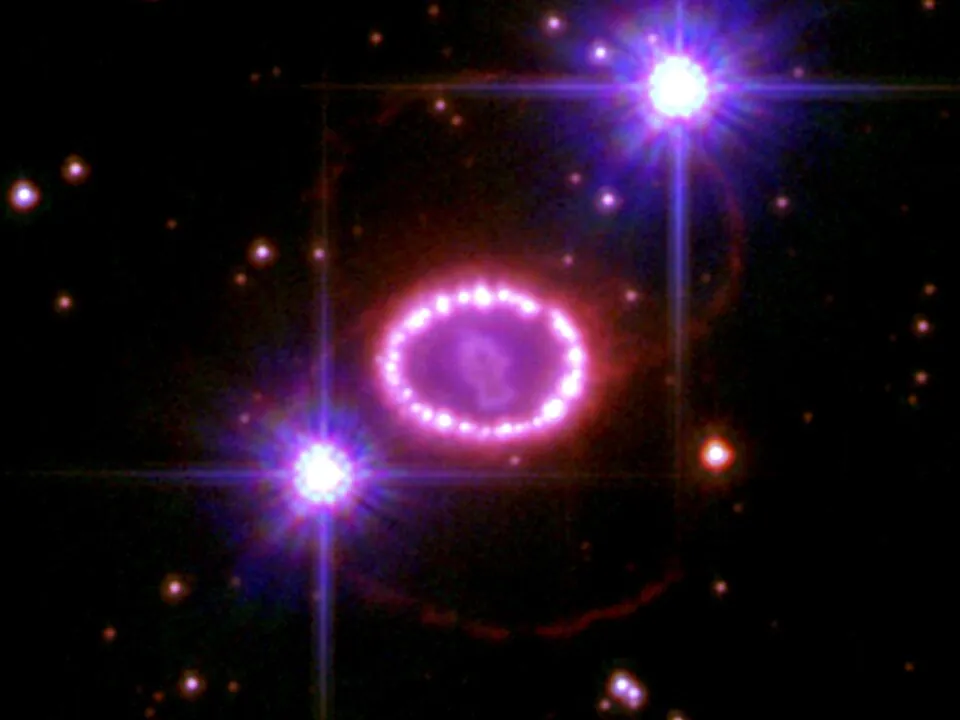
On 24 February 1987, astronomers in Chile and an amateur observer in New Zealand independently noticed a new star in the Large Magellanic Cloud. It was the closest supernova seen in nearly 400 years, and it was only visible from the Southern Hemisphere. Hours before the light arrived, detectors in deep mines in Japan and the United States had caught a burst of ghostly particles called neutrinos, released as the star's core collapsed. Astronomers had predicted exactly that, and they had just watched a star die.
How a star is born
Stars form inside cold, dense clouds of gas and dust called nebulae. A disturbance, such as the shock wave from a nearby supernova, can make part of a cloud dense enough for gravity to take over. The clump collapses, spins faster and flattens into a disc, and its centre heats up as gravity squeezes it. This glowing ball, not yet fusing hydrogen, is a protostar. The surrounding disc can later form planets.
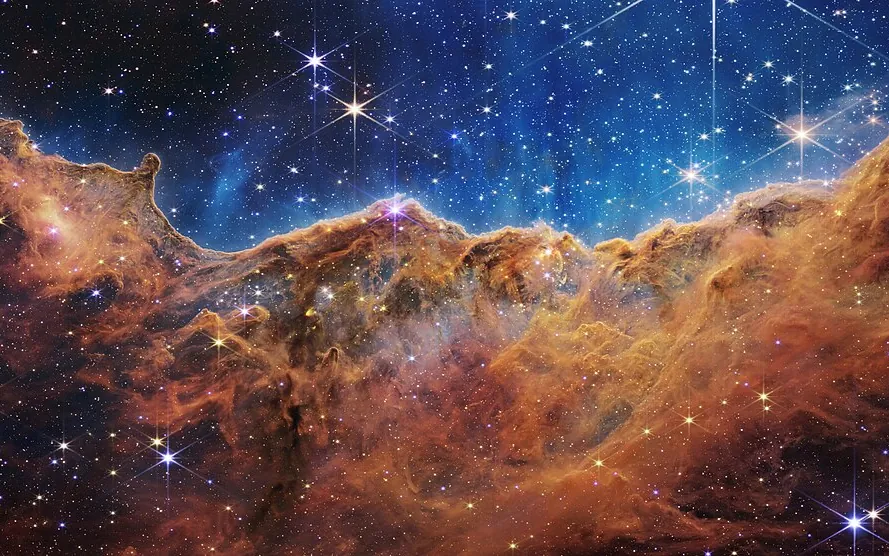
When the core reaches about 10 million °C, hydrogen nuclei are moving fast enough to fuse together, and a star is born. The Orion Nebula and the Carina Nebula are star nurseries where this is happening right now; JWST's infrared camera can see straight through their dust to the protostars inside.
A star is a balancing act
For most of its life a star is in balance. Gravity pulls all its gas inwards. The energy released by fusion in the core keeps the gas extremely hot, and the hot gas pushes outwards with an enormous pressure. When the two balance, the star stays the same size and brightness for millions or billions of years: it is on the main sequence.
In the core, four hydrogen nuclei are joined through several steps into one helium nucleus. The helium nucleus has about 0.7% less mass than the four hydrogen nuclei, and that missing mass becomes energy, given by Einstein's E = mc². Because c² is huge (9 × 10¹⁶ m²/s²), a tiny mass gives a vast amount of energy. The Sun converts about 4 million tonnes of mass into energy every second, and has enough hydrogen to keep going for about 10 billion years in total. It is about 4.6 billion years old, so it's a little under halfway through its main-sequence life.
Stars like the Sun
Red giant. When the hydrogen in the core runs out, fusion there stops. Gravity squeezes the core, which heats up until hydrogen starts fusing in a shell around it. The extra energy pushes the outer layers out to many times their original size; they cool and glow red. In about 5 billion years the Sun will swell to roughly 200 times its present size, swallowing Mercury and Venus and possibly the Earth. (Mars is far enough away to survive.) Long before that, the slowly brightening Sun will have boiled away Earth's oceans.
Helium burning. The core eventually reaches about 100 million °C, hot enough to fuse helium into carbon and oxygen.
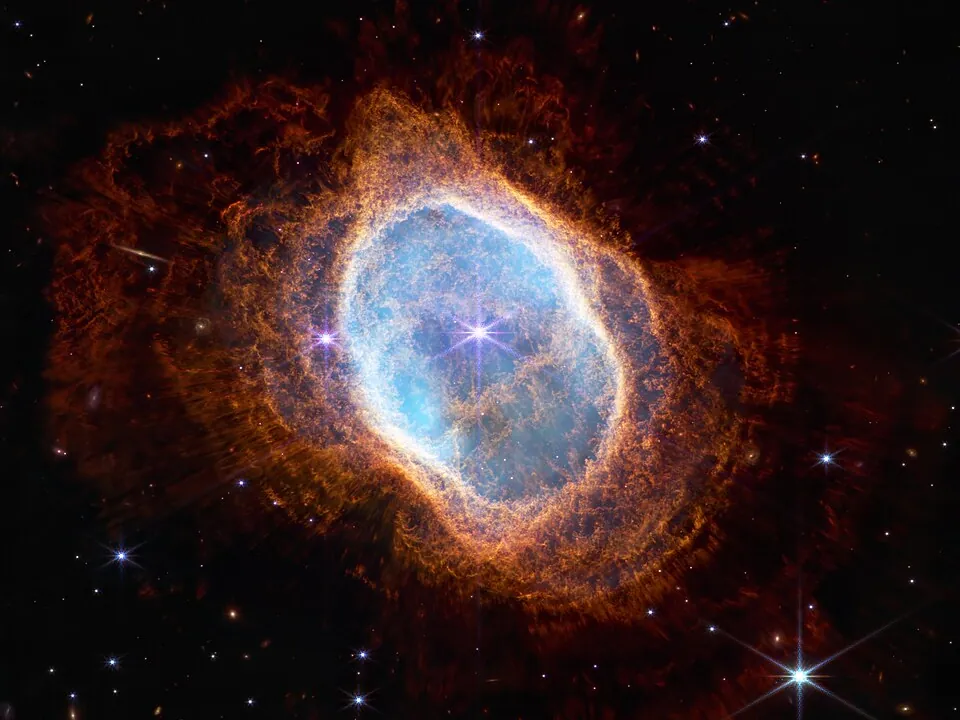
Planetary nebula. At the end, the outer layers drift away into space as a glowing shell, lit up by the hot core left behind. These shells last only tens of thousands of years.
White dwarf. The leftover core of carbon and oxygen, about the size of Earth but with roughly half the Sun's mass, no longer has any fusion. It shines only because it is still hot, and it slowly cools for billions of years. A teaspoon of white dwarf material would have a mass of about 5 tonnes. Sirius B is a white dwarf.
Red dwarfs, the smallest stars, use their fuel so slowly that they will shine for trillions of years. None has ever died, because the universe isn't old enough yet.
Massive stars
A star with more than about 8 times the Sun's mass has a far more dramatic life.
Supergiant. After its core hydrogen runs out it swells into a red supergiant, like Betelgeuse or Antares. Its core is hot enough to fuse heavier and heavier elements, each stage faster than the last, until the star is built in layers like an onion.
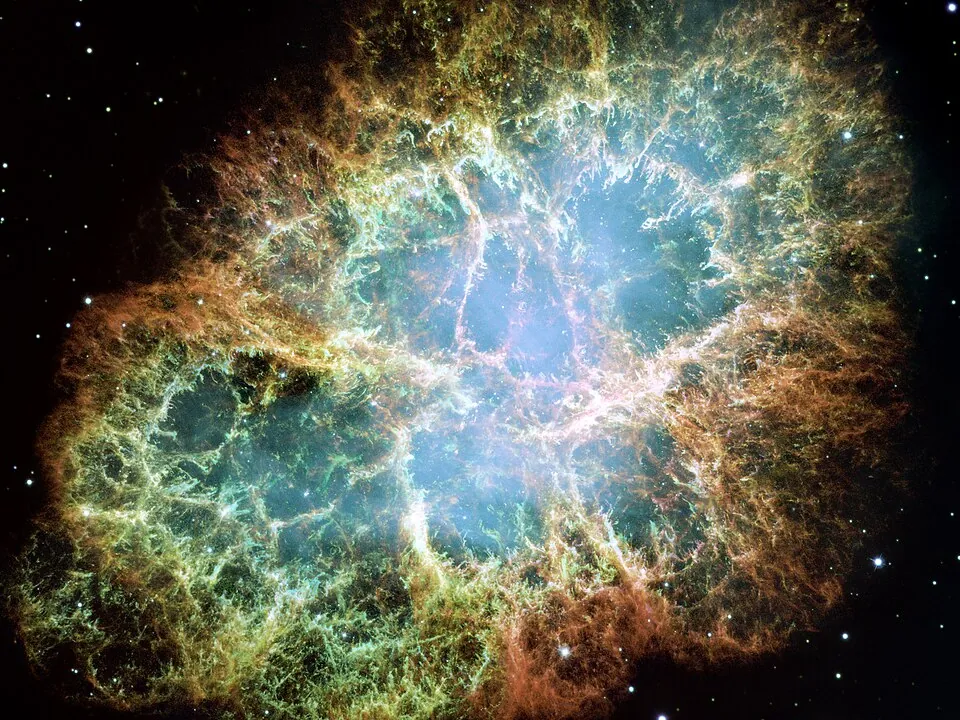
Supernova. Fusion stops at iron, because fusing iron takes in energy rather than giving it out. With nothing holding it up, the core collapses in less than a second, from about the size of Earth to about 20 km across. The outer layers crash down onto it and rebound, and the star blows itself apart in a supernova that can briefly outshine a whole galaxy. Many heavy elements are made in the blast and scattered into space.
Neutron star. If the collapsed core has less than about 3 Sun masses, it becomes a neutron star: electrons and protons are crushed together into neutrons, packing more than the Sun's mass into a ball about 20 km across. A teaspoon of it would have a mass of billions of tonnes. Some neutron stars spin hundreds of times a second and sweep beams of radio waves across space like a lighthouse; these pulsars were discovered in 1967 by Jocelyn Bell Burnell, then a PhD student. The Murriyang radio telescope at Parkes has since discovered a large share of all known pulsars.
Black hole. If the core has more than about 3 Sun masses, nothing can stop the collapse. It becomes a black hole, a region where gravity is so strong that nothing, not even light, can escape. In 2019 the Event Horizon Telescope released the first image of a black hole's shadow, in the galaxy M87, and in 2022 an image of Sagittarius A* at the centre of the Milky Way (6I).
- Start with 1 Sun mass and press Play. How long does it spend on the main sequence, and what does it end as? Watch its path on the H–R diagram.
- Try 10 Sun masses. How long is its main-sequence life? How does its fate differ?
- Try 0.5 Sun masses. Why can't the simulation show how it dies?
- Use the slider to find the smallest starting mass that ends as a neutron star rather than a white dwarf.
- Try 25 Sun masses. What is left after the supernova?
We are made of star stuff
The Big Bang made almost only hydrogen and helium, with a trace of lithium (6G). Nearly every other element was made later, by stars:
- Carbon, nitrogen and oxygen, the elements of life, come mostly from Sun-like stars and massive stars, and are returned to space in planetary nebulae and supernovae.
- Elements up to iron, including the calcium in your bones and the iron in your blood, come mainly from massive stars and supernovae, including white-dwarf (type Ia) supernovae.
- Many of the heaviest elements, such as gold, platinum and uranium, are made when two neutron stars collide. In August 2017, gravitational wave detectors caught two neutron stars merging 130 million light years away, and telescopes saw the glow of freshly made heavy elements, many times Earth's mass of them.
The Sun and Earth formed 4.6 billion years ago from a cloud that had been enriched by generations of earlier stars. So almost every atom in your body, except the hydrogen, was made inside a star.
Watching stars change
Most changes in stars take millions of years, but some happen fast enough to see. Aboriginal and Torres Strait Islander peoples have been watching the sky closely for tens of thousands of years, and some of the knowledge communities have shared publicly includes careful records of stars that change.
Betelgeuse. A Kokatha tradition from the Great Victoria Desert, recorded in the early 1900s, tells of Nyeeruna, a hunter made of the stars of Orion, who pursues the Yugarilya sisters (the Pleiades). The fire magic in his arm, the star Betelgeuse, flares up and dies down again. Researchers studying this and other oral traditions, including astronomer Duane Hamacher, have argued that it records the real variation in brightness of Betelgeuse, a pulsating red supergiant. Western astronomers measure Betelgeuse varying over periods of about 400 days and about 6 years. In late 2019 and early 2020 it faded so dramatically, in what became known as the Great Dimming, that some people wondered whether it was about to explode. Observations, including from the Hubble Space Telescope, showed that the star had thrown off a huge cloud of gas that cooled into dust and blocked some of its light.
Eta Carinae. In 1857 the Boorong people of the Lake Tyrrell area in north-west Victoria shared their knowledge of the stars with a settler, William Stanbridge, who published it. One star, called Collowgulloric War, the wife of War (the crow, the bright star Canopus), was described in a place where no bright star is seen today. In 2010 astronomers Duane Hamacher and David Frew showed that it matches Eta Carinae, a massive unstable star in the Carina Nebula. In the 1840s Eta Carinae had a huge outburst called the Great Eruption and for a while was the second-brightest star in the night sky, before fading from view without a telescope. The Boorong record is one of very few Aboriginal accounts of a specific astronomical event that can be dated. Eta Carinae, about 100 times the Sun's mass, is expected to end as a supernova, perhaps within the next few hundred thousand years.
This knowledge belongs to the communities who hold it. What is shared here is only what has been published with their involvement or recorded publicly, and some knowledge of the sky is restricted.
Test yourself
What keeps a main-sequence star from collapsing under its own gravity?
Gravity and gas pressure are in balance.
The Sun will end its life as a
Stars below about 8 Sun masses end as white dwarfs.
Fusion in a massive star stops at iron because
With no energy from fusion, the core can no longer support itself and collapses.
The energy of the Sun comes from
About 0.7% of the mass becomes energy, E = mc².
The Boorong record of Collowgulloric War is important to astronomers because it
It matches a real, dated change in a star's brightness.
Label the life cycle of stars.
Put the stages in the life of a star like the Sun in order.
Which kind of star does each describe?
Stars form when gravity makes part of a collapse. On the main sequence the inward pull of is balanced by pressure from nuclear in the core. A star like the Sun becomes a red giant, puffs off a planetary nebula and ends as a . A star above about 8 Suns builds up an core, collapses and explodes as a , leaving a neutron star or a black hole.
A teacher says, "You are made of stardust." Explain this statement, describing how the elements hydrogen, carbon, iron and gold were made.
The Big Bang produced almost only hydrogen and helium, with a little lithium, so the hydrogen in your body (for example in water) dates from the first few minutes of the universe. Carbon was made later, inside stars: when a star like the Sun becomes a red giant, its core fuses helium into carbon and oxygen, and the star returns some of this to space when it sheds a planetary nebula. Iron was made in the cores of massive stars, which fuse heavier and heavier elements until they reach iron, and in supernovae, which scatter it through the galaxy. Gold is made in the most extreme events: mostly when two neutron stars collide, as was seen in 2017 when telescopes detected the glow of newly made heavy elements after a gravitational wave signal. The Sun, Earth and everything on Earth formed 4.6 billion years ago from a cloud of gas and dust that had been enriched by many generations of these stars. So apart from the hydrogen, the atoms in your body were forged inside stars, which is why we can say we are made of stardust.