 Coaching Centre
Gravity shapes the universe
Newton's law of universal gravitation and how to use it, how gravity built stars, galaxies and the cosmic web from tiny ripples, the evidence for dark matter from galaxy rotation and clusters, and the detection of gravitational waves.
Hold two sugar cubes a centimetre apart in deep space, far from anything else, and let go. With nothing but their own gravity pulling them, they would drift together and touch in less than a day. Gravity is by far the weakest of the forces we know, yet across the universe it wins, because it only ever pulls and it never switches off. It built every star and galaxy you will meet in this chapter.
Newton's law of universal gravitation
In 1687 Isaac Newton proposed that the force that makes an apple fall is the same force that keeps the Moon in orbit. Every object with mass attracts every other object with mass. The force:
- is proportional to each mass: double one mass and the force doubles;
- follows an inverse square law with distance: double the distance and the force drops to a quarter.
F = G m₁ m₂ / d²
F is the force in newtons, m₁ and m₂ are the masses in kilograms, d is the distance between their centres in metres, and G = 6.67 × 10⁻¹¹ N m² kg⁻² is the universal gravitational constant. G is tiny, which is why you need at least one enormous mass to notice gravity.
m₁ = 5.97 × 10²⁴ kg, m₂ = 7.35 × 10²² kg, d = 3.84 × 10⁸ m.
F = 6.67 × 10⁻¹¹ × 5.97 × 10²⁴ × 7.35 × 10²² ÷ (3.84 × 10⁸)² ≈ 2.0 × 10²⁰ N
A 60 kg student at the surface, d = Earth's radius = 6.37 × 10⁶ m.
F = 6.67 × 10⁻¹¹ × 5.97 × 10²⁴ × 60 ÷ (6.37 × 10⁶)² ≈ 590 N. That is your weight; it matches 60 × 9.8 = 588 N.
Two 60 kg students 1 m apart: F = 6.67 × 10⁻¹¹ × 60 × 60 ÷ 1² ≈ 2.4 × 10⁻⁷ N, about the weight of a grain of fine sand, far too small to feel.
Newton's third law applies too: the Moon pulls on the Earth exactly as hard as the Earth pulls on the Moon. The Earth simply has 81 times more mass, so it accelerates much less. Over a century later Einstein's general theory of relativity (1915) described gravity in a deeper way, as mass curving space and time, which explains effects Newton's law can't, such as light bending around galaxies. For most calculations, though, Newton's law works extremely well.
How gravity built the universe
The cosmic microwave background (6G) shows that 380 000 years after the Big Bang, matter was spread almost perfectly evenly, with differences of only about 1 part in 100 000. That tiny unevenness was enough. Regions with slightly more matter pulled harder, drew in more matter, and pulled harder still. Over hundreds of millions of years:
- gas clouds collapsed and heated until fusion started: the first stars;
- stars and gas gathered into small galaxies, which merged into bigger ones;
- galaxies gathered into groups and clusters, and clusters into a vast network of filaments and walls around huge empty voids, called the cosmic web.
Gravity also explains the shapes. A collapsing cloud that is spinning flattens into a disc as it shrinks, which is why spiral galaxies, the Solar System and the rings of Saturn are all flat. Computer simulations that start with the CMB ripples and add only gravity (including dark matter) produce a cosmic web that looks remarkably like the real one mapped by galaxy surveys, including the 2dF survey run from the Anglo-Australian Telescope at Siding Spring.
Dark matter
If gravity shapes galaxies, we can use the motions in galaxies to weigh them. When astronomers did, the numbers didn't add up.
- In 1933 Fritz Zwicky measured galaxies moving inside the Coma Cluster. They were moving so fast that the cluster should fly apart, unless it held far more mass than its visible galaxies.
- In 1970 Ken Freeman, working at the Australian National University, noticed that the outer parts of some spiral galaxies rotate faster than their visible matter could explain.
- Through the 1970s Vera Rubin and Kent Ford measured how fast stars and gas orbit at different distances from the centres of many spiral galaxies, starting with Andromeda.
In the Solar System, distant planets orbit much more slowly than close ones, because nearly all the mass is in the Sun at the centre. If most of a galaxy's mass were in its bright central region, its outer stars should orbit slowly too. Instead the rotation curves stay flat: stars far out orbit just as fast as those further in. The only way that works under gravity is if each galaxy sits inside a much larger, invisible halo of mass.
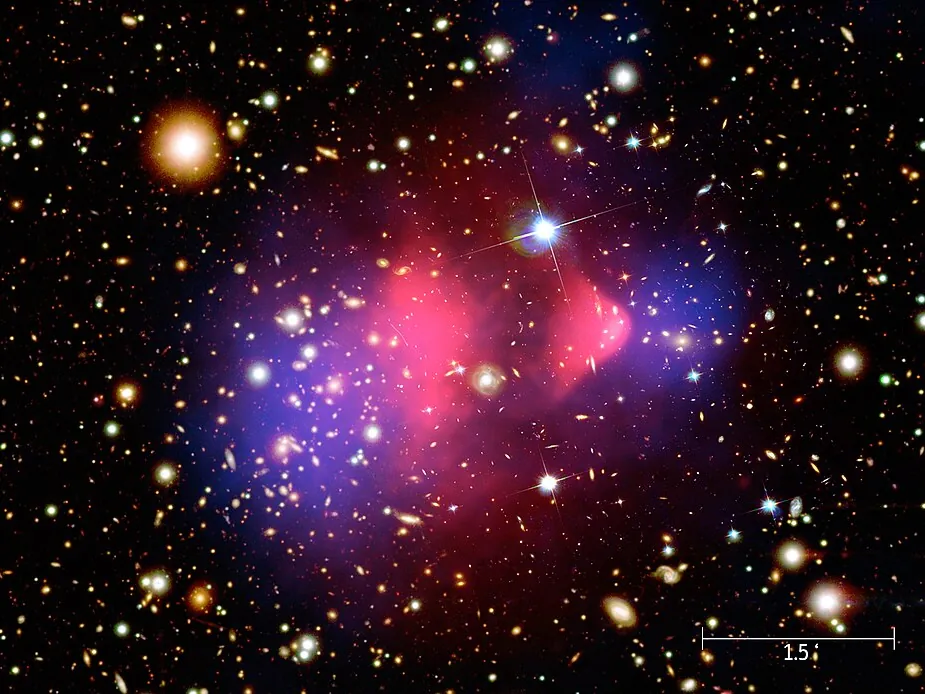
This invisible mass is called dark matter. It doesn't give out, absorb or reflect light, and it only seems to interact through gravity. Further evidence comes from gravitational lensing, where the mass of a galaxy cluster bends light from galaxies behind it, from the pattern of CMB ripples, and from the Bullet Cluster, where two colliding clusters left their hot gas behind while most of their mass (seen by lensing) passed straight through. Overall there is about five times more dark matter than ordinary matter. Physicists have spent decades searching for dark-matter particles in underground detectors, including SABRE South, built 1 km underground in a gold mine at Stawell in Victoria, but none has been found yet.
- Set the dark matter slider to 100%. Read the orbital speed at 10 000 ly and at 50 000 ly. Is the curve rising, flat or falling far from the centre?
- Turn on the visible-matter prediction. Where do the two curves agree, and where do they disagree?
- Slide dark matter to 0%. What happens to the speed at 50 000 ly, and to the mass inside 50 000 ly? Compare with your 100% values.
- Roughly what fraction of the mass inside 50 000 ly is dark matter when the curve matches the real Milky Way?
Gravitational waves
Einstein's theory predicted that accelerating masses make ripples in space itself, spreading out at the speed of light. Einstein doubted they could ever be measured, because the effect is unbelievably small.
On 14 September 2015 the two LIGO detectors in the USA recorded a signal lasting a fraction of a second: two black holes, about 29 and 36 times the mass of the Sun, spiralling together and merging 1.3 billion light years away. It was announced in February 2016, and three of LIGO's founders shared the 2017 Nobel Prize in Physics. Each detector is an L shape with arms 4 km long. A laser beam is split down both arms, reflected off mirrors and recombined. A passing wave stretches one arm and squeezes the other by less than one thousandth of the width of a proton, which shifts how the two beams combine.
On 17 August 2017 detectors picked up two neutron stars colliding. Within seconds a gamma-ray burst was seen, and telescopes around the world, including in Australia, then saw the glow of the explosion. It showed that such collisions make heavy elements such as gold and platinum. Australian scientists in the OzGrav research centre helped build LIGO's precision optics and analyse its data. Since 2015 the LIGO, Virgo and KAGRA detectors have recorded hundreds of mergers. The space detector LISA, with arms 2.5 million km long, is planned for launch in about 2035.
Test yourself
If the distance between two objects is tripled, the gravitational force between them becomes
Inverse square: 1/3² = 1/9.
Flat galaxy rotation curves are evidence for
Outer stars orbit too fast for the visible mass alone.
The first gravitational waves were detected from
Detected by LIGO on 14 September 2015.
Why are spiral galaxies flat?
The same process made the flat Solar System.
A planet has twice Earth's mass and twice Earth's radius. Compared with Earth, your weight on its surface would be
× 2 for mass, ÷ 2² = 4 for distance: 2/4 = 1/2.
Label the gravitational-wave detector.
Put these in order, from the earliest structures to the largest.
Gravity between two masses gets weaker with distance: doubling the distance makes the force a as big. Stars in the outer parts of spiral galaxies orbit too for the mass we can see, which suggests there is invisible . The bending of light by mass, called gravitational , gives more evidence. In 2015, LIGO detected gravitational from two merging .
Explain how measurements of the speeds of stars in spiral galaxies provide evidence for dark matter.
How fast an object orbits depends on how much mass lies inside its orbit pulling on it. In the Solar System almost all the mass is in the Sun, so distant planets orbit much more slowly than close ones. Most of the visible mass of a spiral galaxy is in its bright centre, so we would expect stars far from the centre to orbit slowly too. In the 1970s Vera Rubin and Kent Ford (and Ken Freeman in Australia) measured the speeds of stars and gas at different distances and found that the rotation curves stay flat: outer stars orbit about as fast as inner ones. This means the mass inside each orbit keeps increasing far beyond where the stars and gas thin out, so each galaxy must sit in a large halo of invisible mass, called dark matter. This agrees with other evidence, such as Zwicky's measurements of galaxies moving too fast in the Coma Cluster and the gravitational lensing of light by clusters.