 Coaching Centre
Road safety and collisions
Reaction distance, braking distance and stopping distance, what affects them, why braking distance depends on speed squared, the work–energy and impulse explanations of crumple zones, seatbelts and airbags, active safety systems such as ABS, ESC and AEB, and evaluating road safety rules.
Driving at 60 km/h instead of 50 km/h doesn't feel very different. But if a child runs out 40 m ahead, an alert driver at 50 km/h can stop in time, while at 60 km/h the same driver hits the child at about 30 km/h. The difference comes straight from the physics in this chapter.
Stopping distance
When a driver sees a hazard, the car travels some distance before the brakes even start working, then more distance while it brakes.
stopping distance = reaction distance + braking distance
- Reaction distance is how far the car travels while the driver notices the hazard and moves their foot to the brake. The car is still at full speed, so reaction distance = speed × reaction time. Road safety calculations often use about 1.5 s for an alert driver; tiredness, alcohol, drugs and distractions (especially phones) make it longer.
- Braking distance is how far the car travels while the brakes slow it to a stop. The brakes do work on the car to remove its kinetic energy: F × d = ½ m v². So braking distance is proportional to speed squared, and it is longer on wet or gravel roads, with worn tyres or brakes, going downhill, or in a heavily loaded vehicle.
For a constant deceleration a, the braking distance is
braking distance = v² ÷ (2a)
A typical car on a dry sealed road can decelerate at about 7 m/s²; on a wet road it may be about 5 m/s² or less.
v = 60 ÷ 3.6 = 16.7 m/s. Reaction distance = 16.7 × 1.5 = 25 m. Braking distance = 16.7² ÷ (2 × 7) = 19.8 m. Stopping distance = 44.8 m.
v = 13.9 m/s. Reaction distance = 13.9 × 1.5 = 20.8 m. Braking distance = 13.9² ÷ 14 = 13.8 m. Stopping distance = 34.6 m.
At 50 km/h the car stops with 5.4 m to spare. At 60 km/h, it has 40 − 25 = 15 m to brake in, so v² = 16.7² − 2 × 7 × 15 = 67.8 and v = 8.2 m/s, about 30 km/h at impact.
From 50 to 100 km/h, reaction distance doubles (20.8 to 41.7 m) but braking distance quadruples (13.8 to 55.1 m).
- At 60 km/h, reaction time 1.5 s, dry road, press Hazard ahead! Check the stopping distance is 44.8 m and the impact speed is about 30 km/h.
- Repeat at 50 km/h. How far short of the child does the car stop?
- Stay at 50 km/h but switch to a Wet road. What happens now?
- At 50 km/h on a dry road, increase the reaction time to 2.5 s, as might happen to a driver glancing at a phone. What is the result?
- Find the highest speed at which an alert driver on a dry road stops before the child.
This is why speed limits are lower where pedestrians are likely: 40 km/h school zones, 50 km/h on most urban streets in NSW, and 30 or 40 km/h in many busy shopping and pedestrian areas. Impact speed matters enormously for pedestrians. According to the World Health Organization, an adult pedestrian has less than a 20% chance of dying if struck by a car at less than 50 km/h, but about a 60% risk of dying if hit at 80 km/h.
The physics of a crash
In a crash, the car and everyone in it must lose all their kinetic energy and momentum. Two ways of looking at it give the same message.
- Work and energy: the work done to stop you equals your kinetic energy: F × d = ½ m v². Your KE is fixed by your mass and speed, so the longer the stopping distance d, the smaller the average force F.
- Momentum: F × t = change in momentum. Your change in momentum is fixed by your mass and speed, so the longer the stopping time t, the smaller the force.
A 70 kg person at 50 km/h (13.9 m/s) has KE = ½ × 70 × 13.9² ≈ 6750 J.
Stopped in 0.05 m: F = 6750 ÷ 0.05 = 135 000 N, about 200 times their weight.
Stopped over 0.6 m: F = 6750 ÷ 0.6 = 11 250 N, twelve times smaller.
Is it worse to fall 10 m onto a 0.2 m thick mattress or to stop over 1 m in a car crash at 100 km/h? Per kilogram, the fall gives 9.8 × 10 = 98 J, so F = 98 ÷ 0.2 = 490 N per kg (50 g). The crash gives ½ × 27.8² = 386 J per kg, so F = 386 N per kg (39 g). Both are very dangerous, but the fall onto the mattress is worse.
How cars protect you
Passive safety features reduce injuries when a crash happens:
- Crumple zones at the front and rear are designed to fold up in a controlled way. Crushing metal does work, absorbing kinetic energy, and it makes the car stop over a longer distance and time, so the deceleration and forces are smaller. A car that bounced back off a wall would actually be worse, because the change in momentum would be bigger.
- A rigid safety cell around the passengers resists crushing so there is space to survive.
- Seatbelts stop you with the car instead of letting you fly into the steering wheel or windscreen (first law). The belt stretches slightly, increasing your stopping distance, and spreads the force across the strong bones of your chest and pelvis. Pretensioners tighten the belt in the first instant of a crash, and load limiters let it give a little to reduce chest injuries.
- Airbags inflate in about 30 milliseconds when sensors (accelerometers) detect a huge deceleration. They increase the stopping distance of your head and chest and spread the force over a larger area. They are designed to work with a seatbelt, not instead of one.
- Head restraints reduce whiplash in rear-end crashes (first law: your head tends to stay behind as the seat pushes your body forwards).
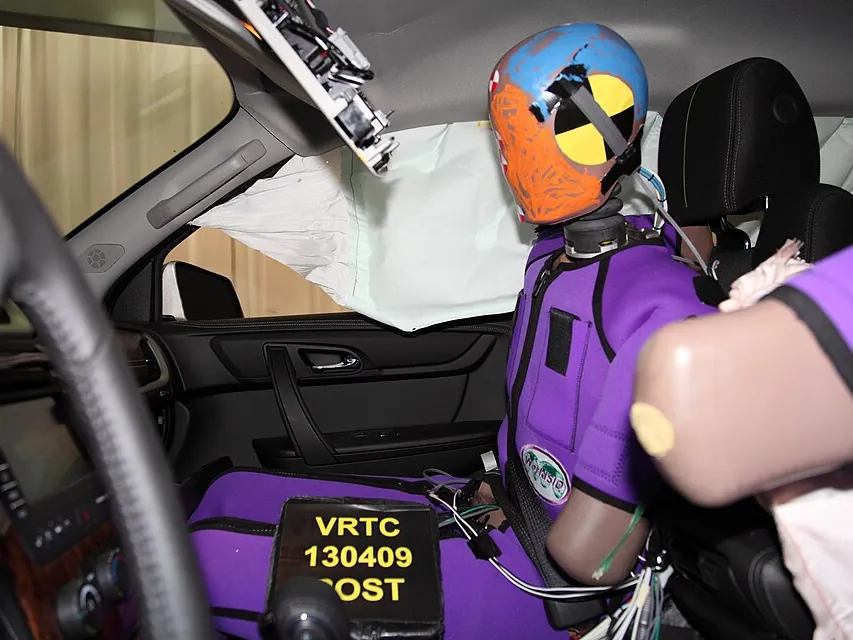
Active safety features help prevent the crash:
- ABS (anti-lock brakes) stops the wheels locking and skidding, so the driver can still steer while braking hard.
- ESC (electronic stability control) brakes individual wheels to stop a car sliding sideways on a bend. It has been compulsory on new passenger cars in Australia since 2013.
- AEB (autonomous emergency braking) uses radar and cameras to detect a vehicle ahead and brakes automatically if the driver doesn't react, cutting out the reaction distance. Since March 2025 it has been compulsory on all new cars and light vehicles sold in Australia.
Independent crash testing by ANCAP (the Australasian New Car Assessment Program) rates new cars from zero to five stars, and the results are published so buyers can compare.
Test yourself
A car travels at 20 m/s and the driver's reaction time is 1.5 s. The reaction distance is
20 × 1.5 = 30 m, all at full speed.
A car's speed increases from 40 km/h to 80 km/h. Its braking distance (same road and brakes) becomes
Braking distance = v² ÷ 2a, so doubling v quadruples it.
Which factor increases reaction distance but not braking distance?
Distraction slows the driver's reaction; the others affect how quickly the car can decelerate.
Airbags reduce injury mainly because they
The same KE and momentum are removed over a longer distance and time, so the force is smaller.
A 25 kg child and a 95 kg adult are both stopped over 0.5 m in a crash, experiencing forces of 7000 N and 26 000 N. The work done to stop the adult is
W = F × d = 26 000 × 0.5 = 13 000 J (for the child, 7000 × 0.5 = 3500 J).
Label the car's safety features.
Sort the safety features.
Stopping distance is the distance plus the distance. Braking distance is proportional to the of the speed. Crumple zones increase the stopping , which reduces the on the passengers.
A council proposes lowering the speed limit on a busy shopping street from 50 km/h to 40 km/h. Using calculations of stopping distance (reaction time 1.5 s, deceleration 7 m/s²) and the physics of collisions, evaluate the proposal.
At 50 km/h (13.9 m/s), reaction distance = 13.9 × 1.5 = 20.8 m and braking distance = 13.9² ÷ (2 × 7) = 13.8 m, so the stopping distance is about 35 m. At 40 km/h (11.1 m/s), reaction distance = 16.7 m and braking distance = 11.1² ÷ 14 = 8.8 m, about 25 m. Lowering the limit cuts the stopping distance by about 10 m, which on a shopping street is often the difference between stopping before a pedestrian and hitting them. Braking distance and kinetic energy both depend on speed squared, so a car at 40 km/h has only (40 ÷ 50)² = 64% of the kinetic energy it would have at 50 km/h. If a collision does happen, the impact speed is lower, so less work has to be done on the pedestrian's body and the forces (F = KE ÷ d) are smaller; the risk of death or serious injury falls steeply as impact speed falls. The cost is small: over a 2 km street, 2 km at 40 km/h takes 3.0 minutes compared with 2.4 minutes at 50 km/h, an extra 36 seconds, and traffic lights often limit speed anyway. On balance the evidence supports the proposal, because a small increase in travel time buys a large reduction in risk for pedestrians.