 Coaching Centre
Acids, bases and pH
What acids and bases are, indicators including red cabbage, the logarithmic pH scale, and the difference between strong and weak acids and between concentrated and dilute solutions, with ash as a base in First Nations chemistry.
You can splash vinegar on hot chips, but hydrochloric acid of exactly the same concentration would burn your mouth. Both are acids, and both have the same number of acid molecules in every litre. The difference is what those molecules do when they meet water.
What makes an acid an acid?
An acid is a substance that releases hydrogen ions (H⁺) when it dissolves in water. Hydrogen chloride gas, for example, is made of molecules, but in water it splits into ions:
HCl(g) → H⁺(aq) + Cl⁻(aq)
(A bare H⁺ ion is just a proton, so in water it actually attaches to a water molecule to form H₃O⁺, the hydronium ion. Writing H⁺ is a useful shorthand.) It is the H⁺ ions that give every acid its shared properties.
A base is a substance that reacts with an acid and cancels out its acidity. Many bases are metal oxides, hydroxides and carbonates. A base that dissolves in water is called an alkali, and alkalis release hydroxide ions (OH⁻), for example NaOH(s) → Na⁺(aq) + OH⁻(aq).
| Property | Acids | Bases (alkalis) |
|---|---|---|
| Ion released in water | H⁺ | OH⁻ |
| pH | below 7 | above 7 |
| Litmus | turns blue litmus red | turns red litmus blue |
| Taste and feel (never test this in the lab) | sour | bitter; feel slippery because they react with oils in your skin |
| Typical reactions | with metals, carbonates and bases | with acids; strong alkalis break down fats and proteins |
| Conduct electricity in solution? | yes (they contain ions) | yes |
| Everyday examples | citrus juice, vinegar, soft drink, stomach acid | baking soda, soap, cloudy ammonia, drain cleaner |
Indicators
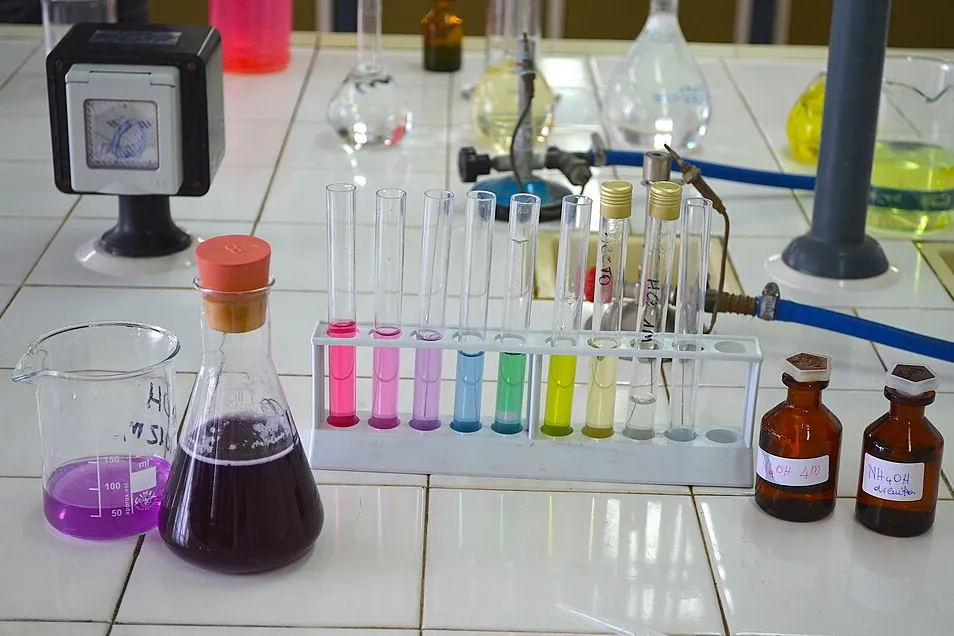
An indicator is a dye that changes colour depending on how acidic or basic a solution is. Litmus only tells you "acid" or "base". Phenolphthalein is colourless in acid and pink in base. Universal indicator is a mixture of dyes that runs through a whole rainbow, so it can estimate the pH.
Many plants contain natural indicators. The purple pigments in red cabbage, blueberries, plums and red onion are anthocyanins, molecules whose structure, and therefore colour, changes as H⁺ ions are added or removed.
The pH scale
The pH scale measures the concentration of hydrogen ions in a solution. Most solutions you meet have a pH between 0 and 14. Pure water at 25 °C has a pH of 7, which is neutral: it contains a tiny but equal number of H⁺ and OH⁻ ions. Below 7 is acidic and above 7 is basic.
The scale is logarithmic: each step of one pH unit means a tenfold change in H⁺ concentration. Lemon juice at pH 2 has 10 times more H⁺ than vinegar at pH 3, and 100 000 times more than pure water at pH 7. A pH probe connected to a data logger measures pH to two decimal places, much more precisely than an indicator.
Strong and weak, concentrated and dilute
Two different ideas are often confused:
- Concentration is how much acid is dissolved in a given volume of water, usually measured in moles per litre (mol/L, or M). A concentrated solution has a lot of acid per litre; a dilute one has a little.
- Strength is the fraction of acid molecules that split up (ionise) into ions in water. In a strong acid essentially every molecule ionises. In a weak acid only a small fraction do; the rest stay as whole molecules.
So 1 mol/L hydrochloric acid has a pH of about 0, while 1 mol/L ethanoic acid (the acid in vinegar) has a pH of about 2.4, because fewer than 1 in 200 of its molecules are ionised at any moment. A strong acid is not one that "eats through things for longer": it is one that is fully ionised.
| Strong | Weak | |
|---|---|---|
| Acids | hydrochloric acid HCl, sulfuric acid H₂SO₄, nitric acid HNO₃ | ethanoic acid CH₃COOH, citric acid, carbonic acid H₂CO₃, phosphoric acid H₃PO₄ |
| Bases | sodium hydroxide NaOH, potassium hydroxide KOH | ammonia NH₃, sodium hydrogen carbonate NaHCO₃ |
- With hydrochloric acid at 1 mol/L, read the pH. Slide the concentration down to 0.1 and then 0.01 mol/L. What happens to the pH each time you dilute ten times?
- Switch to ethanoic acid at 1 mol/L. Compare its pH, its conductivity and the fizzing of the magnesium with hydrochloric acid at the same concentration.
- Dilute the ethanoic acid. Does the percentage of molecules ionised go up or down?
- Find a concentration of hydrochloric acid that has the same pH as 1 mol/L ethanoic acid (about 2.37). How much more dilute is it?
Test yourself
A solution of pH 3 has how many times more H⁺ ions than a solution of pH 6?
Three pH units: 10 × 10 × 10.
A weak acid is one that
Strength is the fraction of molecules that ionise.
The approximate pH of 0.1 mol/L hydrochloric acid is
Fully ionised, so [H⁺] = 0.1 = 10⁻¹ and pH = 1.
Red cabbage juice is added to drain cleaner. The colour will be
Drain cleaner is strongly basic (about pH 14).
Which ion do all alkalis release in water?
Hydroxide ions make a solution basic.
Label the strength and concentration of each acid.
Sort these solutions by pH.
Acids release ions in water. A base that dissolves in water is called an . The purple pigment in red cabbage is an . Each step on the pH scale is a change in H⁺ concentration. An acid that is fully ionised in water is a acid.
A 1 mol/L solution of hydrochloric acid has a pH of 0, but a 1 mol/L solution of ethanoic acid has a pH of about 2.4. Explain this difference, and explain why both solutions could be described as "concentrated".
pH measures the concentration of H⁺ ions. Hydrochloric acid is a strong acid: in water essentially every HCl molecule ionises into H⁺ and Cl⁻, so a 1 mol/L solution contains about 1 mol/L of H⁺ and has a pH of 0. Ethanoic acid is a weak acid: only a tiny fraction of its molecules (less than 1%) ionise, and the rest stay as whole CH₃COOH molecules. Its H⁺ concentration is therefore much lower, about 0.004 mol/L, and its pH is higher. Because the scale is logarithmic, a difference of about 2.4 pH units means roughly 250 times fewer H⁺ ions. Both solutions are still concentrated, because concentration is the amount of acid dissolved per litre, and each contains 1 mol of acid in every litre. Strength describes ionisation, not amount.